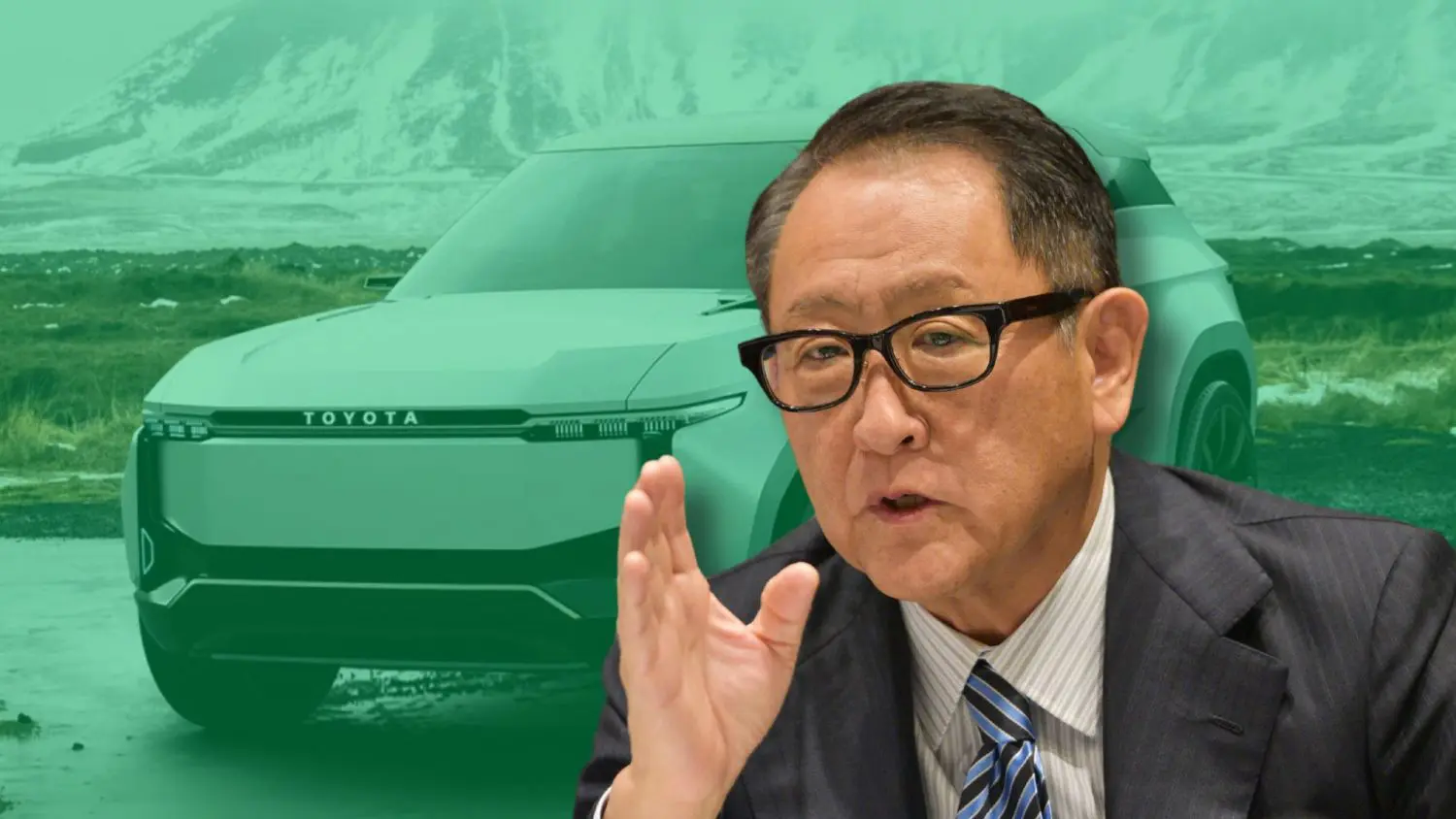
Toyota chairman and former company CEO Akio Toyoda expects the electric vehicle segment to reach a maximum market share of just 30%, regardless of what the automotive industry does to spur growth.
The chairman, grandson of company founder Kiichiro Toyoda, shared his perspective on the global EV market while answering questions during a recent presentation on the Japanese automaker’s manufacturing strategy. According to his remarks, Toyota will pursue a multi-pathway approach to cut emissions, leveraging battery-electric vehicles (BEV) alongside cars with hybrid, hydrogen, or internal combustion engine drivetrains. The executive predicted that these other models would eventually account for 70% of the market. However, Toyoda predicted that fully electrified products will only comprise 30% of sales “no matter how much progress BEVs make.”
The chairman’s comments are at once both unsurprising and surprising given his history with the company. During his tenure as CEO, Toyoda refused to prioritize EV development, arguing battery-powered cars were unpopular with consumers and presented too many challenges, choosing instead to invest heavily in hybrid and hydrogen drivetrains. This position, while shared by some fellow executives, became increasingly unpopular as competitors such as Tesla continued to perform astonishingly well in the EV market.
As more competitors joined the market and Toyota procrastinated releasing its own fully electric model, calls for a new direction increased until Toyoda was eventually replaced by Koji Sato in early 2023. Since becoming CEO, Sato, while refusing to lower the prioritization of hybrid and hydrogen models, has significantly accelerated the automaker’s EV strategy. Given that his departure was largely fueled by his anti-EV sentiment, it is hardly shocking that Sato’s predecessor continues to express pessimistic views on the future of electrification, even if they contradict the view of what appears to be a majority of Toyota leaders.
What is more surprising is that Toyoda’s comments are so confidently stated. EV market share has already exceeded 30% in several, primarily Scandinavian countries: Norway (80%), Iceland (41%), and Sweden (32%). China, where EVs account for 24% of sales, is set to surpass the chairman’s forecast in the coming years, if not in 2024 itself. While the path to 100% electrification is less assured in North America and Europe, given the diversity of their political bodies, current emissions guidelines in both regions call for all new cars to be battery-powered by as early as 2035.
It is difficult to assess whether Toyoda’s beliefs are shared with Toyota executives or if his comments merely reflect his personal attitudes toward electrification. But given the company plans to deliver 1.5 million EVs by 2026, approximately 14% of its anticipated sales total, and claims it is ready to comply with regulations banning sales of gas-powered vehicles by 2035, it is more likely the latter.
However, none of this is to argue that the chairman is against the development of zero-emission vehicles. As he noted during his discussion, “Japan is the only developed country to reduce CO2 emissions by 23%,” a feat that can be heavily attributed to the popularity of hybrids in the country.