TSLA448.95015.5%
GM76.6350.195%
F13.7051.715%
RIVN14.4900.5401%
CYD50.5101.99%
HMC24.5050.395%
TM187.7006.03%
CVNA71.170-2.55%
PAG167.070-1.96%
LAD274.940-0.36%
AN192.830-2.53%
GPI333.040-3.1%
ABG194.9801.3%
SAH77.490-1.09%
TSLA448.95015.5%
GM76.6350.195%
F13.7051.715%
RIVN14.4900.5401%
CYD50.5101.99%
HMC24.5050.395%
TM187.7006.03%
CVNA71.170-2.55%
PAG167.070-1.96%
LAD274.940-0.36%
AN192.830-2.53%
GPI333.040-3.1%
ABG194.9801.3%
SAH77.490-1.09%
TSLA448.95015.5%
GM76.6350.195%
F13.7051.715%
RIVN14.4900.5401%
CYD50.5101.99%
HMC24.5050.395%
TM187.7006.03%
CVNA71.170-2.55%
PAG167.070-1.96%
LAD274.940-0.36%
AN192.830-2.53%
GPI333.040-3.1%
ABG194.9801.3%
SAH77.490-1.09%

U.S. hikes South Korea tariffs to 25% after trade agreement stalls

President Trump cited delays in South Korea’s legislative approval of the trade framework, triggering market declines and renewed uncertainty over U.S.-South Korean trade relations. 

South Korea

On the Dash:

  • President Donald Trump said he will raise tariffs on South Korean autos, lumber and pharmaceuticals to 25%, citing delays in Seoul’s legislative approval of a trade agreement.
  • The announcement triggered immediate market reaction in South Korea, with auto stocks and the won falling amid uncertainty over timing and implementation.
  • Analysts say the move underscores continued volatility in U.S. trade policy and could disrupt South Korea’s auto exports, one of its largest categories to the U.S.

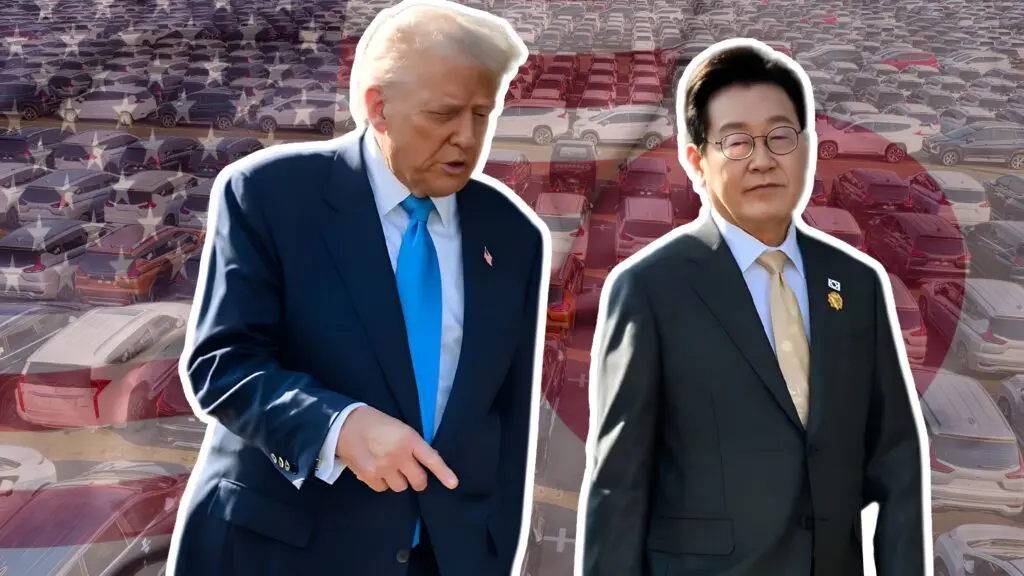
President Donald Trump said Monday he is increasing tariffs on South Korean imports, including autos, lumber and pharmaceuticals, from 15% to 25%, accusing Seoul’s legislature of failing to enact a trade agreement with the United States.

In a social media post, Trump criticized South Korea’s legislature for not approving the deal, saying the delay prompted his decision to raise tariffs across several major sectors. He did not specify when the higher tariffs would take effect or identify a specific triggering event.

However, financial markets in South Korea reacted quickly, with the benchmark KOSPI index falling 0.7% in early trading Tuesday, while the won weakened by about 0.5% against the U.S. dollar. Shares of Hyundai Motor and Kia also dropped 3.5% and 4.8%, respectively, reflecting concerns about the impact on auto exports to the U.S.

Sign up for CBT News’ daily newsletter and get the latest industry stories delivered straight to your inbox

South Korea’s presidential office said it had not received formal notification from Washington regarding the tariff increase. Officials said consultations with relevant ministries were planned to assess potential responses. Industry Minister Kim Jung-kwan is expected to travel to the U.S. later this month for meetings with Commerce Secretary Howard Lutnick.

The United States is South Korea’s second-largest export market after China, with autos accounting for roughly a quarter of shipments to the U.S. Under a framework agreement reached last year, tariffs on South Korean autos and auto parts were reduced to 15% beginning Nov. 1, aligning them with rates applied to Japanese competitors. U.S. officials have expressed frustration over the pace of South Korea’s legislative implementation.

South Korea posted record exports of $709.4 billion in 2025, though shipments to the U.S. declined 3.8%. Auto exports to the U.S. totaled $30.2 billion, down more than 13% from the previous year.

Seoul has also committed to a $350 billion investment package in U.S. strategic sectors, including phased cash contributions designed to limit pressure on the won. Analysts said uncertainty surrounding the timing of those investments, combined with legislative delays, may have contributed to Trump’s decision.

Economists warn that renewed tariff volatility could disrupt global trade flows and add inflationary pressure in the U.S., while reinforcing uncertainty for manufacturers and investors navigating shifting trade policy.
More from Global Industry News
President Trump meets with Chinese leader Xi Jinping in Beijing this week. It comes as China says it exports more EVs than ICE cars, despite a U.S. ban on Chinese auto imports.

China hits new EV export milestone as Trump heads to Beijing to talk trade

- May 11, 2026
On the Dash: China exported more EVs than gas cars for the first time in April. U.S. tariffs are instead redirecting Chinese EVs to Europe and Latin America. Congress and...
Stellantis, Leapmotor expand partnership with Europe EV manufacturing push

Stellantis, Leapmotor expand partnership with Europe EV manufacturing push

- May 8, 2026
On the Dash: Stellantis is activating underused European plants, signaling potential volume stabilization and improved factory efficiency. Local EV production could help shield pricing from EU tariffs, supporting more competitive...
Beijing Auto Show signals China’s growing dominance in automotive innovation

Beijing Auto Show signals China’s growing dominance in automotive innovation

- May 8, 2026
Welcome back to the latest episode of The Future of Automotive on CBT News, where we put recent automotive and mobility news into the context of the broader themes impacting the industry. I’m...
EU trade deal deadlock puts pressure on U.S. dealers as Trump threatens higher tariffs

EU trade deal deadlock puts pressure on U.S. dealers as Trump threatens higher tariffs

- May 6, 2026
On the Dash: EU lawmakers and governments remain deadlocked on how to implement the deal reached last year. President Trump has threatened to raise tariffs on European cars and trucks...
CBT News
Privacy Overview

This website uses cookies so that we can provide you with the best user experience possible. Cookie information is stored in your browser and performs functions such as recognising you when you return to our website and helping our team to understand which sections of the website you find most interesting and useful.