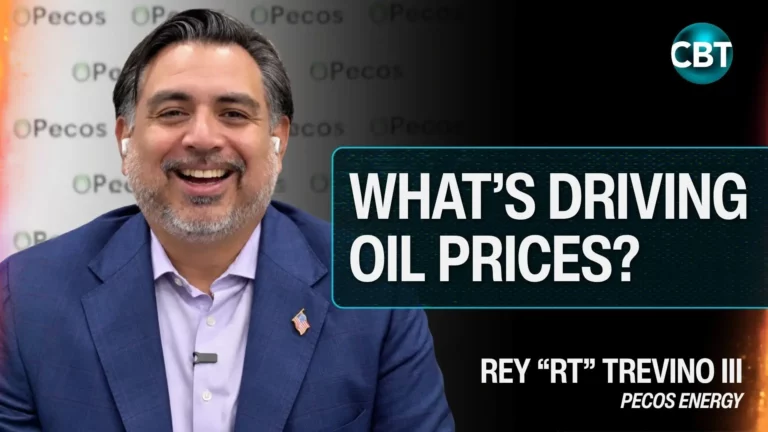
Oil prices are being shaped by more than how much crude the U.S. produces. Rey “RT” Trevino, an Oil and Gas Expert with Pecos Energy and host of The Crude Truth podcast, said global supply, refining capacity and geopolitical disruptions are all influencing the price consumers ultimately pay at the pump. Trevino joins us on today’s CBT Live segment to break down the current oil market and explain why strong U.S. production does not necessarily translate into lower gasoline prices.
According to Trevino, one of the biggest distinctions in the current market is between the physical price of oil and the price traded on paper markets. He said physical oil is currently commanding a significant premium over the paper price, reflecting supply concerns and disruptions tied to global events. He also pointed to the Strait of Hormuz and other transportation routes as areas the industry continues to watch closely. While he said the Strait of Hormuz remains open, reduced tanker activity and higher insurance costs have affected oil flows through the region.
For U.S. consumers, however, the price of crude is only part of the equation. Trevino said the country produces nearly 14 million barrels of oil per day but consumes about 21 million barrels, meaning the U.S. still relies on international supplies. He also said domestic refining capacity presents another challenge. According to Trevino, much of the nation’s refining infrastructure is designed to process crude from outside the U.S., limiting how much domestically produced oil can be turned directly into gasoline and other refined products. He said expanding refining capacity could help address that imbalance over the long term.
Trevino also emphasized the industry’s focus on capital discipline rather than rapidly expanding production whenever prices rise. He said independent producers and major oil companies are being more deliberate about investments, rather than dramatically increasing drilling activity in response to temporary price spikes. That approach is designed to avoid a cycle in which a surge in production pushes prices sharply lower. Looking ahead, Trevino said the energy industry will need significant investment in production, refining and other infrastructure to support more stable energy prices. For businesses and consumers, he said, the goal is a reliable and abundant energy supply regardless of the source.