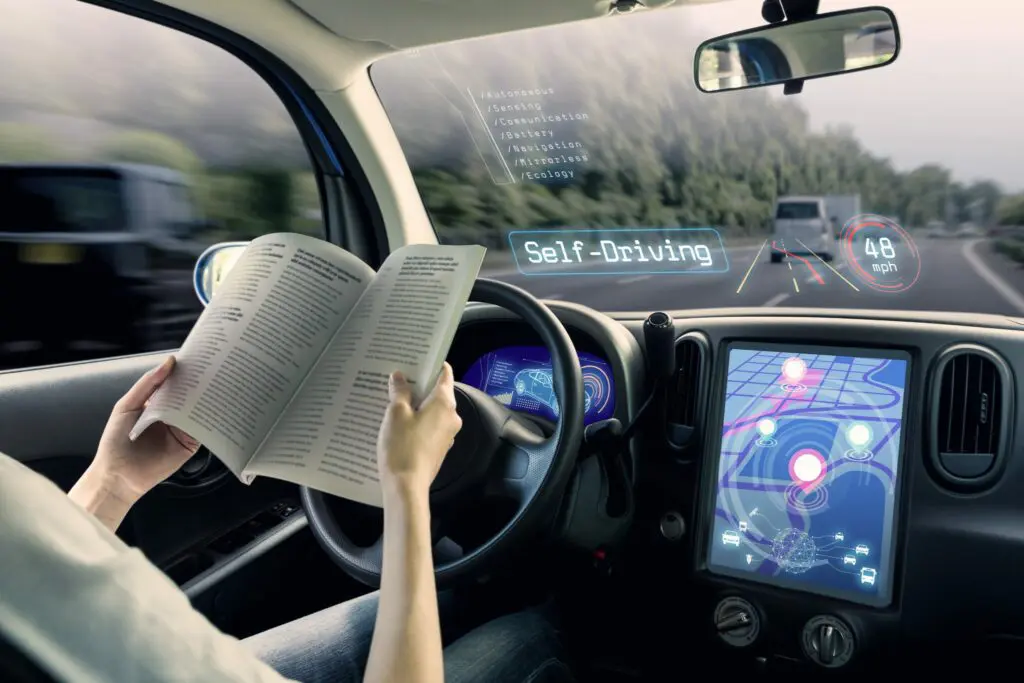
The future seems bright for self-driving cars. A few years ago, the public was wondering if vehicles fueled by electricity were even possible. Now, the trend has turned to autonomous vehicle technology. However, the conversation has gone past automatic parking and lane assist to entirely independent cars. The driver’s cockpit would turn into full passenger seating for the majority of car buyers for the first time in history. Some estimates feel that we are still decades away from the majority of cars being fully autonomous; while others believe we will see numbers of these cars grow into the millions by 2020.
The fact remains that self-driving vehicles are inevitably entering the automobile industry. A Forbes article pointed out the increased rate of technology adoption in the United States. It took ten years for cell phones to reach 60 percent of households, while smartphones only took five. When a new piece of revolutionary technology hits the airwaves, once its popularity increases, the time for adoption is incredibly low. The self-driving switch is moving fast, but are the American people genuinely ready to give up the wheel and allow the car to take over their commute? Does the trepidation about this technology move beyond safety and reveal a more profound attachment to driving?
People are Emotionally Attached to Their Cars
Cars reflect the personality, taste, and style of the people who own them. Road and Travel Magazine revealed statistics from a study they conducted that shows how connected people are to their cars. These were their results from more than 2,200 respondents:
- 38 percent of their vehicles were a part of their wedding in some way
- 20 percent held meetings in their cars
- 60 percent hold conversations with their cars
- 90 percent sing in their cars
- 27 percent give their cars pet names
Even though these connections have nothing to do with driving, they show that the relationship between driver and car goes beyond being transported by a mere machine. For some, a car represents a home away from home. The intensity of most urban commute times causes many people to spend hours in cars per day. Therefore, it would make sense car buyers would become attached to their vehicles and the driving process as a whole.
Do Car Buyers Want Self-Driving Cars?
In the wake of tech companies and car manufacturers investing massive amounts of capital in self-driving cars, MIT decided to do a study to gauge the public’s interest in autonomous vehicles. Their findings were a little disheartening to self-driving car fans and to the manufacturers who are going full-force with the development of these vehicles. Out of 3,000 survey respondents, 48 percent said they would never drive a car with level five autonomy. The lack of control and distrust of the technology were cited as primary reasons. While safety is always referred to in studies like this, it is telling that people also do not want to give up “control.” The simple but complex act of steering the wheel and increasing the gas holds a lot of weight in the eyes of the car buyer. The study also revealed that people did want some autonomous elements such as automatic emergency braking, lane-keeping systems, and auto-park features, but these were all things that would aid drivers in keeping control of the vehicle. Bryan Reimer, a research scientist at MIT’s AgeLab, summed up the findings with the following statement, “They’re just not looking for a car to drive them in a chauffeur kind of framework.” So, people are not as open to self-driving cars as manufacturers and the tech community would have hoped. Negative feelings against these vehicles go beyond concerns about safety. An Uptick in Driving Across the Country
According to Scientific American, Americans drove more miles than ever before in 2015. Drivers commuted the equivalent of 337 round trips from Earth to Pluto, a startling 3.15 trillion miles. This was the largest increase in miles driven since 2004. Even with the options of public transportation and ride sharing, Americans are still selecting the option of handling the commute themselves. In 2013, a group of Italian researchers conducted a study that revealed most people who participated in the study preferred to drive even when other modes would get them to their destination faster and cheaper. The bottom line is that people prefer to have control of their commutes because they have strong attachments to their automobiles. Similar to purchasing a home, a car is a massive investment of money and time. However, also like a home, many life milestones and emotions go into owning one. Government regulations that favor self-driving car development, and the amount of capital put up by manufacturers like Tesla, Ford, and Volvo to bring these cars to the masses shows that this is going to become a reality sooner than initially thought. Most manufacturers are already testing the technology. However, the question remains: is this something consumers really want?