TSLA388.900-3.05%
GM78.0500.27%
F12.435-0.275%
RIVN16.8900.48%
CYD42.3200.03%
HMC24.3600.1%
TM212.860-0.32%
CVNA362.240-8.84%
PAG156.0200.89%
LAD274.8700.39%
AN198.2902.48%
GPI335.4802.75%
ABG204.0901.55%
SAH67.3701.48%
TSLA388.900-3.05%
GM78.0500.27%
F12.435-0.275%
RIVN16.8900.48%
CYD42.3200.03%
HMC24.3600.1%
TM212.860-0.32%
CVNA362.240-8.84%
PAG156.0200.89%
LAD274.8700.39%
AN198.2902.48%
GPI335.4802.75%
ABG204.0901.55%
SAH67.3701.48%
TSLA388.900-3.05%
GM78.0500.27%
F12.435-0.275%
RIVN16.8900.48%
CYD42.3200.03%
HMC24.3600.1%
TM212.860-0.32%
CVNA362.240-8.84%
PAG156.0200.89%
LAD274.8700.39%
AN198.2902.48%
GPI335.4802.75%
ABG204.0901.55%
SAH67.3701.48%


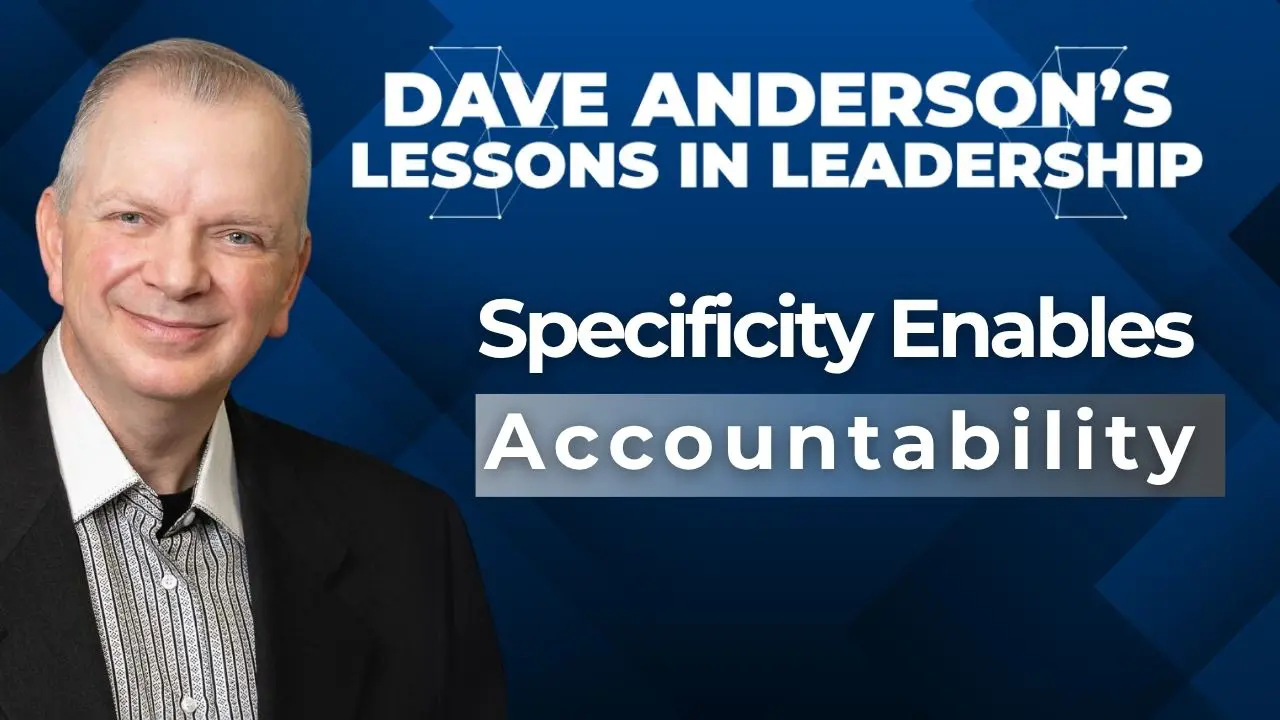
How specificity drives accountability

Specific commitments and clear daily actions are the keys to effective accountability in leadership coaching.

In this episode of Lessons in Leadership, Dave Anderson, president of LearnToLead and a leadership expert, breaks down the power of specificity in coaching and accountability. Anderson explains why vague commitments often fall short and how drilling down into clear, actionable behaviors can transform promises into measurable results.

To start, Anderson begins with a common coaching challenge: when employees make broad promises, such as “I’ll work harder” or “I’ll be 100% committed,” it’s difficult to hold them accountable. These general commitments sound encouraging but lack the detail needed for meaningful follow-up. Anderson’s solution? Push for specificity.

Sign up for CBT News’ daily newsletter and get the latest industry stories delivered straight to your inbox.

He suggests asking the employee to define precisely how their improved effort will manifest in their daily routine. For example, rather than accepting “I’ll work smarter,” a leader should ask, “Where will I see that in your daily routine? What will be different?” By drilling down repeatedly, leaders help employees identify specific behaviors and habits that can be changed.

This approach serves two key purposes:

  • First, it clarifies the commitment in measurable terms.
  • Second, it provides concrete criteria for future accountability conversations.

If the employee follows through, the leader can acknowledge the specific actions taken and reinforce the progress. But if the employee falls short, the leader can refer back to the agreed-upon specifics and address the gaps directly.

“Get really specific about behaviors that are going to change, habits that are going to change, how they spend their time.”

Anderson emphasizes that clarity is essential: without it, accountability is impossible because you can’t hold someone accountable for an undefined promise. This technique of asking “where will I see it?” encourages a shift from vague intentions to actionable commitments, making coaching more effective.

He closes by encouraging leaders to try this method in their coaching conversations to see improved behavior and results. Viewers are invited to explore more of Anderson’s leadership insights at CBTNews.com and to check out his book Elevate Your Excellence on Amazon or LearnToLead.com.

Read More


More from Lessons in Leadership
peer pressure

Utilizing peer pressure to define high-performing cultures

- April 15, 2026
  Dave Anderson, President of LearnToLead, says the most effective business cultures are defined by peer pressure to perform rather than management-driven oversight. During today’s episode of Lessons in Leadership, Anderson...
Are your employees growing—or stagnating?

Are your employees growing—or stagnating?

- April 8, 2026
According to leadership expert Dave Anderson, high-performance cultures insist on continuous growth, creating an environment in which employees understand that their development directly impacts both personal value and organizational success.  In...
Building a culture where input from all levels matters

Building a culture where input from all levels matters

- April 1, 2026
By fostering open dialogue across all levels, leaders can build high-performing cultures that encourage innovation and engagement, says leadership expert Dave Anderson. On the latest episode of Lessons in Leadership, Anderson...
Preventing “toxic achievers” through values-based accountability

Preventing “toxic achievers” through values-based accountability

- March 25, 2026
High-performing organizations do not separate results from behavior. Leadership expert Dave Anderson says the strongest cultures hold employees equally accountable for achieving performance targets and living the company’s core values. On...
CBT News
Privacy Overview

This website uses cookies so that we can provide you with the best user experience possible. Cookie information is stored in your browser and performs functions such as recognising you when you return to our website and helping our team to understand which sections of the website you find most interesting and useful.