Welcome back to the latest episode of The Future of Automotive on CBT News, where we put recent automotive and mobility news into the context of the broader themes impacting the industry.
I’m Steve Greenfield from Automotive Ventures, and I’m glad that you could join us.
Ten years ago, there was a confident prediction circulating through boardrooms and consulting reports alike: by now, every new car on the road would be fully autonomous. Ownership, they said, would be obsolete. Instead, we’d summon a vehicle the way we order a ride today—on demand, seamless, invisible.
It didn’t happen. At least not yet.
But look closer, and you could argue the timeline wasn’t wrong—just early.
Waymo, one of the leaders in autonomous driving, is now expanding into roughly 20 additional cities this year. That kind of momentum suggests the shift many envisioned a decade ago may finally be taking shape.
The economics help explain why. According to Cox Automotive, the average cost to operate a personally owned vehicle in the U.S. is about 88 cents per mile. That figure includes depreciation, financing, insurance, and maintenance. Compare that to traditional alternatives: New York City taxis run closer to $2.50 per mile, while Uber averages around $2.30.
Now consider the promise of autonomy. A fully autonomous “cybertaxi” could potentially bring that cost down to 50 cents per mile—or even less. At that level, for some consumers—especially in dense urban areas—the math begins to shift.
The average U.S. household owns nearly two vehicles. If autonomous ride-hailing becomes significantly cheaper than ownership, a natural question emerges: does that second car still make sense? Or does it quietly disappear from the driveway?
And then there’s Uber, the world’s largest Ridehailing company.
Back in 2020, at the height of the pandemic, Uber made a decisive move. It sold off its autonomous vehicle division—known as the Advanced Technologies Group—after it racked up more than $300 million in losses in just nine months. The message was clear: pull back, cut costs, and abandon the capital-intensive pursuit of building self-driving technology in-house.
Instead, Uber repositioned itself as a platform. A marketplace. It would partner with companies like Waymo and Aurora, integrating their autonomous vehicles into its app rather than developing its own.
Fast forward to today, and that strategy appears to be evolving—dramatically.
Uber is now committing more than $10 billion toward autonomous vehicles. That includes buying thousands of robotaxis and taking equity stakes in the companies building them. It’s a notable departure from the company’s original asset-light model—the very approach that disrupted the taxi industry in the first place.
Over the past year, Uber has struck deals with more than a dozen partners, from China’s Baidu to U.S.-based Rivian. The company says it plans to launch robotaxi services in at least 15 cities by 2026. Altogether, it’s on track to invest roughly $2.5 billion in equity and spend more than $7.5 billion building out autonomous fleets—assuming its partners hit key deployment milestones.
It’s a striking reversal. A company once defined by avoiding ownership is now leaning into it—at scale.
And the implications extend far beyond ride-hailing.
If autonomous vehicles significantly reduce accidents—there are about 40,000 traffic fatalities each year in the U.S.—the ripple effects could be profound. Fewer accidents could mean changes in how insurance works. It could reshape healthcare demand tied to traffic injuries. It could disrupt entire industries, like collision repair.
In other words, this isn’t just about how we get from point A to point B. It’s about what happens when the risks, costs, and assumptions tied to driving begin to change.
The march toward full autonomy hasn’t been as fast as some predicted. But it hasn’t stopped, either.
And wherever you sit in the automotive ecosystem—or even outside of it—it may be worth asking: when it does arrive at scale, what changes for you?
So, with that, let’s transition to Our Companies to Watch.
Every week we highlight interesting companies in the automotive technology space to keep an eye on. If you read my weekly Intel Report, we showcase a company to watch, and take the opportunity here on this segment each week to share that company with you.
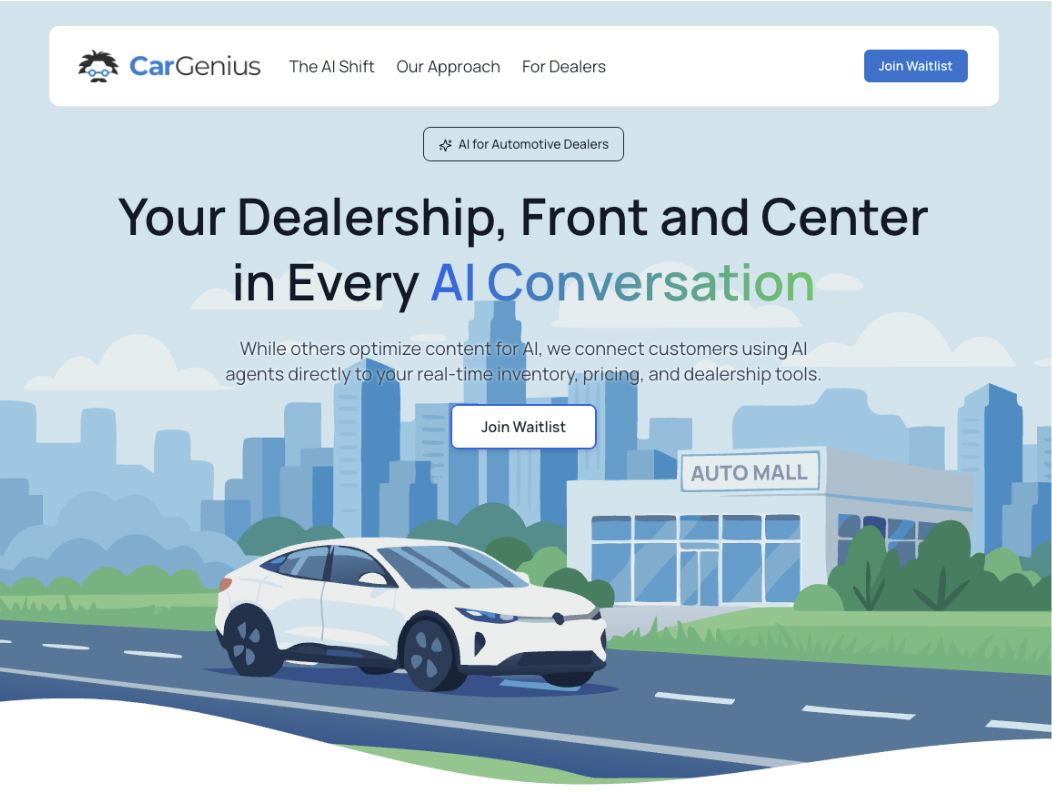
Today, our new company to watch is CarGenius
More and more consumers are shifting their online activity to chat bots like ChatGPT and Claude.
And even Google is disrupting themselves with their “AI Overviews” at the top of each search result.
It’s certain that AI is reshaping every step of the car-buying journey, a trend that will accelerate.
Smart dealers are acting now to take control of the conversation – feeding AI agents the right data while bringing AI power to their own sites.
CarGenius is helping dealers think through the implications of AI-powered consumer search, and prepare for the future.
If you’d like to learn more about CarGenius, you can check them out at: www.CarGenius.ai.
So that’s it for this week’s Future of Automotive segment.
If you’re an AutoTech entrepreneur working on a solution that helps car dealerships, we want to hear from you. We are actively investing out of our new Mobility Fund.
Don’t forget to check out my two books, The Future of Automotive Retail and The Future of Mobility, both available on Amazon.com.
Thanks (as always) for your ongoing support and for tuning into CBT News for this week’s Future of Automotive segment. We’ll see you next week!