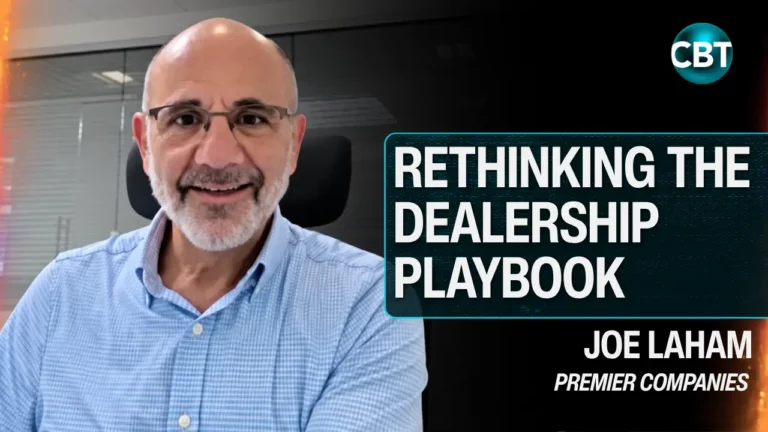
AI continues to evolve rapidly across automotive retail, but one of the biggest questions remains what is actually working on the ground. Joining us on the latest episode of CBT Now is Alex Perdikis, CEO and Owner of Koons Motors and Chairman and Founder of InRide, to break down how his dealership is putting AI into real-world use.
According to Perdikis, automotive retail is entering a phase where AI is no longer theoretical. He cites early validation from Ford and strong performance metrics for his dealer-built platform as evidence that AI is beginning to meaningfully reshape vehicle acquisition, customer engagement, and retail operations.
At Koons Motors, business rebounded strongly after early-year weather disruptions slowed the Washington, D.C. market, with March and April bringing improved lead flow, stronger CSI scores, and solid profitability. Perdikis also credits shifting market conditions and greater pricing transparency with reducing friction in the buying process, noting that recent regulatory attention has helped standardize expectations across the industry, benefiting both customers and dealers.
Perdikis says that inconsistent third-party pricing and lead systems have created operational challenges across the industry. In response, Koons Motors has begun reassessing certain vendor relationships and shifting more resources toward internal digital marketing channels, including paid search and Google advertising, to improve direct customer acquisition.
Results on the ground
A major focus of Perdikis’ strategy centers on InRide, a dealer-built platform originally designed for used-vehicle acquisition and later expanded into a broader, nationwide auction and engagement system. He emphasizes that InRide operates independently from Koons Motors and functions as its own technology company.
The platform now uses what Perdikis describes as an agentic AI system that actively engages customers, evaluates trade-in vehicles, and manages communication without requiring human intervention at every step. He contrasts this approach with traditional chatbot systems, noting that the platform is built to execute multi-step interactions and refine responses based on customer behavior and dealership feedback.
Perdikis says the system was developed through real dealership use cases, where early versions revealed gaps in lead quality and engagement. The AI was refined to handle objections, gather additional vehicle details, and adjust valuations in real time based on inputs such as payoff and equity scenarios.
"Some of the stuff we have coming out is really exciting because they’re really builders tools to allow dealer groups to really build and solve problems and participate in what AI is offering."
He reports that Ford has validated the system following internal testing and deployment. After initial success with vehicle acquisition workflows, Koons Motors expanded the platform into the service lane, targeting customers who had recently visited the dealership for maintenance and service.
According to Perdikis, the system identifies trade-in opportunities from service customers and initiates outreach with real-time vehicle valuations. He says the AI continuously engages customers through multiple touchpoints until it generates either an appointment or a qualified lead.
Perdikis reports strong performance metrics from early deployments, including engagement rates above 50% across thousands of customers. He says campaigns have produced thousands of leads, more than a thousand qualified opportunities, and hundreds of appointments, with consistent conversion into vehicle sales.
He also highlights operational discipline as a key factor in success, emphasizing that high-value AI-generated leads must be handled by experienced managers with decision-making authority rather than being filtered through multiple layers of dealership staff. He compares the process to moving a customer close to purchase before final execution by senior personnel.
What’s next
InRide currently operates Trade Agent AI across 51 rooftops, with Koons Motors planning to add more dealerships in the onboarding pipeline. According to Perdikis, the onboarding process typically takes about two weeks and includes compliance reviews, system configuration, and the integration of dedicated communication channels for each dealership.
He notes that the platform continues to scale quickly as dealers seek tools that improve vehicle acquisition efficiency and reduce reliance on traditional marketing methods such as direct mail, which his store has largely eliminated in favor of digital engagement systems.