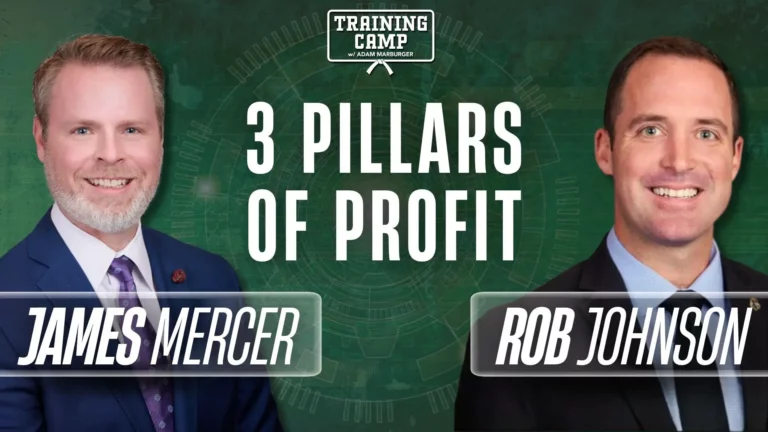
Dealers should judge every profit participation program on three pillars, which are underwriting, fees and investment income. Ascent Dealer Services Vice President of Sales James Mercer and Vice President of Acquisitions Rob Johnson laid out the framework on today’s episode of Training Camp with host Adam Marburger. Picking up where part one left off, Mercer and Johnson move from how participation programs work to which structure fits a store.
According ot Mercer, every participation program rests on underwriting, fees and investment income, while underwriting covers how claims perform. Fees cover what the dealer pays and whether the dealer knows about every charge. Investment income covers how the reserve is invested. The gap between earning 1% and 8% on that reserve can double a dealer’s returns as it compounds.
Underwriting depends on rates and product mix
Repair costs rose 20% to 30% after COVID, yet some dealers have not raised their contract rates in 10 to 12 years, Mercer said. Some positions now sit near or above a 100% loss ratio. Mercer said the target is a loss ratio of 50% to 60%, and 40% to 50% is a strong result. Dealers should ask their provider for a rate increase whenever they raise their labor rate, such as a move from $180 to $200, he said.
Dealers should also check their reporting, keep claims in the selling store and confirm that contracts steer customers back to the dealership through a first right of refusal or a disappearing deductible. About half of the partners Mercer works with do not offer a limited warranty. The three-month, $3,000 guarantee on a used car costs $150 to $250 and feeds directly into the participation.
The vehicle service contract carries the most reserve, so it anchors the structure, Mercer said. Dealers can choose which contracts go into their position, such as those under 100,000 miles, and leave out snow plows, commercial units and high-mileage diesels. Paint and fabric are easy additions. Gap depends on the market. Windshield coverage is the toughest fit because camera technology has pushed some repairs to about $3,000.
Ask who controls the investment income
Dealers should ask their provider whether they share in investment income and at what level, Johnson said. Some retros let dealers participate only in underwriting profit, and the insurer keeps the investment income.
“They’re not going to let it just sit in cash, right? And you shouldn’t either.” - Rob Johnson
The traditional 90-10 split places 90% of the unearned premium reserve, the money set aside to pay future claims, in cash-like equivalents such as government-rated bonds. The other 10% can go into the market. Providers now offer 80-20 and 70-30 splits, and sometimes 60-40, because participation programs are turning into commodities, Johnson said.
Dealers should also ask whether they must use one provider’s prepackaged funds or can hire an investment manager who specializes in dealers and reinsurance companies. A $1,000 investment earning 7% roughly doubles in 10 years, Mercer said.
Performance matters more than the admin fee
A participation program depends on a steady flow of contracts, Johnson said, a point he credited to former colleague Nicole Martin. He tested the idea on a store that sells 100 cars a month. A 5% gain in VSC penetration adds five contracts a month. At an average reserve of $800 and a 60% loss ratio, the dealer keeps $320 on each contract. That totals $19,200 a year in underwriting profit. The full $800 also earns investment income, for at least three years on a new car because the manufacturer covers early claims, he said.
Even the best participation program cannot outpace stronger VSC sales, Mercer said. Admin fees work like a price increase on a new Tahoe, he said. The customer pays the higher price, and the dealer’s margin does not shrink.
“Admin fees are just stacked on top of the reserve, and that’s the price the customer gets.” - James Mercer
The difference between a $195 and a $295 admin fee comes to $50 to $100 in the contract price, Mercer said. Hidden fees cost more. A 10% ceding fee takes $80 off an $800 reserve before it reaches the dealer’s investment account. Dealers should confirm that every fee is visible and stacked on top of the reserve so the full amount goes into the position, he said.
Dealers have the right to ask their provider straight questions, and transparency matters in today’s market. With margins thin, F&I performance deserves more attention than ever.