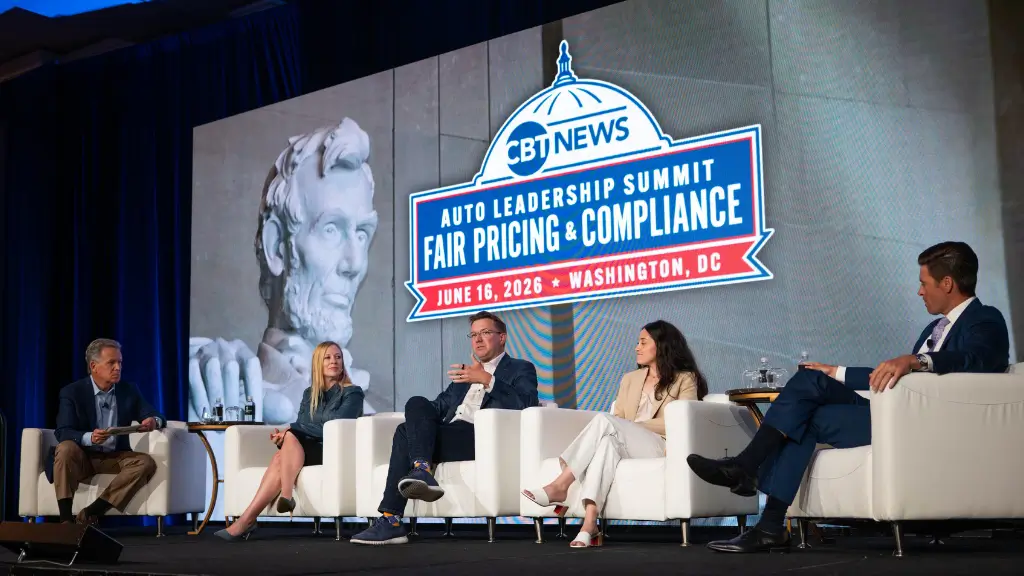
CBT News brought dealers, marketing executives and trade association leaders to Washington, D.C., on June 16 for the Auto Leadership Summit: Fair Pricing & Compliance at the Salamander Hotel. The event came as the Federal Trade Commission (FTC) puts pressure on deceptive advertising practices. Sessions throughout the day looked at how dealers and vendors are adjusting to the pressure.
One of the most comprehensive panels of the day focused directly on the issue of staying competitive with online pricing while also staying compliant. The panel, “Advertising in the Crosshairs: Online pricing, third-party listings, and what the FTC is watching,” took a closer look at how pricing shows up in ads, on dealer websites and on third-party listing sites. CBT News co-founder Jim Fitzpatrick moderated the panel, which included Aaron Baldwin, CEO of automotiveMastermind, Laura Perrotta, President of NJ CAR, John Fitzpatrick, CEO of Force Marketing, and Tianna Mick, CMO of Dealer Synergy.
Fines, fees and the need for clarity
Dealers spend millions of dollars on advertising and marketing, so it’s no surprise that regulatory scrutiny on this side of the industry is shaking things up.
Force Marketing handles marketing for more than 1,600 rooftops. CEO John Fitzpatrick says that as soon as the FTC’s letters went out in March, internal data showed the issue dominated client calls for weeks. GMs and dealer principals from across the country wanted to ensure their marketing campaigns wouldn’t face an FTC fine.
"This feels like a complex issue. The risks are real. The fines are large," -John Fitzpatrick
AutomotiveMastermind CEO Aaron Baldwin said the issue shines a light on areas where the industry needs more centralized data management. While it may be a challenge now, he says ultimately the FTC’s policy will put all dealers on the same page when it comes to competitive pricing.
“There’s no centralization that’s ever really occurred here on collecting dealer fees and making sure that it is readily available across your networks,” said Baldwin, “It’s systemic and it’s really a challenge and problem that we need to address.”
"Once we get through this and everybody's on the right footing together, it's going to be better for more dealers overall." – Aaron Baldwin
Dealers are not pushing back on the new pricing rules, but they are asking for a clear definition of what compliance actually looks like.
“Everyone just wants clarity. What’s expected? How do I color within the lines? What is wrong advertising? What is correct advertising?” said Perrotta. She said dealers are leaning on compliance vendors while they wait for more direction from regulators. She adds, “One of the biggest things that our dealers are waiting on is the FAQs from the FTC. They are just anxiously waiting for that,” Perrotta said.
Sales teams rethink their pitch on social media
Social media has become its own compliance risk, since salespeople who post prices and payments online now draw the same scrutiny as dealership ads.
Tianna Mick, CMO of Dealer Synergy, said the scrutiny on pricing claims should push salespeople toward selling value instead of racing to the lowest number. “I really don’t think that racing to the bottom dollar or the bottom line is going to be effective for any of that anymore, any dealership,” she said.
Additionally, she believes the same logic applies to fees for add-ons such as bed liners and paint protection.
"Price only becomes relevant with the absence of value," - Tianna Mick
The role of vendors & third parties
Vendors are rebuilding their own technology to keep up, rewriting marketing templates and pushing dealers toward fewer, more connected partners. Baldwin said automotiveMastermind rebuilt its templates so cars are advertised only once they are close enough to delivery to be sold.
“We actually had to retool the entire platform to support VIN-specific advertising and understand the logic around in-transit vehicles and how close it is in the pipeline, should it be advertised,” said Baldwin.
Third-party listing add another layer of complexity to the pricing policy issue. They often show shoppers numbers that do not match those on a dealer’s own website. “Where we’re disconnected is these third parties. And it’s very much where the consumer is connected, and it’s where they will hang out,” said Fitzpatrick.
The push toward one-price selling
The compliance pressure has dealers taking a fresh look at one-price selling, where there is no negotiation and no surprises at the desk. Not only would it address the FTC’s pricing policy, but it could shift the public’s perception of car dealers.
“When you talk to a consumer about their many purchases, and you say, who do you trust the most, who do you trust the least, I think we can all be honest that car dealers would not be on the top of that list. We already have a big barrier here to overcome in buying a car,” said Fitzpatrick.
However, Mick pushed back on the idea, countering that all-in pricing costs dealers money. “One of the biggest misconceptions of all this, the new rules, the online pricing, is that dealers are going to be losing money, and I think that’s absolutely false,” Mick said.
Compliance Q&A
Moving to the Q&A portion of the panel, an audience member asked how a one-price model works on new cars, where manufacturer rebates change the math. Mick said dealers can stay transparent about incentives without folding every rebate into the sticker price.
“It’s not bundled in that price, which is why we’re having this whole conversation,” Mick said.
Another audience member had a question about factoring in rebates when it comes to one-price advertising for new cars. Perrotta noted that it can be done as long as you are clear in your ad about who qualifies for the rebate.
“I think there is definitely a way that you can offer incentives and be clear on the all-in pricing. There are these opportunities for these different individuals who qualify, and you have very clear descriptions,” said Perrotta.
As dealers wait for clarity from the FTC, the panelists left them with a few specific recommendations:
- Document every price and fee
- Push vendors to share data instead of working in silos
- Train sales teams to explain value instead of leading with discounts
- Treat transparency as a selling point instead of a liability