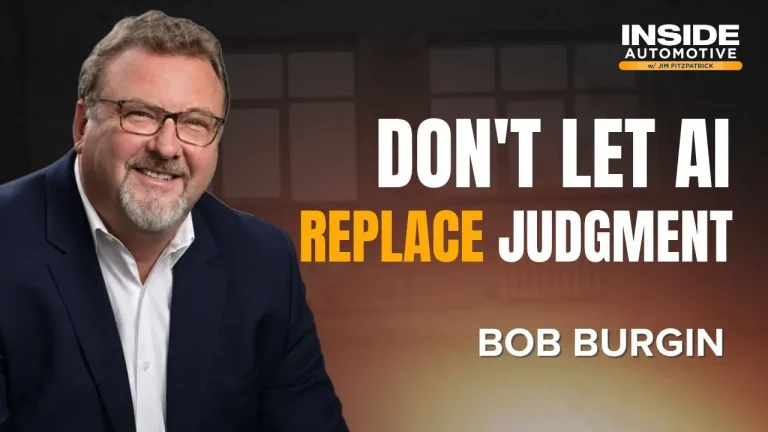
As AI shifts from answering basic questions to autonomously executing workflows, dealership leadership faces the challenge of ensuring their sales teams develop the judgment to manage these tools effectively rather than becoming overly reliant on them. On the latest episode of Inside Automotive, we’re joined by Bob Burgin, Serial Entrepreneur, Chairman and CEO of Amplifire, and Author of Emergence, to examine how cognitive brain science informs modern AI deployment and how dealers can use conversational AI to sharpen employee performance.
Over 16 years of partnering with leading cognitive science laboratories at institutions such as Harvard, Amplifire studied how the human brain encodes, stores, and retrieves information through functional MRI research. According to Burgin, that work led to an adaptive learning algorithm that currently trains roughly two million professionals annually, primarily in high-stakes healthcare settings such as hospitals, where knowledge gaps carry severe consequences.
Burgin explained that while developing this infrastructure, his team discovered they were effectively reverse engineering the same neural learning principles that powered modern AI breakthroughs. He said that rather than functioning as a traditional computational calculator, AI operates as a learning engine. By using conversational AI as a one-on-one training agent, dealers can give sales team employees an interactive partner that answers complex questions, explains difficult concepts, and adapts in real time to individual knowledge gaps.
Avoiding the AI “easy button”
A central risk in deploying AI across the dealerships’ workflows is treating the technology as a shortcut that replaces human critical thinking. Burgin cautioned dealers against relying on an AI “easy button” that simply completes high-order tasks for staff, noting that automated output prevents sales teams from growing their skills and leaves them vulnerable to undetected errors.
"There are tasks that are mundane you just want the AI to do, but much of what you're doing with AI is really high order thinking. And the critical thing to do is avoid the easy button.”
To illustrate how dealers can design AI to elevate human capability, Burgin shared how Amplifire built an intelligence layer on top of its customer relationship management (CRM) platform using 14 specialized research sub-agents. Instead of handing sales representatives a pre-written script, the AI synthesizes prospect research and prompts the representative with strategic questions, such as asking how they might leverage a client’s background or pivot if a meeting takes an unexpected turn. When employees engage in that Socratic dialogue multiple times a week, their discovery skills improve substantially. Conversely, allowing AI to generate ready-made answers causes staff capabilities to atrophy.
Protecting junior employees from confident AI errors
According to Burgin, the risk of uncritical AI reliance is particularly acute for younger, early-career workers who have yet to develop the foundational judgment traditionally gained through hands-on mentorship. Burgin pointed to cognitive science research showing that people often believe poorly reasoned or inaccurate information presented with polish and authority over accurate information delivered poorly. Because large language models present hallucinations with seamless fluency, inexperienced employees often lack the domain expertise to spot mistakes.