As customer payment preferences evolve, dealerships need payment systems that do more than process transactions. Integration with dealership management systems, fraud prevention, reporting and the ability to support emerging payment methods are becoming important considerations when evaluating payment partners.
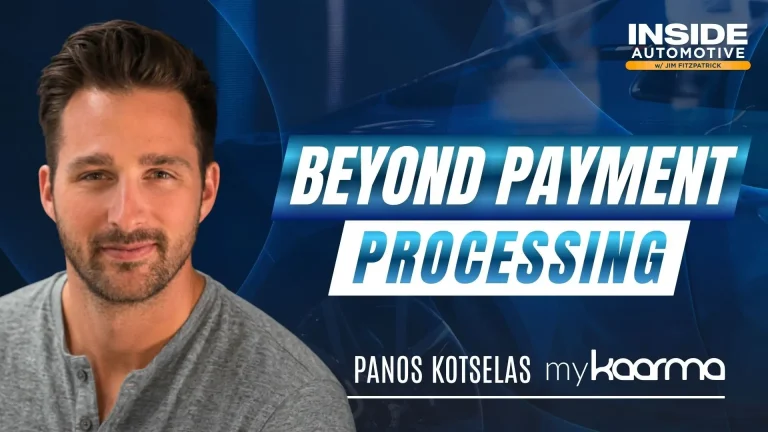
On the final installment of our three-part series with myKaarma, Panos Kotselas, Senior Director of Payment Operations at myKaarma, joins us on today’s Inside Automotive episode to discuss how dealerships can evaluate payment technology, streamline back-office operations and prepare for changes in the payments landscape.
According to Kotselas, connecting payments directly to the DMS is a “game changer,” and he pointed to myKaarma client Galpin Motors, where payment information now flows automatically into the DMS instead of employees posting it by hand. Kotselas said the integration has saved the dealership hours of reconciliation every day, and because the system records what the customer actually paid rather than relying on manual keying, accuracy improves as those daily savings add up over the month.
Choosing a partner for the long term
Kotselas also urged dealerships to weigh long-term capabilities over the “glitz and glam” of surcharging and fast savings. He said dealers should ask up front which payment methods a provider offers, what is coming soon, what technology stack it runs on and how it can support the next phase of the dealership life cycle. He also recommended that a comptroller, chief financial officer or treasury staff member help make the decision, describing those executives as important decision-makers and adding that dealerships otherwise face too many surprises.
“What we’ve seen is there’s the glitz and glam of surcharge- and, being able to save money really quickly, but the mid- to long-term decision of that partner needs to be addressed when you’re considering partners for payments.”
On fraud, Kotselas said the biggest risk comes with online payments, where dealers cannot see the customer, and he noted that a payment over a terminal is more secure than one over a link. He explained that 3D Secure works as two-factor authentication for card payments, prompting customers to confirm a purchase, and that it can shift liability for a fraudulent dispute to the customer. Kotselas said 3D Secure is a card-brand standard introduced by Visa, Mastercard, American Express, and Discover, rather than an insurance product that myKaarma sells. He added that reporting lets enterprise customers see which employees take or manually key many online payments and revoke access, so back-office staff can coach those employees to use 3D Secure online or a payment terminal.
New ways to pay
Kotselas said new payment options are arriving faster than many dealers expect, including phone-based payments in which a dealership hands over an iPhone that serves as a payment terminal with no hardware purchase required. He also said stablecoin payments are an option on myKaarma’s near-term roadmap for its customers. Dealers should also ask providers how their tools handle surcharging and dual pricing, how they vet the solution, how easily dealers can turn it on and off while staying compliant as state legislation moves quickly, and whether the platform offers tools such as scheduling, inspection, and check-in.
Ultimately, the payment experience should work well for customers and dealership employees alike. Kotselas said dealerships should aim to deliver a payment experience comparable to what customers encounter with other businesses, while keeping internal processes simple and making incoming funds easy to track. Beyond processing costs, dealers should assess hardware, customer experience, DMS integration, reporting and operational efficiency. Choosing a payment partner with those priorities in mind can help dealerships reduce administrative work, improve transaction accuracy and remain prepared for changing customer expectations.