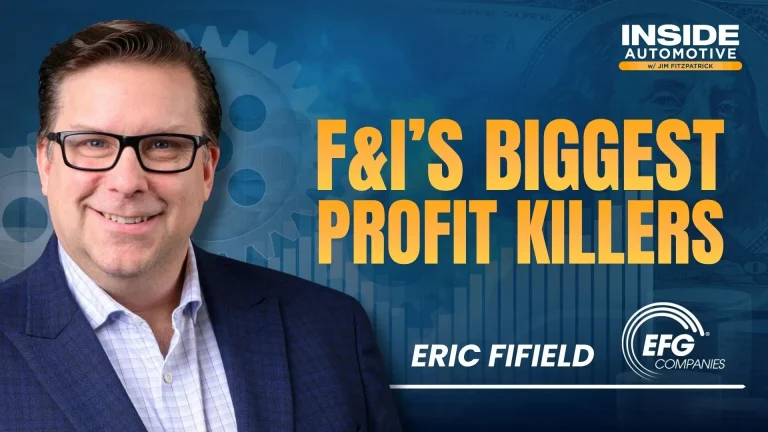
As front-end margins tighten across the automotive retail landscape, dealers are leaning heavily on Finance and Insurance (F&I) and fixed operations to protect overall profitability. Yet, according to Eric Fifield, Chief Revenue Officer at EFG Companies, some of the most significant profit losses never appear as red flags on a profit and loss (P&L) statement. On today’s episode of Inside Automotive, Fifield explains why traditional financial statements are inadequate and how dealers can identify and fix hidden operational leaks that hurt profits.
According to Fifield, financial statements are inherently backward-looking. While they show historical outcomes, they fail to reveal why or where operational breakdowns are occurring. Additionally, relying on broad dealership or 20-Group averages can mask underperformance. Fifield says a store generating $2,000 per vehicle retailed (PVR) might look strong against local peers, yet still leave hundreds of dollars per copy on the table compared to top-performing dealerships in comparable markets.
Where F&I profits leak
Fifield highlighted several interconnected operational areas where dealers quietly lose revenue:
- Rushed menu presentations and chargebacks: When F&I managers rush through transactions on busy Saturdays without uncovering a buyer’s true driving habits and needs, customers leave confused. Lack of clarity leads directly to canceled products, early credit union payoffs, and costly chargebacks.
- Imbalanced pay plans and metrics: Tracking PVR alone isn’t enough. Dealers must monitor the balance between finance reserve and product profit, product-by-product penetration, and deal audit findings to ensure managers aren’t taking the path of least resistance.
- Evolving compliance and lender rules: Falling behind on federal regulations—such as heightened FTC scrutiny—or state-specific lender requirements doesn’t just invite legal risk; it results in rejected contracts, forced deal rehashes, and soured lender relationships.
- Overlooked customer retention: F&I is a direct feeder for fixed ops. When customers understand and use their mechanical breakdown and maintenance coverage at the dealership, service revenue climbs, CSI scores improve, and repeat vehicle purchases follow.
Additionally, Fifield notes that the biggest threat to F&I profitability is post-training complacency. Sending an F&I manager to a classroom workshop yields temporary gains, but without reinforcement back at the store, bad habits quickly return. He emphasized that sustainable performance requires ongoing, real-time coaching, role-playing, and leveraging modern tools, including AI-driven coaching platforms, to sharpen skills continuously.
Equally important is “training the trainers.” Promoting top salespeople into management without teaching them how to coach leaves them ill-equipped to spot subtle process breakdowns and hold teams accountable. Across multi-rooftop dealer groups, even small, incremental improvements in F&I consistency can compound into massive bottom-line gains.
Dealers next steps
To stop profit leaks before they erode your next financial statement, take these immediate steps:
- Audit daily granular metrics: Ask your leadership team what yesterday’s product-by-product profit, finance-to-product mix, and deal audit results looked like, and what immediate coaching is happening today to address gaps.
- Align sales and F&I handoffs: Ensure desk managers and F&I work off the same playbook so payment-sensitive buyers are transitioned smoothly rather than surprised in the box.
- Schedule an objective F&I assessment: Bring in an experienced, unbiased partner to evaluate your current processes, compliance posture, and lender mix against top-quartile benchmarks, and insist on walking away with an executable, store-specific action plan.