There’s a conversation happening behind closed doors in Washington that should make every American pay attention, and it has nothing to do with EV mandates or fuel economy targets. This time, it’s about war, capacity, and whether Detroit is about to be pulled into something far bigger than the auto business.
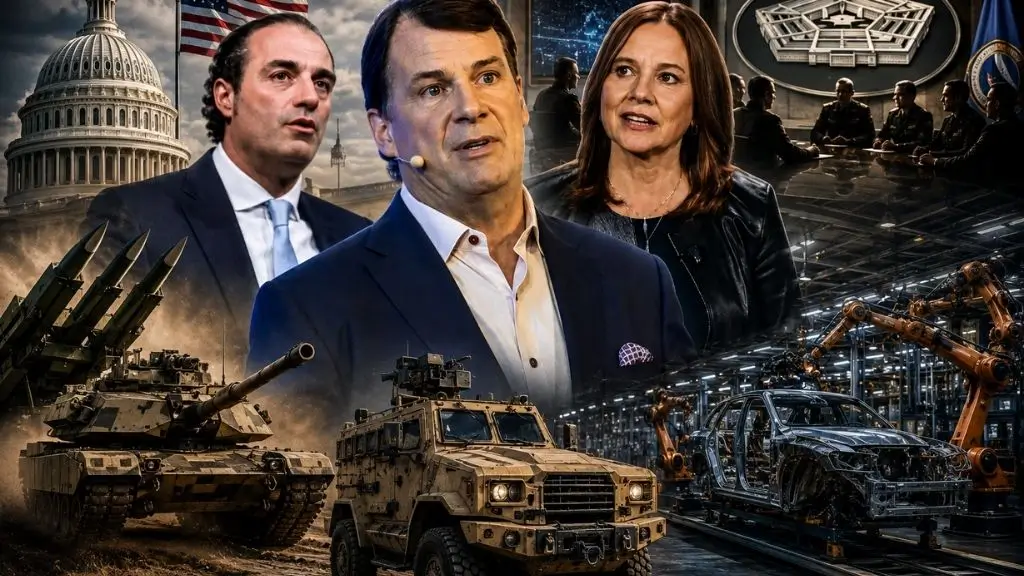
According to emerging reports, senior Pentagon officials have been quietly engaging with leadership from General Motors and Ford Motor Company, including CEOs Mary Barra and Jim Farley. The message is not subtle. The U.S. may need its automakers to help build the tools of modern warfare.
This isn’t speculation. It’s a direct response to a growing problem that Washington can no longer ignore. Ongoing conflicts abroad have exposed a reality that’s uncomfortable but unavoidable. The United States does not currently have the industrial capacity to produce munitions, missiles, and advanced defense systems at the speed and scale modern warfare demands. Stockpiles are being drained faster than they can be replenished, and the traditional defense contractor base is under pressure.
So now, the Pentagon is looking elsewhere. And when you need scale, speed, and manufacturing expertise, there’s one place you go. Detroit.
Let’s be honest about what this really means. This is not a routine government outreach effort. This is Washington signaling that America’s industrial base may need to shift priorities, and fast. The auto industry, which has spent the last decade being pushed toward electrification at enormous cost, is now being evaluated for something entirely different, its ability to support national defense on a large scale.
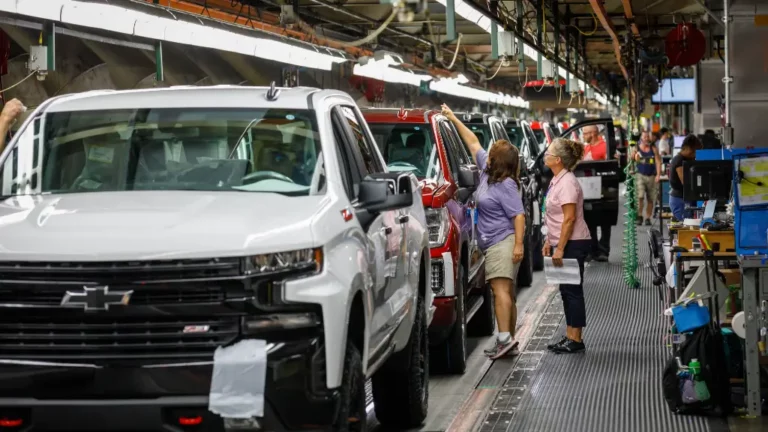
There is precedent for this, and it’s not ancient history. During World War II, American automakers famously halted civilian vehicle production and became the backbone of military manufacturing. Tanks, aircraft, trucks, engines, all of it rolled out of facilities that once built cars for Main Street. It was called the Arsenal of Democracy, and it worked.
The question now is whether history is about to repeat itself, not through mandates, at least not yet, but through “collaboration,” which in Washington terms often means something a lot closer to expectation than suggestion.
These discussions are still in the early stages, but don’t mistake “preliminary” for unimportant. Pentagon officials are asking hard questions. Can automakers pivot their production lines quickly? Do they have the workforce flexibility? Can their supply chains handle defense-grade manufacturing? And perhaps most importantly, what regulatory and contractual barriers stand in the way?
This isn’t a theoretical exercise. The Pentagon is actively exploring how commercial manufacturers can backstop traditional defense companies. That alone tells you everything you need to know about where things stand. The existing system isn’t enough.
Companies like GE Aerospace and Oshkosh Corporation are already part of the broader conversation, bridging the gap between commercial manufacturing and defense production. Oshkosh Corporation in particular has long operated in both civilian and military spaces, producing tactical vehicles while maintaining a diversified portfolio. That kind of hybrid model may soon become more common if Washington gets its way.
But this isn’t just about national security. It’s also about economics, and that’s where things get complicated.
Automakers are navigating one of the most challenging environments in decades. Sales growth has cooled. Profit margins are tightening. The cost of electrification has ballooned beyond early projections, putting enormous pressure on balance sheets. Billions have been spent chasing EV targets that consumers have been slower to adopt than expected.
In that context, defense contracts start to look less like a burden and more like an opportunity. Stable, long-term revenue backed by government funding has a certain appeal, especially when your core business is under strain.
That doesn’t mean this is an easy pivot. It’s not. Building consumer vehicles and building military hardware are fundamentally different businesses. Defense manufacturing comes with layers of compliance, extensive testing requirements, and procurement cycles that can stretch for years. This isn’t about slapping a different badge on a pickup truck and calling it a day.
Factories would need to be retooled. Workers would need retraining. Entire supply chains would need to be adjusted to meet military specifications. And all of it would have to happen within a regulatory framework that is far more complex than anything the auto industry deals with today.
Still, if there’s one thing American manufacturers have proven, it’s that they can adapt under pressure. During the COVID-19 pandemic, both GM and Ford shifted production to build ventilators in partnership with medical companies. It wasn’t perfect, but it was fast, and it demonstrated something important. When pushed, this industry can move.
Now, the Pentagon is betting that same flexibility can be applied to defense production. Defense Secretary Pete Hegseth has been explicit about the need for what he calls a “wartime footing” in manufacturing readiness. That phrase matters. It doesn’t necessarily mean the U.S. is entering a traditional war, but it does mean planning for sustained, high-volume production of military equipment.
And the financial scale behind that planning is enormous. The Pentagon’s proposed $1.5 trillion budget would be the largest in modern history, with significant allocations for munitions, drones, and next-generation battlefield technologies. That kind of spending demands one thing above all else, capacity. And right now, capacity is the bottleneck.
There’s also a strategic shift happening here that shouldn’t be ignored. For years, the U.S. has relied on a relatively small group of defense contractors to supply its military. Those companies are highly capable, but concentration creates vulnerability. Expanding the industrial base to include commercial manufacturers could increase resilience and reduce dependency on a limited number of suppliers.
That’s the upside. The downside is just as real.
What happens when civilian manufacturing capacity is redirected toward defense? What does that mean for vehicle production, pricing, and availability? And how does this reshape the long-term business models of companies that were already in the middle of a massive transition toward electrification?
These are not abstract questions. They are practical concerns with real economic consequences.
Timing is another factor that adds urgency to the conversation. These discussions reportedly began before recent escalations in global tensions, but the current geopolitical environment has only intensified the pressure. The reality is simple. Military stockpiles are being depleted faster than they can be replaced, and the Pentagon is looking for solutions that can be implemented quickly.
Some automakers are already positioned to step into a larger role. General Motors, for example, operates a defense subsidiary that produces an infantry squad vehicle based on the Chevrolet Colorado platform. It’s a relatively small part of the business today, but it serves as proof of concept. Automotive technology can be adapted for military use, and it can be done efficiently.
Looking ahead, GM is expected to compete for a major Army contract to develop the next-generation infantry squad vehicle, a platform designed to replace the aging Humvee. This isn’t just a transport vehicle. It’s being envisioned as a mobile command center, a power hub, and a critical component of modern battlefield operations.
That kind of project sits squarely at the intersection of automotive engineering and defense innovation. It’s also a preview of what could become a much larger trend.
So where does this go from here?
In the near term, expect more discussions, more feasibility studies, and more pressure from Washington. The Pentagon is clearly signaling that it wants industry to be ready, not just willing. Readiness is the key word. This is about preparation for a scenario where demand spikes and the current system can’t keep up.
In the longer term, this could fundamentally reshape how we think about American manufacturing. For decades, the auto industry has been driven by consumer demand, regulatory requirements, and technological innovation. Now, national security is entering the equation in a much more direct way.
That’s not a small shift. It’s a structural change.
Detroit has always been a symbol of American industrial strength. Now, Washington is looking at it as something more, a potential force multiplier in a world where manufacturing capacity is becoming a strategic asset.
Whether automakers fully embrace that role remains to be seen. There are financial incentives, but there are also risks. There’s opportunity, but there’s also complexity. And there’s a bigger question hanging over all of it.
When the government starts looking at your industry not just as a business, but as a strategic resource, the rules change.
One thing is certain. When the Pentagon starts making calls like this, it’s not casual. It’s a signal. The stakes are rising, the demands are increasing, and America’s industrial base may be heading into a new era where building cars is only part of the job.
Check out my full commentary on this story: https://youtu.be/6K-c7KPEt7o
Looking for more automotive news? https://www.CarCoachReports.