On the Dash:
- FTC warned 97 dealership groups in March, then named them all publicly in May.
- Many vendors, dealers and third-party sites made changes to align with FTC pricing standards.
- CBT News’ Auto Leadership Summit: Fair Pricing and Compliance will address the issues in Washington, D.C., on June 16.
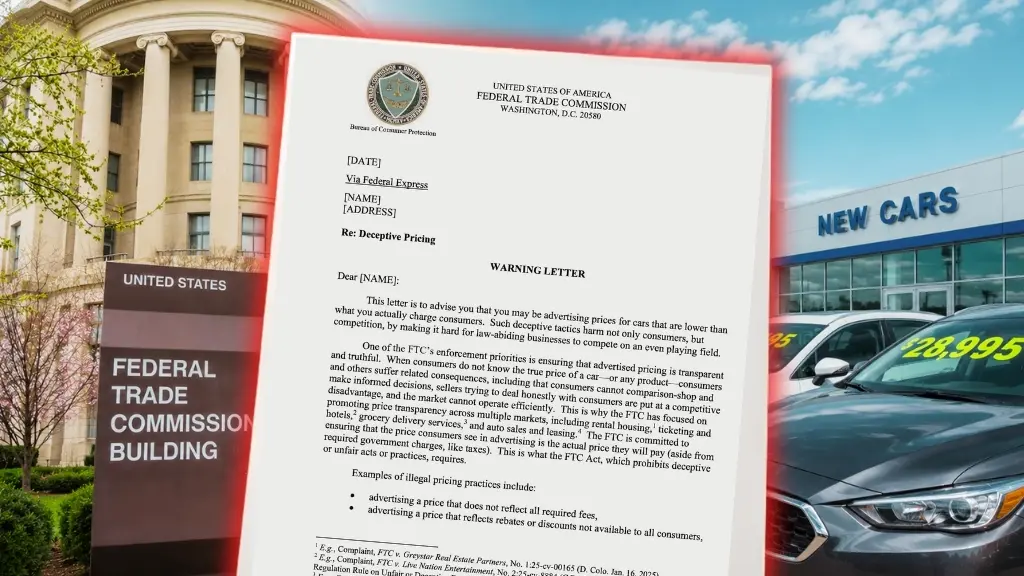
Since March 2026, the Federal Trade Commission (FTC) has put the auto industry on notice over how dealers advertise vehicle prices. The agency sent warning letters to 97 dealership groups, stating that advertised prices must reflect the total amount a customer actually pays, with no hidden fees.
The letters didn’t accuse anyone of wrongdoing, but made it clear that the FTC is watching. The agency also signaled that dealers who don’t fall in line could face fines down the road. With that, dealers, vendors, and third parties took notice, and many scrambled to review their pricing and advertising practices.
The scale of this issue is why CBT News is bringing dealers, regulators, and industry leaders together for the Auto Leadership Summit: Fair Pricing & Compliance. The one-day event takes place Tuesday, June 16, at the Salamander Hotel in Washington, D.C. It will cover the FTC’s warning letters, the consent orders, settlements and what dealers need to do now to stay compliant. More than 200 rooftops are already registered, emphasizing how much this issue has come to dominate conversations across the industry.
This Saturday marks exactly three months since the FTC’s warning letters first landed on dealership desks. Here’s a month-by-month look at how the story has unfolded so far.
March: Warning letters land
On March 13, the FTC sent identical letters to 97 dealership groups. The letters cited six pricing practices the agency considers illegal under Section 5 of the FTC Act. Each letter said the recipient “may be advertising prices for cars that are lower than what you actually charge consumers.”
The letters didn’t name names at first. But they signaled a clear shift toward enforcement, with attorneys who work with dealers saying the letters gave the FTC stronger legal footing for future action.
“What the FTC is trying to enforce is to make sure that the dealer takes a hands-on role to ensure that the third parties that are the vendors that are working for the dealership remain in compliance,” said Seth Dobbs, Partner and Co-Chair of the National Automotive Practice at Fox Rothschild, on Inside Automotive.
April: Compliance confusion
Throughout April, dealers worked to understand what the letters required. Shannon Robertson, Executive Director of the Association of Finance and Insurance Professionals (AFIP), broke down the letters for dealers on another Inside Automotive episode.
“I think this letter is interesting because this comes directly from the FTC. They’re saying they’re involved. And they’re watching over these specific items. They’re not going to tolerate it,” said Robertson.
The scrutiny also reached social media, with CBT News reporting that dealership posts now count as advertising under the FTC’s framework. A “Call for Price” post can still violate the rules if it implies a specific deal without showing the real total.
Later in April, an FTC official told dealers they could report competitors for noncompliant pricing. The move signaled the agency wants the industry to help police itself.
May: Vendors respond, names go public
May brought two major developments. First, vendors started changing how they handle pricing. For example, TrueCar announced it would fold mandatory dealer fees directly into advertised prices. The company also updated its dealer agreement to align with FTC standards.
“TrueCar has always been built on price transparency. It is our founding principle. The FTC’s current enforcement validates that approach,” said Scott Painter, Founder and CEO of TrueCar, in a statement.
automotiveMastermind also adjusted its approach. CEO Aaron Baldwin told CBT News his company moved away from generic pricing based on average MSRP. Instead, it shifted toward verified, out-the-door pricing for each vehicle.
Then, on May 28, the FTC published the full list of the 97 dealership groups it had warned in March. The list included some of the largest names in auto retail, such as Lithia Motors, AutoNation, Group 1 Automotive, Sonic Automotive, and Hendrick Automotive Group. So did Ken Garff Automotive Group, Ken Ganley Automotive Group, Berkshire Hathaway Automotive, Morgan Auto Group, and Holman.
Analytics company Widewail looked deeper into customer satisfaction data for those dealerships and groups. Widewail compared 63 of the 97 warned groups against its broader database. It found that those dealers drew roughly twice as many bait-and-switch complaints as the industry average in the first quarter of 2026.
June: The industry mobilizes
In June, more vendors took action as S&P Global Mobility opened FeeSync to the entire industry at no cost. The platform gives dealers one place to manage and share fee data across advertising channels.
Cox Automotive paused its “Good” and “Great” price badges on Autotrader and Kelley Blue Book, a sign that even pricing tools built before the FTC letters are now under review.
Through it all, dealers have had to face an uncomfortable truth. David Spisak, CEO of Disruptive Growth Solutions, said the industry brought much of this scrutiny on itself.
“Have we brought this on? Yeah. Do we have some culpability? No, we have a lot of culpability,” said Spisak on Inside Automotive.
What’s next, The CBT News Auto Leadership Summit
The FTC has said it will keep monitoring the market. It has also said it may take further action if dealers don’t clean up their pricing practices. For many dealers, the warning letters were a wake-up call. The question now is how to respond and what impact that response will have on the market.
That’s the conversation CBT News plans to continue at the Auto Leadership Summit on June 16. Sessions will dig into the 97 letters, recent consent orders, and what “all-in pricing” looks like in practice. Dealers, legal experts, policy advocates, and lawmakers, including U.S. Sen. Bernie Moreno (R-OH), will all be in the room.
Dealers who want to learn more can join the conversation at the CBT News Auto Leadership Summit: Fair Pricing & Compliance on June 16. Register at cbtnews.com/auto-leadership-summit.