For years, dealership social media teams have treated vehicle posts like digital window stickers with a little extra sparkle: “Only $399/month,” “Huge savings TODAY ONLY,” “This one won’t last,” “$5,000 off MSRP,” “Drive it home today!”
But the FTC’s March 13, 2026, warning letters to 97 auto dealership groups sharpened the rules of the road and made one thing explicit: if your team posts a price the dealership can’t honor, that’s the dealer’s Section 5 violation. The Commission warned that advertised vehicle prices must reflect the total price a consumer is required to pay, including mandatory fees, required government charges such as tax, title, and registration, and can remain excluded in this new ruling.
In other words, if the dealership requires the customer to pay for it, then the dealership must advertise the price, including it. This includes mentioning the required documentation fees, processing fees, prep or reconditioning fees, certification fees, or any required dealer add-on or package.
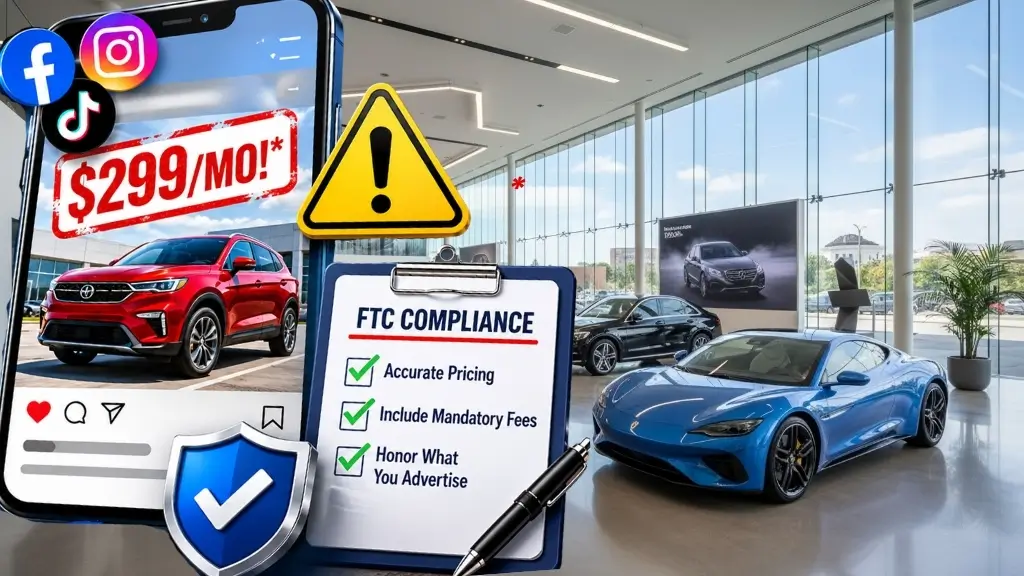
That means a Facebook post, Instagram Reel caption, TikTok overlay, YouTube Short, paid ad, lead-gen landing page, or inventory carousel can simultaneously become an instant compliance problem if it promotes a specific price, payment, discount, incentive, or vehicle availability that the dealership cannot honor.
The FTC’s message is not subtle: if the public sees one price and the showroom produces another, the dealership may have a Section 5 problem under the FTC Act. The current maximum civil penalty listed for key FTC Act penalty provisions is $53,088 per violation.
Why this matters to dealership marketing in 2026
Social media moves fast… yet compliance moves slowly. That communication gap is where potential risk breeds.
A dealership may have compliant pricing inside the DMS, desking tool, website inventory feed, or finance office, but social media teams often work from screenshots, handwritten notes, outdated specials, vendor templates, OEM graphics, or “quick post this one” requests from managers.
That creates several potential pitfalls for your new (and old) social media posts:
- The vehicle gets posted with a payment that assumes the customer has perfect credit.
- A discount is promoted without identifying which rebates a customer must qualify for. (Military discount, First Responder discounts and incentives, etc.)
- A “today only” price remains live for two weeks.
- A sold unit stays on Facebook Marketplace because nobody told marketing it was gone, and it continues to gather leads.
- A social media video says “$0 down” without explaining the credit, lender, term, tax, title, fees, or approval conditions.
- A BDC rep boosts a post that was true yesterday but wrong today…
In the FTC’s view, consumers need the real price to comparison shop. The FTC is focused primarily on ensuring dealers’ prices include the mandatory dealer-imposed fees and remain allowed to exclude government charges, such as tax, title, and registration fees.
The takeaway is simple: social media is no longer a tool to “say anything just to get a customer through the door”. Every price, payment, discount, incentive, and vehicle offer posted online needs to be accurate, transparent, and honored for all it’s advertised to.
A misleading post may generate a lead, but it can also create a compliance risk that costs the dealership far more in FTC penalties than the profit from that vehicle sale. In today’s environment, the goal is not just to get attention, but to advertise in a way that protects both the customer and the dealership.
The top 5 social media danger zones
1. Payment posts without clear qualification language outlined
The most tempting posts are often the riskiest:
- “Lease for $299/month.”
- “Own it for $499/month.”
- “Bad credit? Approved!”
- “$0 down today!”
As we know, a customer’s monthly payment is not just a simple number. It is the output of credit tier, term, APR, down payment, lender approval, taxes, fees, incentives, trade equity, negative equity, residency, military status, loyalty eligibility, and VIN-specific programs.
If the average consumer cannot actually get the advertised payment, the post can become misleading, and worse, cost you millions! (Remember, you only need 19+ violations to exceed over a million dollars in fines).
2. Discount posts that stack incentives, not everyone qualifies for
A post saying “$7,500 OFF” may combine incentives that only apply to different customers, and not everyone. For example, conquest, loyalty, military, college grad, first responder, EV tax credit eligibility, lender bonus cash, and dealer discount may not all be available to one buyer.
If the discount is not broadly available, the post needs guardrails clearly outlined within that post.
3. “Internet Only Pricing” that excludes mandatory dealer fees
The FTC’s warning letters focus heavily on the total advertised price. A dealership can no longer advertise a “lower price online” and then reveal unavoidable charges later, which increases that advertised price. If your ads, website listings, social media posts, and/or third-party inventory feeds currently exclude those required dealer fees or present a lower price than what’s actually offered, they need to be reviewed and corrected immediately.
These are the exact pricing gaps the FTC is warning the industry about.
4. Advertising sold or unavailable inventory
The FTC expressed major scrutiny towards dealerships continuing to advertise vehicles after sale, especially when unavailable units are used to attract shoppers, which can create bait-and-switch risk.
Social teams need a process for removing or updating posts when inventory status changes, and must train their sales teams on how to overcome specific availability issues for customers.
5. Third-party platforms and Vendors not syncing
You may update your dealership website, but the old price may still be floating around on Vendor Platforms, Facebook Marketplace, Instagram, TikTok, Google Business Profile, YouTube descriptions, vendor landing pages, or even old boosted ads.
Compliance is not just the original post. It is the entire digital breadcrumb trail.
What dealers need to do now
1. Build a “Price-posting Permission Process”
Before any vehicle price or payment gets advertised, the social media and sales team needs to ensure they:
- Confirm that the advertised offer is tied to an available VIN or specific vehicle model before publishing or promoting any offers. If you advertise a model-level offer, the post needs to clearly state “pricing may vary by VIN, trim, equipment, incentives, and availability”. Social media posts, marketplace listings, paid ads, and inventory feeds need to be updated once a vehicle is sold, reserved, or no longer available.
- Check that the advertised price includes all mandatory dealer fees. This means all required government charges, such as tax, title, registration, and licensing fees, may continue to be excluded, but unavoidable dealer fees can not be added later in the buying process. (This includes: Dealer documentation fees, Processing fees, Dealer prep fees, Reconditioning fees, and more).
- Ensure that the advertised price is based on real, documented deal terms. Any posted price, payment, discount, or incentive should be supported by an actual deal structure that the dealership can verify, reproduce, and honor if a qualified customer responds to the ad.
- Verify every incentive included in the advertised price is actually available to the audience seeing the ad. Conditional incentives, such as military, first responder, college graduate, loyalty, conquest, or other customer-specific offers, should not be built into the advertised price unless the ad clearly explains who qualifies for them.
- Include a clear expiration date on every advertised offer. Without an expiration date, an old post may continue to create consumer expectations long after the promotion was intended to end. For example, if a customer finds a January offer in February and no expiration date was listed, the dealership may face pressure or risk around honoring the previously advertised price.
- Confirm all disclosures and qualifications are clear, readable, and easy for consumers to find. Important terms should not be hidden in tiny print, buried at the bottom of a caption, or placed where the average shopper is unlikely to notice or understand them.
- Require approval from the sales manager, compliance lead, or another authorized designee before publishing. Every advertised price, payment, incentive, or offer should have a clear approval trail showing that the dealership reviewed and verified the information before it went live.
- Conduct a monthly review of all active and recent vehicle posts. Dealership teams should regularly audit social media posts, marketplace listings, paid ads, and inventory promotions to confirm that vehicles are still available, offers are still valid, and sold or unavailable units are removed or updated promptly.
Compliance does not have to slow your team down when the right process is in place. A simple checklist can keep your social media process fast, accurate, and protected from expensive errors!
2. Create approved social media posts and caption templates
Dealers can reduce risk by replacing improvised disclaimer language with approved templates. Every employee posting vehicle offers should work from the same compliant language, so pricing terms, payment assumptions, incentive qualifications, and expiration dates are communicated consistently across every platform.
Build pre-approved templates for your Sales and Social Media Teams:
- Cash price posts
- Finance payment posts
- Lease payment posts
- Rebate/incentive posts
- Used vehicle specials
- Certified pre-owned specials
- Trade-in campaigns
- Credit-challenged campaigns
- Marketplace listings
- Short-form video overlays
Each template should include room for VIN, stock number, MSRP, selling price, mandatory fees (minus government charges), payment assumptions, lender approval language, expiration date, and confirmed availability.
Warning: a simple disclosure in the caption may not be enough to protect a misleading video. If your online Video advertises “$299/month” in large on-screen text, but the qualifying terms are buried several lines down in the caption… the consumer-facing message may still be incomplete or misleading.
For social media videos in 2026, key conditions need to appear clearly on-screen and remain visible long enough for the average viewer to read and understand them. “It was in the caption” is not a strong defense if the main message of the video leaves out important pricing, payment, or qualification details.
3. Consistently audit (old and new) social media posts
You need to regularly review active and recent posts published by both your dealership sales team and social media team. During this review, you need to look for:
- Vehicles that are sold
- Expired offers or incentives
- Payments without assumptions or clear qualifications outlined
- Prices that do not match the website or showroom
- Rebate stacks that are not universally available for everyone its advertised to
- “Call for price” workarounds paired with misleading savings claims.
- Mandatory fees are missing from the advertised price.
A dealer may be able to say “Call for Price” if no price, payment, discount, or savings claim is being advertised. But it becomes a problem if the ad still implies a specific deal without giving the real total price. For example:
Risky Language:
- Call for price! Huge discount available!
- Call for price! $5,000 off MSRP!
- Call for price! Only $399/month!
- Call for price! Lowest price in the state!
Those are still price-quoting claims.
Safer Language:
- Call for current availability and pricing!
- Pricing may vary based on current incentives, vehicle availability, and customer qualifications.
- Contact the dealership for today’s current price!
Bottom line: Dealership social media new rulebook of 2026
In 2026, “close enough” is no longer safe for dealer social media. One inaccurate post can turn “close enough” into costly. The newly released FTC’s warning letters make it clear that advertising price is no longer just “casual content”.
It is an official offer and commitment to a customer.
Once it is published, it can be saved, shared, screenshotted, reviewed, and enforced if the dealership does not have the proper language, disclosures, and qualifying terms clearly included in the post.
The dealerships that succeed will not be the ones who “stop marketing”. They will be the ones who build smarter marketing workflows where speed, creativity, and compliance work together.
In today’s environment, the strongest social media teams will be the ones that can adapt to these new rules, put the right processes in place to maintain compliance, and follow those processes consistently. The goal is not to stop creating engaging content. The goal is to keep creating content that performs while making sure every post is accurate, transparent, and protected by a repeatable compliance workflow!