TSLA441.3420.9816%
GM84.9300.81%
F16.5500.67%
RIVN15.0410.3407%
CYD58.350-1.36%
HMC27.3050.425%
TM192.3902.28%
CVNA73.7700.77%
PAG170.4501.44%
LAD296.7304.1%
AN195.5500.61%
GPI331.070-0.63%
ABG194.9000.94%
SAH84.6551.075%
TSLA441.3420.9816%
GM84.9300.81%
F16.5500.67%
RIVN15.0410.3407%
CYD58.350-1.36%
HMC27.3050.425%
TM192.3902.28%
CVNA73.7700.77%
PAG170.4501.44%
LAD296.7304.1%
AN195.5500.61%
GPI331.070-0.63%
ABG194.9000.94%
SAH84.6551.075%
TSLA441.3420.9816%
GM84.9300.81%
F16.5500.67%
RIVN15.0410.3407%
CYD58.350-1.36%
HMC27.3050.425%
TM192.3902.28%
CVNA73.7700.77%
PAG170.4501.44%
LAD296.7304.1%
AN195.5500.61%
GPI331.070-0.63%
ABG194.9000.94%
SAH84.6551.075%

EV market finds footing after steep post-incentive decline

U.S. EV demand cools after tax credit expiration, but quarterly trends suggest the market may be finding a floor.

EV market finds footing after steep post-incentive decline

On the Dash:

  • EV demand is stabilizing, not rebounding, with sales likely to remain flat in the near term
  • Incentive-driven volatility highlights the importance of pricing strategy and inventory discipline
  • Long-term EV growth will depend on affordability, infrastructure, and consumer confidence, not policy support

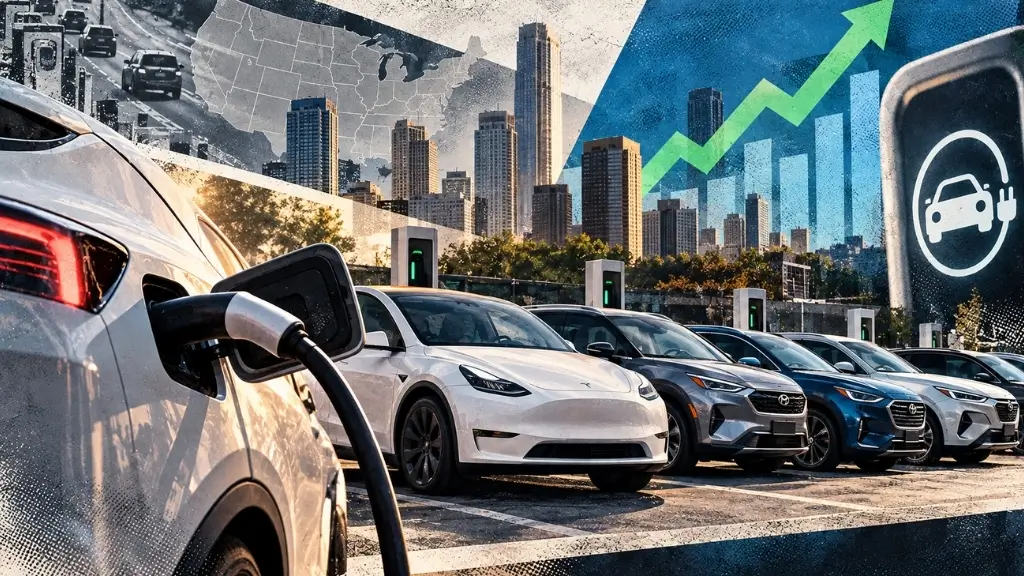
U.S. electric vehicle sales fell sharply in the first quarter of 2026 but may be stabilizing after a steep decline triggered by the end of federal incentives.

Americans purchased 216,399 EVs in Q1, down 27% year over year, according to Kelley Blue Book. The drop follows the expiration of a $7,500 federal tax credit that had previously accelerated demand.

Sign up for CBT News’ daily newsletter and get the latest industry stories delivered straight to your inbox.

Despite the annual decline, the pace of the slowdown appears to be easing. EV sales were down just 7.8% compared to the fourth quarter of 2025, suggesting the market may be leveling off after a post-incentive correction.

EV market share held steady at 5.8% of total new vehicle sales, unchanged from the prior quarter. That marks a significant pullback from a peak of 10.6% in Q3 2025, when buyers rushed to take advantage of the expiring tax credit.

Industry analysts describe the current environment as a transition period. Without government incentives, EV adoption is increasingly driven by pricing, product availability, and charging infrastructure rather than policy support.

Globally, EV adoption continues to accelerate, with roughly one in four vehicles sold worldwide now electric. This divergence places automakers in a challenging position as they balance slower U.S. demand with faster-growing international markets.

Automakers are responding differently. Some are scaling back U.S. EV investments, while others are maintaining or expanding electrified lineups in anticipation of longer-term growth.
More from EVs & Technology
North Carolina sues VinFast over delayed EV plant project

North Carolina sues VinFast over delayed EV plant project

- May 28, 2026
On the Dash: North Carolina’s lawsuit highlights the growing financial and political scrutiny of large-scale EV investments and incentive packages. Automakers continue reassessing EV spending as weaker demand and changing...
Ferrari launches Luce, a $640,000 five-seat EV

Ferrari launches Luce, its first-ever EV

- May 26, 2026
On the Dash: Ferrari enters the EV market with a $640,000 five-seat performance sedan due in Q4 2026. The launch contrasts with Porsche and Lamborghini, which have both scaled back...
Waymo halts Atlanta robotaxi service after vehicle drives into flooded road

Waymo halts Atlanta robotaxi service after vehicle drives into flooded road

- May 22, 2026
On the Dash: Waymo paused Atlanta robotaxi service after a driverless vehicle drove into floodwaters Wednesday. The suspension marks the second city impacted, following a similar incident in San...
SK On restructures U.S. battery footprint as EV demand weakens

SK On restructures U.S. battery footprint as EV demand weakens

- May 21, 2026
On the Dash: EV supply chain restructuring signals continued volatility in production timing and long-term battery availability. Automaker-supplier realignments could shift cost structures and sourcing strategies across EV programs. Slowing...