Dealerships moving from service into vehicle sales must manage title, licensing, tax, and credit compliance, which are requirements repair shops don’t face. Owners making this shift are also weighing software costs, and some are turning to AI tools to replace paid platforms and make customer visits more personal.
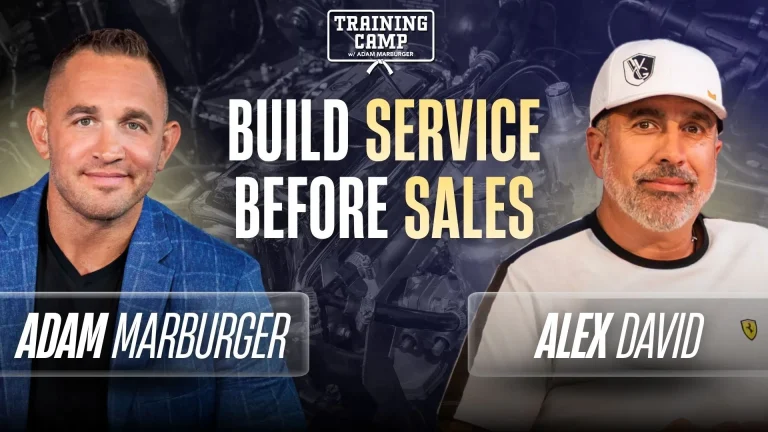
On this episode of Training Camp, host Adam Marburger sits down with Alex David, Founder and CEO of White Glove Automotive & Service, to discuss his move from wholesale to a 41,000-square-foot facility near St. Louis and how other dealers can improve operations with new technology.
From wholesale volume to a 41,000-square-foot facility
David has spent his whole career in the car business, starting as a porter at 16 and joining the Auffenberg Dealer Group at the end of 1999. After he lost his job in late 2008, a mentor told him to get a dealer license and go wholesale, and he eventually moved 500 to 600 cars a month. That volume taught him how to recondition and repair just about any problem, from titles to odd electrical issues.
Wholesale margins fell apart after COVID, and he said he was losing money on every car he bought. He took that experience and opened White Glove in 2022 in a 7,000-square-foot, five-bay shop. In 2025, the business moved into its current 41,000-square-foot building, which has 21 service bays, a full detail department, and a fabrication shop, with a body shop going in now.
"I learned from my car mentors that service and parts are supposed to support the store, and then sales can be the gravy."
David notes that the sales came last on purpose. His mentors taught him that service and parts should support the store, with sales as the gravy, so he built service first to cover the bills and payroll for the 29 full-time employees. White Glove ran its first sales marketing this March, and the facility can have a twin-turbo Lamborghini and a Ford Ranger getting an oil change under the same roof.
Preventive fleet service & a single point of contact
Fleet management is a big part of the business, and White Glove works to prevent breakdowns before they happen. That costs more up front, but David said it’s cheaper over the long term because vehicles stay on the road and sales teams don’t miss meetings over flat tires. As a self-described tech nerd, he tracks each vehicle’s mileage and how often it comes in. “We’re not a reactive service department,” David said.
The shop also handles small things that keep customers coming back. He holds about 250 spare keys for customers who lose theirs, along with garage codes to hundreds of customers’ cars, houses and gates. Some accounts run on a schedule, like picking up seven cars every March for annual service, and the shop does polishing, ceramic coating and detail work too. It takes every warranty company, even the ones that don’t pay.
Customers deal with the same person for every visit, whether they’re buying, selling or consigning a Ferrari or coming in for a Ford Fiesta oil change. David said he wants customers treated differently than they expect to be when they walk into an automotive facility.
AI-built software, compliance and a CFO hire
David knows the cost of software firsthand, since a software-as-a-service product he developed with investors closed after the money and time piled up. Now he can build from his phone, and he believes software as a service is on its last legs. He acknowledged he might be wrong, but he expects to cancel every software subscription within 12 months and run his own CRM, DMS, inventory management and appraisal tools in one app.
White Glove is also bringing AI cameras online with plate recognition, plus facial recognition that isn’t fully ready yet. The goal is for staff phones to show who has arrived and which cars they drive, so someone can greet a returning customer by name and ask if they want the same coffee as last time.
Over the next 60 days, he’s stepping back from running the store and hiring a CFO or controller-type to run the operation, accounting and back end. Adding car sales brings regulation, tax codes, titles, licensing and credit compliance that go well beyond servicing cars, and he wants someone else’s hands on that work.
Looking ahead, David said he hopes White Glove reaches 10 locations in five years and that he’s looking at real estate, with hopes of buying something next year. For dealers adding sales to a service-driven operation, he said the added compliance work is the reason he’s putting finance leadership in place as the sales side grows.