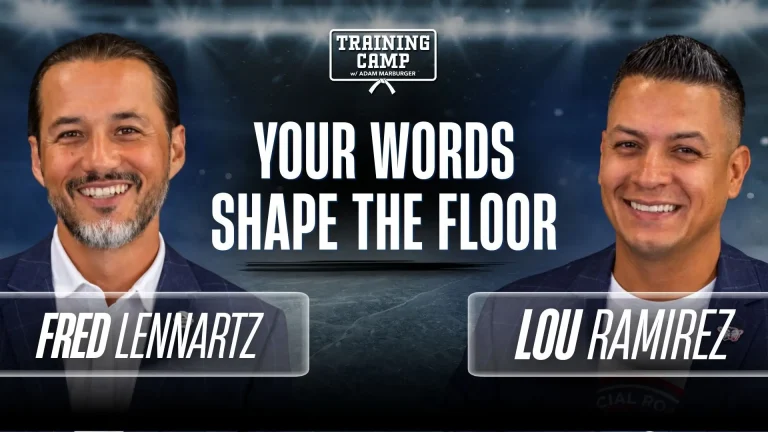
Maintaining sustained momentum in a dealership requires more than closing techniques, it demands operational accountability, clear internal communication, and modern digital visibility. On the latest Training Camp episode, host Adam Marburger sat down with Lou Ramirez and Fred Lennartz, Co-Founders of Car Guy Coffee and CGC Media, to discuss practical operational strategies dealers can implement immediately.
Dealership culture is directly shaped by the language staff members use daily. Negative habit loops, such as complaining about market conditions, dismissing customer credit profiles, or venting at the sales desk, quickly degrade the entire floor’s performance.
According to Ramirez, dealers must establish clear self-awareness by evaluating how managers speak to staff and how salespeople talk about prospective buyers. Shifting internal dialogue toward accountability and structured solutions sets an intentional baseline that aligns marketing promises with actual customer experiences.
Addressing personal branding, Lennartz pointed out that many sales professionals still hesitate to post video content online out of fear of low vanity metrics like likes and shares. However, Lennartz emphasized that digital branding isn’t designed for viral reach, but to connect with the one person who needs help that day and spark one-on-one conversations that convert into vehicle deliveries.
"Any culture is developed around a language. and the understanding of how we speak to each other and how we speak of our customer, how we speak of our industry, what we believe and what we say is ultimately what we see and what we experience." – Lou Ramirez
To accelerate sales growth:
- Set clear standards: Dealerships should treat digital branding and video proficiency as conditions of employment rather than optional hobbies.
- Provide daily accountability: Sales managers must coach and track digital outreach alongside traditional phone and showroom activities.
- Emphasize belief: Salespeople who genuinely believe in their product, their dealership, and their service must be encouraged to market that value daily.
Lennartz also highlighted the generational gap on the sales floor, noting that tenured salespeople who have spent decades building repeat books of business often succeed without modern digital tools. However, younger associates cannot afford to wait 20 to 30 years to build a client base through traditional floor traffic alone. Leveraging social media lets newer sales associates condense that timeline and quickly build an independent business within the dealership framework.
Dealerships are constantly targeted by new software, artificial intelligence tools, and operational platforms. However, many technology providers struggle to communicate their value within real-world retail workflows.
"I keep joking and I keep saying these three letters and it's a VDC. And it's a vendor development company... we want to be the advisors, the trainers, showing them how to speak to dealers, how to actually approach somebody." - Fred Lennartz
To solve this, Lennartz proposed the concept of a Vendor Development Company (VDC) and pointed to peer groups like the Vendor 20 (V20) Group, which help technology partners learn dealership dynamics and speak the language of dealers. Ramirez added that media production and focused communication ensure stores adopt tools that solve real operational pain points rather than adding unnecessary friction to daily operations.