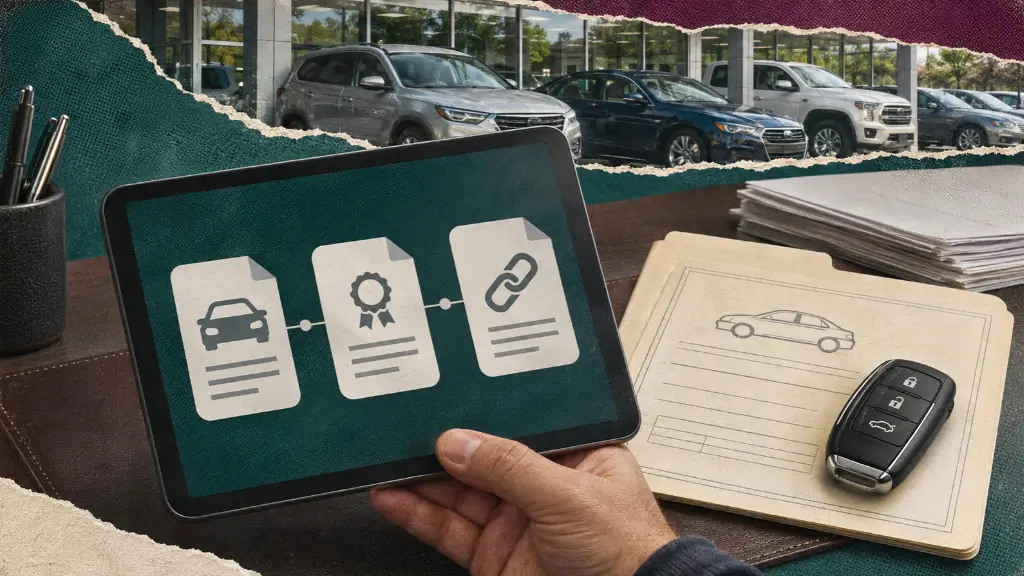
Artificial intelligence is rapidly transforming automotive retail. From inventory management and pricing optimization to customer engagement and transaction processing, dealerships are investing in technologies designed to improve efficiency, reduce costs, and accelerate operations.
Yet a divide is emerging. While some dealerships are successfully integrating AI into their operations, others are discovering that even the most advanced technology cannot overcome longstanding operational challenges.
The difference often comes down to one critical factor: the infrastructure supporting automation.
As dealerships embrace AI, the conversation must shift beyond adopting new tools to ensuring the underlying systems can deliver reliable, measurable results.
The hidden barriers to automation
Despite significant investments in digital transformation, many dealership operations still depend on fragmented systems, manual verification, and disconnected workflows.
These limitations become particularly apparent in vehicle titling and ownership verification, where delayed information, inconsistent processes, and varying state requirements can create uncertainty throughout the transaction lifecycle.
For AI-driven systems, uncertainty presents a fundamental challenge.
Automation depends on accurate, structured, and authoritative data. When ownership or lien status cannot be verified confidently, even sophisticated technology cannot reliably advance a transaction.
Instead, employees must intervene to resolve discrepancies; inventory may remain idle, and operational efficiencies are lost.
Digitizing a process does not automatically make the information behind it reliable enough to automate.
For dealerships seeking meaningful returns on AI investments, addressing these foundational challenges is essential.
Why state-verified data changes the equation
As dealerships expand their digital capabilities, the distinction between digitized information and authoritative data becomes increasingly important.
Commercial platforms may simplify paperwork and information exchange, but digitization alone does not guarantee that ownership and lien information has been verified against official state records.
When AI operates on incomplete or unverified information, dealerships risk accelerating errors rather than eliminating them.
State-backed digital titling infrastructure offers a more reliable foundation.
Through the National Digital Titling Clearinghouse (NDTC), powered by CHAMP, participating state motor vehicle agencies, dealerships, and lenders can connect through infrastructure designed around authoritative title information.
By supporting access to state-verified ownership and lien data, this approach enables more dependable automation while reducing reliance on fragmented documentation and manual reconciliation.
For AI systems, that level of certainty is critical.
Scaling efficiency without increasing risk
The importance of reliable infrastructure becomes even greater when dealerships operate across state lines.
Different titling requirements, processing timelines, and compliance standards create operational complexities that traditional systems often struggle to manage.
Layering AI onto these fragmented processes can introduce additional risk. Transactions may advance based on incomplete information, allowing title defects, unresolved liens, or compliance issues to surface later.
At scale, these inefficiencies can translate into financial exposure, delayed inventory turnover, and increased administrative costs.
Modern, state-connected infrastructure allows dealerships to take a more proactive approach.
By combining authoritative title verification with AI-driven validation, dealerships can identify potential discrepancies earlier, reduce manual intervention, and prevent issues from disrupting downstream transactions.
The objective is not simply faster automation. It is more reliable automation that reduces risk while improving operational performance.
What it really means to be AI-ready
As AI becomes more accessible, adopting new technology alone will no longer differentiate dealerships.
The competitive advantage will belong to organizations that establish the operational foundation necessary to use it effectively.
AI-ready dealerships prioritize connected systems, verified information, and workflows designed to support automation at scale.
AI-risky dealerships, meanwhile, may continue layering sophisticated tools onto fragmented processes, potentially magnifying the very inefficiencies they are attempting to eliminate.
The future of automotive retail will not be determined solely by who adopts AI first, but by who builds the infrastructure necessary to make it work.
Because successful automation begins long before the technology is deployed.
Continue the conversation at Used Car Week 2026
Join Bryan Calloway, Executive Vice President of Commercial Partnerships at the National Digital Titling Clearinghouse (NDTC)/CHAMP, at Used Car Week 2026 in San Diego on Monday, November 16, for his session, “AI-Ready or AI-Risky? Why Automation Fails in Some Dealerships—and Thrives in Others.”
Calloway will explore how fragmented title and ownership workflows impact automation, why state-verified data is essential, and how dealerships can identify infrastructure gaps, reduce risk, and prepare for the next generation of AI-driven automotive retail.