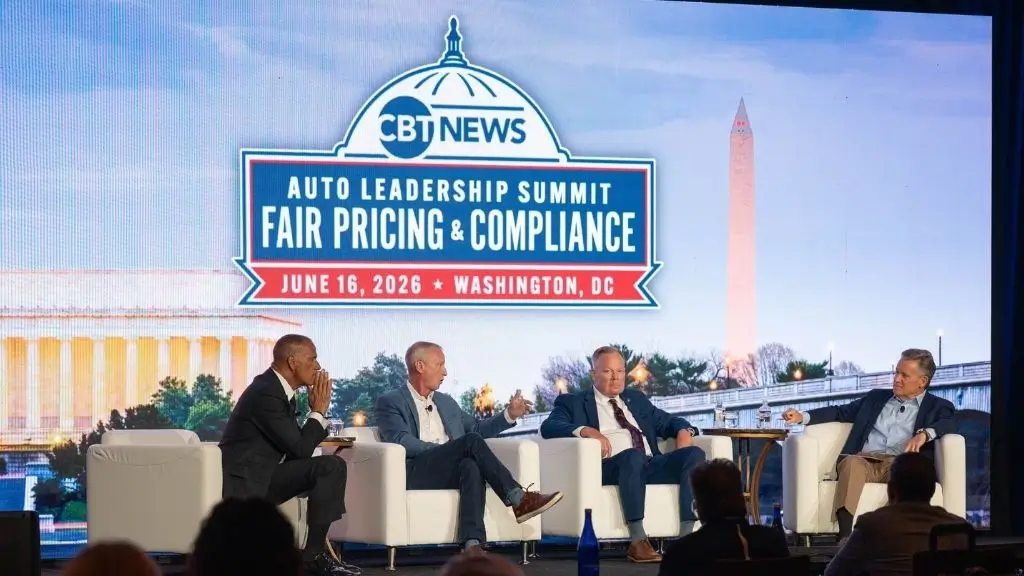
“In the end, it’s the dealer who pays the price.”
That’s what Sam Weaver, VP and Partner at Chevy Chase Auto, made clear during “The Dealer’s Perspective” panel at the CBT News Auto Leadership Summit: Fair Pricing and Compliance event, and it set the tone for everything that followed.
During the summit at the Salammander Hotel in Washington, D.C., Jim Fitzpatrick sat down with Weaver, Kevin Frye, eCommerce Director at Jeff Wyler Automotive Family, and Brian Benstock, Partner GM/VP at Paragon Honda, to work through one of the most pressing questions facing dealers right now: how do you run a compliant store without killing the deal?
The answer, according to the panel, starts long before the Federal Trade Commission (FTC) comes knocking.
The compliance officer problem
According to Benstock, “It’s time to review everything.” He believes that every dealership needs a dedicated compliance officer, and for his group, that hire was not optional.
Following a half-million-dollar acquisition in January that added 14 new brands and more than 50 franchises, Benstock’s team faced over 1,300 pages of OEM compliance requirements that change monthly. A part-time solution or a once-a-month compliance vendor was not going to cut it, he said.
"Compliance in this highly regulated modern market is a necessity." – Brian Benstock
He added that vetting the right person for the role is a challenge in itself. The different moving parts across service, parts, finance, and advertising require someone who understands the full dealership operation, not just the regulatory paperwork.
However, Fitzpatrick noted that a show-of-hands survey of the room confirmed what most dealers already suspect: compliance officers remain rare, and dealers are leaning on outside vendors who, by their own admission, do not review advertising and pricing daily.
‘Set it and forget it’
During the discussion, Weaver also emphasized that “Part of the challenge we face is we have an industry that loves the set-it-and-forget-it solution, and those days are gone.”
"This is a constantly changing issue, and dealers are going to have to be on top of what's happening in their store." – Sam Weaver
Weaver points to turnover as one of the most underappreciated compliance risks. He illustrated that when a new hire comes in from another store, they bring the culture of that store with them. If that culture was not compliant, onboarding a person without reorienting them creates immediate exposure to risks.
Therefore, the goal, Weaver said, is a compliant culture, not a compliant checklist. The distinction matters because a checklist gets completed once, whereas a culture governs every conversation at the desk, every ad that goes live, and every number that gets quoted over the phone.
The platform problem
All three panelists landed on the same point when the conversation turned to third-party aggregators: the platforms are not bystanders.
Frye put it directly. When a dealer advertises a $25,000 vehicle after a $5,000 down payment on a $30,000 car, the platform rewards that listing with a higher rank. Everyone in the room knows the math does not add up. The platform knows too. And yet that listing gets preferential placement.
“The platform should have some responsibility for that,” Weaver said.
Frye framed it as a partnership ask, where if everyone is going to do this, then do it the same way across the board. He notes that platforms represent one of the clearest opportunities for the FTC to drive broad compliance quickly, particularly in the pre-owned space where doc fee manipulation is most visible.
Benstock stated that the FTC’s position has been consistent: if the dealer can control it, the dealer owns the liability, not the marketing agency or the third-party platform. Therefore, getting that in writing with vendors, he argues, is no longer optional.
Compliance vs. profitability
The fear that transparency kills profit came up directly, and Benstock addressed it with 20 years of evidence.
His store has operated as a one-price dealership for used and certified pre-owned vehicles for two decades. As a result, they have led certified pre-owned sales in their market for that same stretch. The data, he said, does not support the idea that compliance and profitability are at odds.
Instead, Frye reframed the argument, citing that transparency equals convenience, and convenience is what consumers want. The number one complaint in automotive retail for decades has been that buying a car takes too long. A dealer who removes the friction and the guesswork wins on experience, and experience builds the kind of trust that brings customers back.
Weaver pointed to Carvana and CarMax as the case study the industry keeps ignoring. While consumers do not go to those retailers because the cars are better, they go because the process is easier. The industry created those disruptors by giving consumers a reason to look elsewhere. Fixing that starts with removing the variability, not just from store to store, but from desk to desk.
Compensation and culture
Moreover, the conversation circled back to a topic that was more uncomfortable, which included the incentive structures that quietly reward the behavior that compliance is trying to eliminate.
Fitzpatrick was direct when spotlighting the last-week-of-the-month call from ownership to hit the number, which is where the wheels come off. Managers who do not want to lose their job quote one number on the phone and another in the finance office. Spot deliveries go out the door to customers who cannot qualify, and the system rewards the short-term result.
Weaver put the long-term math on the table, indicating that selling four cars to the same customer over 20 years at $2,000 gross each matches a single $8,000 deal, and it comes with service revenue, trade-ins, and referrals that no incentive plan currently accounts for. Honda’s lease retention data backs the logic, showing that a customer who leases a second vehicle has a 70% chance of returning at the end of that term.
The compensation plan, all three agreed, should reflect that math. Benstock reiterated, “Compliance should not be something you reward. It should be the expectation.”
Closing remarks
Benstock closed with a note of measured optimism, noting that the industry has become more transparent over time and that every push in that direction has been a win for consumers and dealers alike.
Weaver issued a straightforward challenge to the room, declaring that the stores that will be around long-term are the ones that embrace the change. Operating like it is 1979, he said, is not a strategy.
Frye offered the final word on where the dealer’s obligation actually sits. The agencies are not the ones running fraudulent ads. Dealers know the difference between an honest ad and a dishonest one.
"We can't blame the platform...It's incumbent on us to do it." Kevin Frye