TSLA428.35016.56%
GM78.8000.39%
F12.3250.145%
RIVN14.2200.045%
CYD46.2402.51%
HMC24.5100.45%
TM187.530-1.47%
CVNA77.940-2.064%
PAG173.8102.2%
LAD293.9902.89%
AN205.9700.68%
GPI357.8307.67%
ABG200.390-0.06%
SAH81.2001.07%
TSLA428.35016.56%
GM78.8000.39%
F12.3250.145%
RIVN14.2200.045%
CYD46.2402.51%
HMC24.5100.45%
TM187.530-1.47%
CVNA77.940-2.064%
PAG173.8102.2%
LAD293.9902.89%
AN205.9700.68%
GPI357.8307.67%
ABG200.390-0.06%
SAH81.2001.07%
TSLA428.35016.56%
GM78.8000.39%
F12.3250.145%
RIVN14.2200.045%
CYD46.2402.51%
HMC24.5100.45%
TM187.530-1.47%
CVNA77.940-2.064%
PAG173.8102.2%
LAD293.9902.89%
AN205.9700.68%
GPI357.8307.67%
ABG200.390-0.06%
SAH81.2001.07%

Japan’s UBE to build first U.S. factory for crucial EV battery materials

Japan's UBE Corporation will invest $500 million to build the first U.S. EMC and DMC plant, two chemicals used in electric vehicle batteries
UBE expects the EV battery supply chain facility to open in the latter half of 2026 but will begin construction later this year.

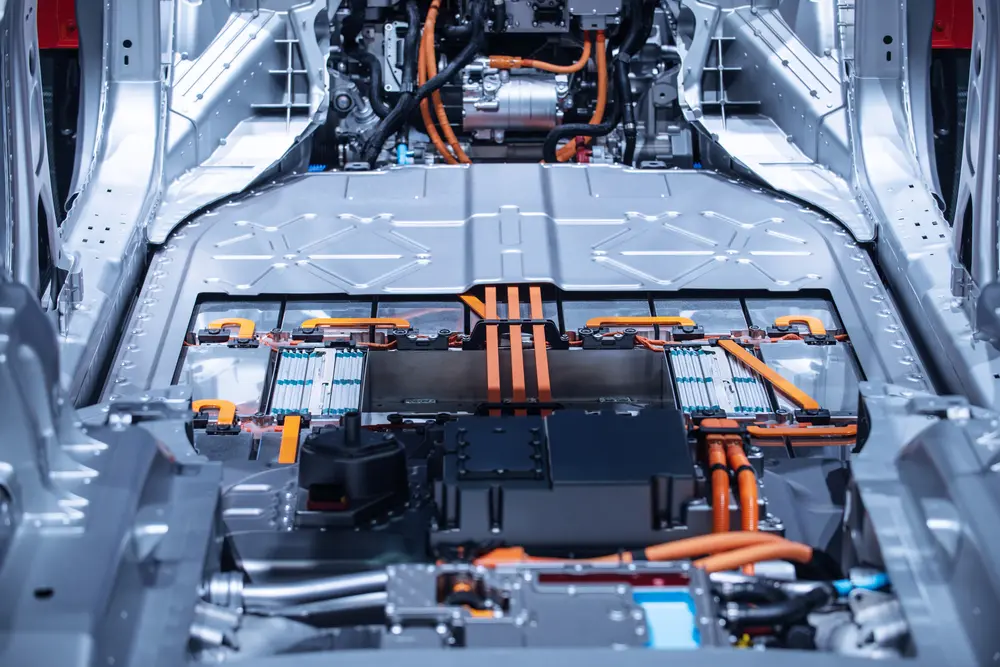
The first facility in the U.S. for producing dimethyl carbonate (DMC) and ethyl methyl carbonate (EMC), two materials essential to electric vehicle (EV) battery manufacturing, will be built by a Japanese firm.

Japan’s UBE Corporation has announced plans to invest $500 million toward founding a DMC and EMC plant at Cornerstone Energy Park in Jefferson Parish, Louisiana. The factory will be capable of producing 100,000 metric tons of DMC and 40,000 metric tons of EMC annually (EMC can be produced through DMC processing). Both chemicals are used in a lithium-ion EV battery.

UBE will launch a new company, UBE C1 Chemicals America (UCCA), to oversee the facility, which will also partner with Louisiana-based Cornerstone Chemical Company. The project will produce around 356 jobs, 300 of which will be construction-related, with the remainder split between UCCA and Cornerstone Chemical Company.

The founding of a U.S.-based firm to direct EMC and DMC manufacturing will help battery-powered car models constructed using the plant’s products to earn electric vehicle tax credits, which require a percentage of domestically sourced components and materials.

Due to a recent tightening of this domestic sourcing mandate, few models now qualify for government incentives, leading to a surge in U.S. construction projects similar to UBE’s that seek to create a native EV battery supply chain.

The policy is intended to wean the U.S. automotive industry off of Chinese suppliers due to a variety of economic, political, and moral concerns. UBE president and representative director Masato Izumihara also claimed in a statement that the company’s DMC and EMC manufacturing method has a “limited environmental impact” that results in “much fewer by-products compared to other existing plants and processes, particularly in mainland China.”

UBE expects to open the facility in the latter half of 2026 but will begin construction later this year.

Read More
More from Articles
NADA urges Congress to reject REPAIR Act as bill advances to House committee

NADA urges Congress to reject REPAIR Act as bill advances to House committee

- May 8, 2026
On the Dash: NADA is urging Congress to vote against the REPAIR Act, calling the legislation unnecessary and a data privacy threat. The REPAIR Act advanced out of subcommittee in...
Toyota Indiana A real-life field of dreams

Toyota Indiana: A real-life field of dreams

- May 8, 2026
PRINCETON, Ind. (May 7, 2026) — Thirty years ago, Toyota took a bold leap of faith. The automaker chose Princeton, Indiana—a small town known for popcorn and basketball—as the site for...
Fette Auto Group acquires Leo Kaytes Ford in Warwick, New York

Fette Auto Group acquires Leo Kaytes Ford in Warwick, New York

- May 8, 2026
John Fette, owner of New Jersey-based Fette Auto Group, has acquired Leo Kaytes Ford in Warwick, New York, from Leo Kaytes Jr. The transaction closed on April 22, 2026, and...
Auto trade groups urge USMCA extension as tariff pressures reshape industry

Auto trade groups urge USMCA extension as tariff pressures reshape industry

- May 8, 2026
On the Dash: Dealers depend on USMCA stability to maintain predictable vehicle pricing and supply across North America. Any fragmentation of the trade agreement could raise costs and complicate sourcing...
CBT News
Privacy Overview

This website uses cookies so that we can provide you with the best user experience possible. Cookie information is stored in your browser and performs functions such as recognising you when you return to our website and helping our team to understand which sections of the website you find most interesting and useful.