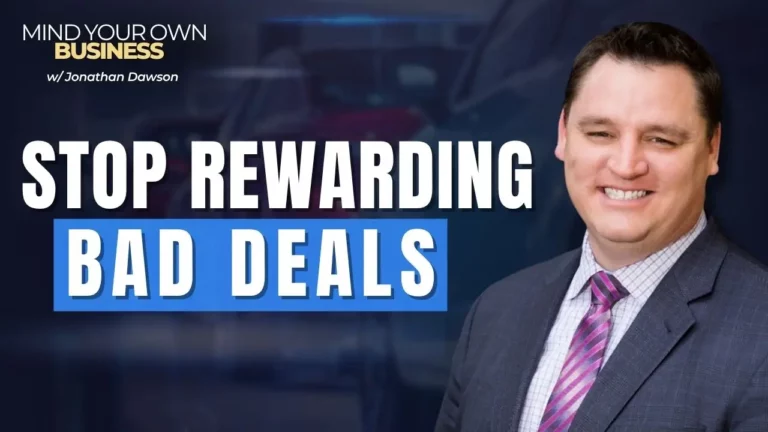
When consultant Jonathan Dawson bought Cherokee Mitsubishi, he took on all the classic headaches of dealership ownership, along with a brand that, while growing, requires a sharp operational strategy to navigate. Now, marking his first full year in the operator’s seat, Dawson shares on today’s Mind Your Own Business episode how unconventional incentive structures are transforming his store’s bottom line.
Following a recent feature in Automotive News, Dawson unpacks a policy that turned heads across the retail automotive industry, which centers on paying salespeople a guaranteed base commission, or “mini,” for walking away from fishy deals.
Paying staff to kill bad business
In most showroom environments, commission-only or volume-heavy compensation models inadvertently encourage salespeople to push deals across the finish line at all costs, even when something feels off. Dawson’s approach flips that dynamic on its head.
At Cherokee Mitsubishi, sales reps are expected to complete their standard needs analysis, vehicle selection, and walkaround. However, if red flags appear around potential fraud, straw purchases, or lender non-compliance, Dawson says that the rep is instructed to alert management before presenting numbers.
"You never wanna create a scenario where it is to someone's financial benefit to put your company at risk."
If a deeper investigation confirms questionable activity and management squashes the deal, the salesperson fills out a brief report and receives their guaranteed commission anyway.
Overcoming the “follow-up myth”
Beyond fraud prevention, Dawson argues that traditional dealership compensation fails to incentivize the very habits managers complain about most, namely, post-sale follow-up and customer retention.
Rather than scolding staff for failing to call back past buyers, Cherokee Mitsubishi bakes the reward directly into the pay plan. According to Dawson, salespeople receive a distinct financial bump whenever they sell another vehicle to a repeat customer or another driver within the same household.
Dawson calls this strategy “owning the driveway.” The goal isn’t just to sell a single unit, but to ensure every license plate frame parked at a customer’s home comes from his store. By aligning the pay plan with repeat business, follow-up stops being an afterthought and becomes a primary driver of agent income.
Relational vs. transactional buyers
Central to Dawson’s operational philosophy is the distinction between two types of consumers:
- Transactional Buyers: Driven purely by price, payment, or specific inventory promotions. They quickly jump to a competitor for a better discount.
- Relational Buyers: Motivated by reputation, trust, and personal rapport. They are more collaborative, flexible, and yield significantly higher profit margins.
By focusing compensation on cultivating relational buyers rather than constantly acquiring strangers, Cherokee Mitsubishi slashed its customer acquisition costs to astonishing levels. In August 2026, the dealership’s total advertising spend per car sold dropped to just $35 and actually went net-negative after accounting for factory ad credits.
While Dawson cautions dealers against abandoning marketing altogether, he emphasizes a stark contrast in resource allocation: he is willing to spend $50 to attract a stranger, but up to $500 to retain a loyal customer.