

On the Dash:
- Ford has canceled the successor to the F-150 Lightning, known as the T3 truck, and has shelved its plans for electric vans, shifting its focus to a gas-hybrid strategy.
- The total writedown amounts to $19.5 billion, which includes $8.5 billion for canceled electric vehicles, $6 billion from the split of a joint venture with SK On, and $5 billion in program costs.
- Ford plans to introduce an affordable EV lineup, starting with a midsize EV priced around $30,000, set to launch in 2027.
Ford Motor announced Monday it will take a $19.5 billion writedown and cancel several electric-vehicle models, signaling a major retreat from battery-powered vehicles amid weakening demand and the Trump administration’s policy changes.
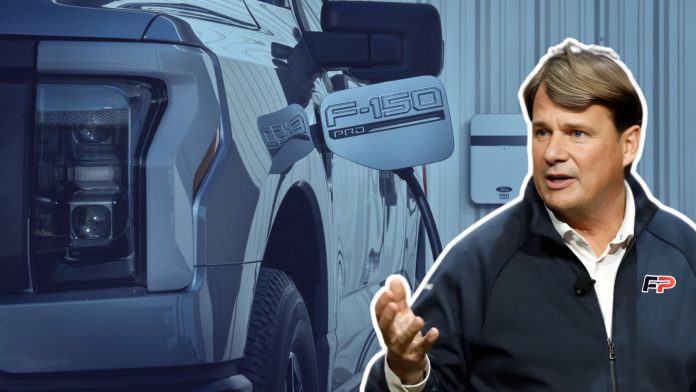
The fully electric F-150 Lightning will be replaced with a new extended-range EV that uses a gas engine to recharge the battery. CEO Jim Farley said the pivot to gas and hybrid vehicles aims to boost volume while maintaining some profitability, though layoffs are expected at a Kentucky battery plant.
CEO Jim Farley said the decision responds to market shifts over the past few months. The company plans to pivot toward gas and hybrid vehicles, while some layoffs are expected at a jointly owned Kentucky battery plant. Ford aims to raise the global share of hybrids, extended-range EVs, and pure EVs to 50% by 2030, up from 17% today.
The $19.5 billion writedown will be spread primarily through the fourth quarter and into 2027, broken down as: $8.5 billion for canceled EV models, $6 billion for dissolving the battery joint venture with South Korea’s SK On, and $5 billion in program-related expenses.
Ford also raised its 2025 guidance for adjusted EBIT to about $7 billion, up from a previous range of $6–6.5 billion, and shares rose about 1% in after-hours trading.
Moreover, the U.S. EV market saw a 40% sales decline in November after the expiration of the $7,500 tax credit, affecting models such as the F-150 Lightning, which sold 25,583 units through November, down 10% year over year.
Nonetheless, Ford is shifting focus to more affordable EVs, starting with a $30,000 midsize truck in 2027, produced at the Louisville plant, with batteries from plants in Marshall, Michigan, and Kentucky.
Other automakers are also retreating, including GM, which took a $1.6 billion EV charge in October, and Stellantis, which canceled an electric Ram pickup and is focusing on hybrids.