Welcome back to the latest episode of The Future of Automotive on CBT News, where we put recent automotive and mobility news into the context of the broader themes impacting the industry.
I’m Steve Greenfield from Automotive Ventures, and I’m glad that you could join us.
A new automotive startup is making a rather unconventional bet: that American consumers have become so frustrated with rising vehicle prices they’ll be willing to give up many of the features they’ve come to expect.
The company is called Slate Auto.
It’s a Michigan-based startup backed by Amazon founder Jeff Bezos, and later this year it plans to begin production of a compact, all-electric pickup truck unlike anything currently on the market. It has just two seats, hand-crank windows, no built-in radio, and a starting price of just under $25,000.
That price alone makes it stand out.
Today, there are only a handful of new vehicles available in America for less than $25,000.
Automakers have argued for years that building truly affordable cars is simply not profitable.
Slate believes otherwise.
Its approach is built around eliminating costs wherever possible. Instead of traditional paint, buyers can choose inexpensive vinyl wraps. Rather than an integrated navigation system, the dashboard is designed to hold a smartphone. And perhaps most unusual, the company plans to offer a do-it-yourself conversion kit that transforms the pickup into a five-passenger SUV.
It’s certainly a different way of thinking about vehicle ownership.
But the question is whether American consumers are actually looking for simplicity—or whether they’ve simply grown accustomed to expecting more.
Slate launched in 2022 and has raised roughly $1.3 billion from investors, including Jeff Bezos and TWG Global. When it emerged publicly in April 2025, the company positioned itself as a lean startup focused on stripping away unnecessary costs. Almost immediately, however, the economic landscape shifted.
Just days after unveiling the truck, the Trump administration imposed a 25% tariff on imported auto parts. Later that year, Congress eliminated the $7,500 federal tax credit for electric vehicles—a subsidy that likely would have pushed Slate’s effective price below $20,000.
Even with those headwinds, the company believes it can keep costs under control by rethinking how vehicles are built.
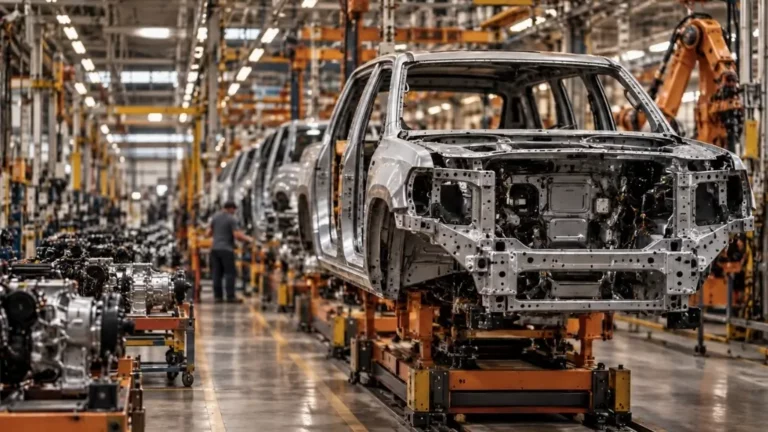
Its Indiana factory, located inside a former printing facility, won’t include two of the most expensive parts of a traditional auto plant: a paint shop and a metal stamping operation. Instead, robotic systems will weld together pre-formed body panels and the vehicle’s frame.
Inside the truck, the philosophy continues.
Features like ambient lighting and adaptive cruise control didn’t make the cut. Air conditioning nearly didn’t either—until potential customers made it clear that was a bridge too far. It ultimately stayed.
The result is a truck designed around essentials rather than luxury.
Physically, it’s remarkably small. In fact, it’s shorter than a Toyota Corolla, making it the smallest pickup available in the United States. Its dimensions are closer to the compact pickups Americans drove decades ago, like the original Ford Ranger and Chevrolet S-10, before the market shifted toward larger, more expensive trucks.
There are signs that smaller pickups are making a comeback. Ford’s Maverick has found considerable success, although it starts closer to $30,000 and offers hybrid power rather than a fully electric drivetrain.
Slate is betting there’s room for something even more basic.
Its truck offers an estimated 205 miles of range, compatibility with Tesla’s Supercharger network, and the ability to recharge from 20% to 80% in about 30 minutes. The company says it has already collected more than 160,000 reservations and expects deliveries to begin in the fourth quarter.
Still, the timing raises important questions.
Electric vehicle sales have slowed amid shifting consumer preferences and changing government policies. At the same time, American buyers continue to gravitate toward larger trucks loaded with technology, comfort, and convenience features.
Which brings us to the bigger question.
For years, industry leaders have warned that affordable vehicles simply can’t be built profitably in America. Slate is attempting to prove otherwise by removing many of the features consumers have come to expect.
From a competitive standpoint, particularly as Chinese automakers continue producing lower-cost vehicles, there is logic in simplifying the product and taking cost out of the equation.
Whether American consumers are willing to embrace that tradeoff is another matter entirely.
Price certainly matters. But so do comfort, convenience, and expectations. After decades of increasingly feature-rich vehicles, asking buyers to crank down their own windows and stream music from their phones instead of using an integrated infotainment system may prove to be a much tougher sell than simply offering a lower sticker price.
Slate’s success may ultimately depend on whether affordability has become more important than amenities. That’s a question the broader automotive industry will be watching very closely.
So, with that, let’s transition to Our Companies to Watch.
Every week we highlight interesting companies in the automotive technology space to keep an eye on. If you read my weekly Intel Report, we showcase a company to watch, and take the opportunity here on this segment each week to share that company with you.
Today, our new company to watch is AutoTrainer.
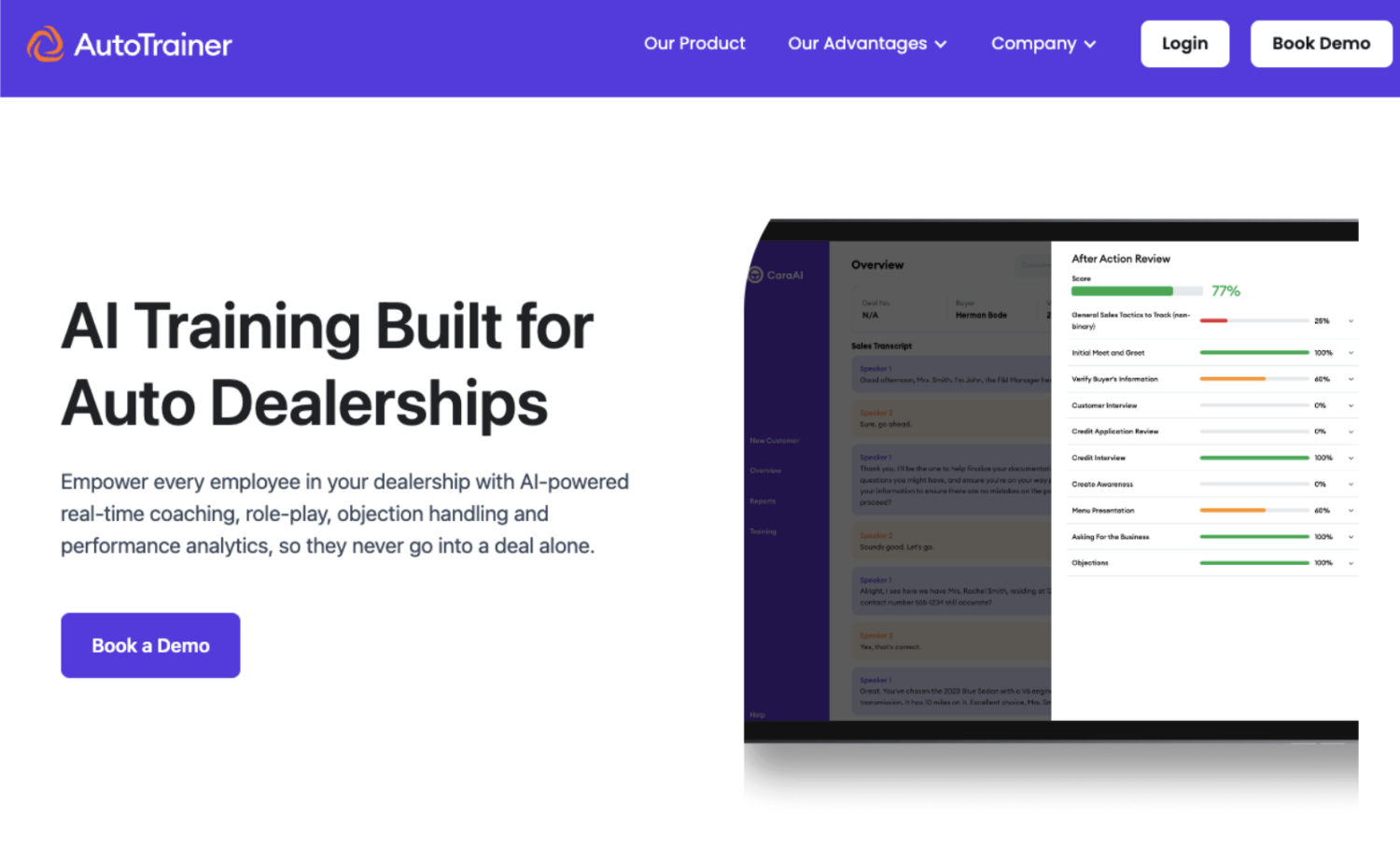
AutoTrainer provides AI training built for auto dealerships.
Empower every employee in your dealership with AI-powered real-time coaching, role-play, objection handling and performance analytics, so they never go into a deal alone.
Dealers can’t effectively role-play live deal scenarios with their teams. That leaves managers unprepared, margins shrinking, compliance risks rising, and training that fades too quickly.
Compliance is tightening, margins are shrinking, and customers demand transparency. Only AI can deliver the always-on accountability your dealership needs.
AutoTrainer is the First AI Copilot for F&I. Purpose-built to bring live role-play into every deal, while coaching, monitoring, and optimizing F&I performance at scale.
If you’d like to learn more about AutoTrainer, you can check them out at: www.AutoTrainer.com
So that’s it for this week’s Future of Automotive segment.
If you’re an AutoTech entrepreneur working on a solution that helps car dealerships, we want to hear from you. We are actively investing out of our new Mobility Fund.
Don’t forget to check out my two books, The Future of Automotive Retail and The Future of Mobility, both available on Amazon.com.
Thanks (as always) for your ongoing support and for tuning into CBT News for this week’s Future of Automotive segment. We’ll see you next week!