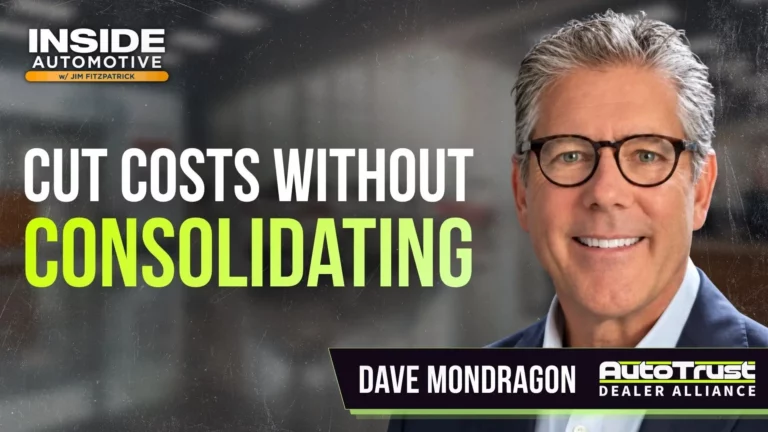
As operating costs keep climbing for franchise dealers, a single dealer group has little power to bring them down. But dealers who combine their spending can change that. Joining us on today’s episode of Inside Automotive is Dave Mondragon, Founder and CEO of AutoTrust Dealer Alliance, to take a closer look at how group purchasing and dealer ownership can substantially lower those costs.
While operating costs decide which dealers stay profitable, Mondragon believes that front-end gross gets most of the attention, but every store also spends across dozens of categories. That spending is scattered across vendors, contracts and rooftops.
"Franchise dealers that want to stay private shouldn't be priced out of the market."
A mid-sized dealer group Mondragon spoke with recently spends $1.2 million per month on software fees alone. That totals $14.4 million a year, and a 10% savings would return $1.4 million. He called that a meaningful difference even for large and mid-sized groups.
Public dealer groups and private equity buyers already use scale to win savings like that. They gain shared infrastructure savings and better terms on almost everything they buy, Mondragon said. AutoTrust gives franchise dealers that scale by pooling their volume, which brings better value and lower costs, he said.
Dealer ownership adds equity to the savings
Additionally, dealer ownership gives AutoTrust members two ways to benefit. Lower costs and incremental revenue come first, and members then earn equity as they help build AutoTrust, Mondragon said.
As a dealer-owned cooperative, AutoTrust lets members pool purchasing volume while keeping the profit from their own stores. A vendor sees one dealer group as a single account, even with five or 10 stores. AutoTrust brings together hundreds and eventually thousands of rooftops. That puts members in a position of strength in negotiations, and each new member adds leverage, Mondragon said.
AutoTrust also works on lending and stays centered on the dealer’s relationship with the original equipment manufacturer (OEM).
When it comes to non-OEM business, such as used vehicles and subprime, it also brings high-volume lender relationships and incremental programs to each rooftop. Group purchasing covers the cost side, which helps dealers earn more and spend less, Mondragon said.
Group purchasing aims to cut spend across dozens of categories
The group purchasing organization is one of the engines inside AutoTrust’s collective purchasing model. It aggregates dealer spend on parts, technology, credit services, payment processing and dozens of other categories. The savings go directly to dealers.
"We don't change how our dealers run their business. We add leverage and we take nothing away."
A typical rooftop spends about $2 million a year in addressable operating expenses. Roughly half of that can be influenced through AutoTrust programs, Mondragon said. The average AutoTrust dealer group has 11 stores, which puts about $11 million in spending within reach. A 10% savings would equal $1.1 million a year, and AutoTrust’s goal is savings of up to 25%.
Members can track results through a live portal, Mondragon said. It shows discounts, rebates, incentives and transaction costs by category at both the group and store level.
A growing network adds leverage with every dealer
AutoTrust has reached 350 rooftops and adds about 50 more each month without a sales team. Growth comes from dealer referrals and word of mouth, Mondragon said. As AutoTrust grows, so does its collective purchasing power. More dealers create more scale, and more scale creates better economics that attract more dealers.
AutoTrust’s long-term goal is to become the Costco of the auto industry, Mondragon said. Much like the members-only warehouse club, AutoTrust uses scale to deliver lower prices and greater value.
Dealers interested in learning more can visit autotrustdealer.com to explore membership details.