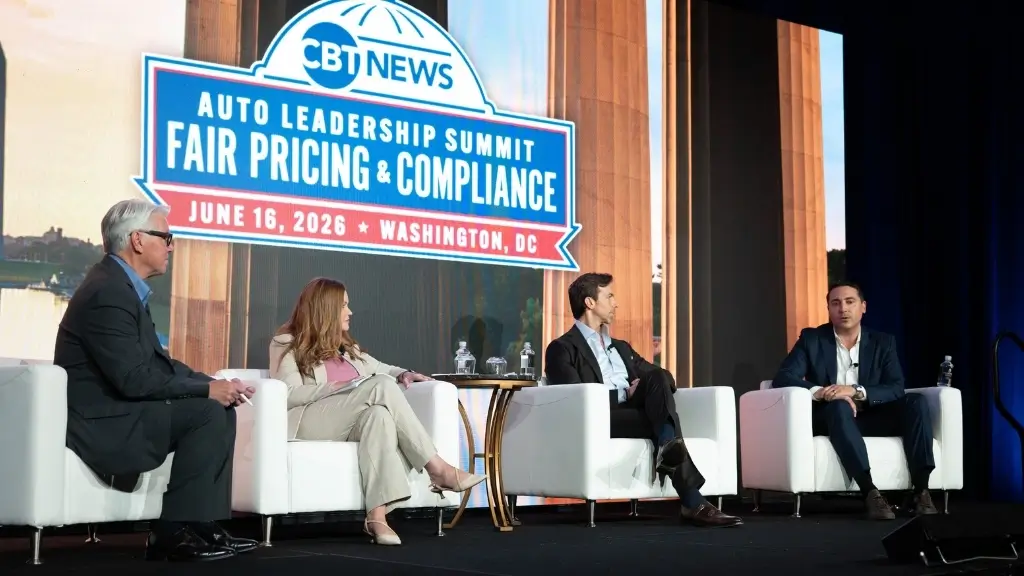
During the CBT News Auto Leadership Summit, David Kain, CEO of Kain Automotive, moderated a panel discussion surrounding the idea of “The Next Frontier” of AI, digital retailing, and pricing transparency. Kain was joined by Devin Daly, CEO of Impel; Michael Affronti, Chief Product and Business Officer at DriveCentric; and Cassie Broemmer, Chief Revenue Officer at Car Wars, to work through what compliant, AI-assisted communication actually looks like at the dealership level and where the technology still falls short.
Kain began the panel with an anecdote, noting that his family has been in the Ford business for years and that their store runs on DriveCentric as its CRM. Watching his brothers operate the dealership, he said, gave him a front-row seat to just how much they depend on AI-driven communication day to day.
What consumers actually want
Daly began with a premise that reframes much of the compliance conversation. Consumers, he said, want timely, transparent replies, and increasingly they want a single point of contact to manage that relationship rather than navigate multiple disconnected systems.
"What a consumer wants is that one consistent concierge that manages the experience from chat, through the sales process, through F&I and accessories, through service." Devin Daly
He pointed to fragmented systems as a direct driver of compliance risk. When different departments or platforms quote different prices to the same customer, that inconsistency creates duplicate work internally and exposes the dealership externally. Daly illustrates the stakes of loyalty with a simple scenario. He outlines that a driver with a flat tire is far more likely to text a concierge they already trust than to pull into an unfamiliar shop.
Affronti added a related point about consumer psychology. He said, customers want to feel in control of their communication, not bombarded by it. That expectation puts pressure on software vendors to build tools that respect a customer’s time and deliver genuinely useful information, not just frequent updates.
Additionally, Affronti identified what he sees as the root mechanical issue behind much of the FTC’s pricing concern, which he alludes to as a drift. This drift occurs when a customer sees one price online, but by the time they reach the dealership, two or three internal systems have generated slightly different versions of that customer’s record, each with a different number.
While nobody intends to mislead the customer, some systems simply fail to stay in sync.
According to Affronti, AI can correct for that when configured properly. Unlike a person who might pull up a duplicate record and quote an inconsistent figure, a well-built AI system identifies the single source of truth and holds that price consistently from first contact through delivery.
Hallucinations, jailbreaks, and the safeguard model
Daly drew a clear distinction between the two primary risk categories in AI deployment.
- Hallucinations, which occur when an AI system doesn’t know the correct answer and generates one anyway rather than acknowledging the gap. He cited two real examples, like when a Chevy Suburban sold for a dollar and a BMW trade-in value invented entirely by a chatbot in Canada.
- Jailbreaks are a separate threat in which a bad actor deliberately manipulates an AI system into acting outside its intended purpose. For instance, pressuring it into locking in a firm offer that was never legitimate.
However, Daly’s recommended safeguard model works on two fronts. When an AI system’s confidence drops below a set threshold, it should hand the conversation off to a human rather than guess. When the system detects patterns consistent with manipulation, it should flag the interaction rather than comply with it. Daly also pointed to ecosystem-wide integration as a third safeguard, since disconnected systems make it nearly impossible to maintain consistent pricing.
On the other hand, Broemmer brought a legal memo her company’s attorneys had sent ahead of the summit, outlining compliance risk areas for AI-driven outreach. Her point wasn’t that established vendors are paralyzed by caution, but rather that not every vendor in the market is doing this work.
Some, she said, are building AI tools without fully accounting for consent requirements, do-not-call regulations, or the patchwork of state-by-state TCPA rules that govern outbound communication. The responsibility, Broemmer argued, ultimately sits with the dealership, since the FTC’s position has consistently been that whoever controls the communication owns the liability for it, not the vendor and not the platform.
DIY AI
Notably, Daly drew a sharp line around do-it-yourself (DIY) AI builds. While these are internal tools for reconciliation or accounting automation, he said, they are generally safe ground for dealers to build themselves. However, consumer-facing communication is not.
He cited the complexity of the Telephone Consumer Protection Act (TCPA) compliance as the reason, stating that the rules apply state by state, not just federally, and they follow the consumer’s location rather than the dealership’s. Daly notes that a text sent to a customer in Florida falls under Florida’s TCPA requirements, even if the dealership sending it is based elsewhere.
Affronti reinforced the point with a cautionary example, citing a tech CEO who built his own lightweight CRM wrapper and inadvertently wiped out customer records in the process, recovering only a partial backup.
"Customers, they want control, right? They're being bombarded by information. So they want to know that they're in control."– Michael Affronti
When asked how a dealer can effectively audit large volumes of AI-generated communication, Daly provided a three-part response. He emphasized that every new feature, lead source, or outreach agent should be tested in a dedicated environment before engaging actual consumers. Additionally, vendors should establish an ongoing quality assurance process that regularly reviews conversations, not just during the initial launch.
Daly also highlighted an often-overlooked benefit of AI-driven communication, noting that it automatically creates a comprehensive, timestamped record. This record can serve as evidence if a customer questions how the pricing was presented. He also mentioned that consolidating vendors, instead of using multiple separate AI tools, minimizes the risk of delivering conflicting price quotes to the same customer.
Agent-to-agent transactions
Moreover, Daly pointed to a development from roughly two months earlier involving the first reported agent-to-agent transaction, where a consumer’s AI negotiated directly with a dealership’s AI. He framed this as the natural extension of an information landscape that has already shifted dramatically. Generative AI has effectively closed the information gap that dealerships once relied on, as consumers can now access the same depth of information dealers once had.
Affronti offered a retail parallel from his time working in e-commerce. While the pandemic did not eliminate physical stores, as many predicted, it did change what stores were for. Affronti said he expects a similar shift in dealerships, driven by a generation of consumers who will arrive already equipped with their own AI agents handling research and negotiation on their behalf.
"You have to be really, really careful, and we as an established business have to be thoughtful and mindful about our dealer customers."– Cassie Broemmer
However, Daly countered on the idea that AI threatens to replace the BDC role. According to him, the pattern he sees across the industry isn’t fewer people doing the same work, but fewer people doing significantly more, with AI handling the repetitive groundwork.
“What AI unlocks is the ability for BDCs or salespeople to be focused on low-funnel activities and high-value activities,” Daly said.
He pointed to the top-performing sales rep that nearly every dealership already has, the one who closes 25, 30, or even 50 cars a month through a system only they’ve mastered. Daly’s argument is that AI can extend that same system to the average rep, lifting their output from roughly 10 cars a month toward 20 or 25.
The offensive posture
Daly closed his remarks by reframing FTC compliance entirely. Rather than treating it purely as a defensive obligation, he argued that dealers can use AI to get ahead of the issue. Proactively disclosing F&I products before a customer even enters the finance office, for instance, turns a compliance requirement into a smoother, more transparent buying experience. A dealership that commits publicly to FTC-compliant pricing, he added, can use that commitment as a genuine differentiator against competitors who haven’t.
Broemmer closed on a note of resolve rather than alarm, predicting that a high-profile compliance failure in AI outreach will soon emerge and force the industry to standardize its practices. She reminded the audience that automotive retail has a long history of successfully navigating major regulatory shifts and will inevitably adapt to this new frontier as well.
Daly characterized this moment as a genuine inflection point for the industry, noting that AI offers a path to lift dealerships beyond the historically thin 3-5% net margins that have long defined the business. The bigger opportunity, he said, lies in connecting what already happens online with what happens inside the showroom, building a closed loop that makes the entire customer journey visible for the first time.