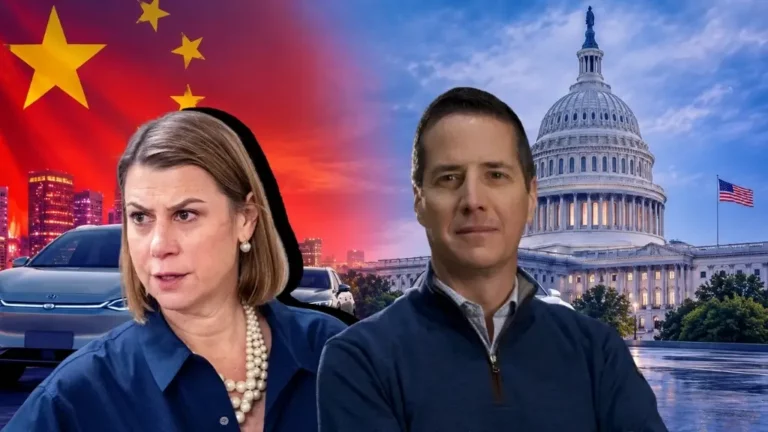
With the debate over Chinese automakers entering the U.S. market no longer being theoretical, it raises questions about national security and industry strategy, according to Virginia Automobile Dealers Association (VADA) President Don Hall.
Hall joins us on the latest episode of Inside Automotive to debrief on the growing concerns about Chinese vehicle imports, national security risks in global automotive supply chains, and increasing Federal Trade Commission (FTC) enforcement targeting dealer advertising and compliance standards.
“I don’t want the Chinese here. They’re not our friends… Their game is to take us down to nothing so they’re in control.”
National security argument
Hall frames the Chinese vehicle debate less as a trade question and more as a matter of national defense. He points to decades of alleged intellectual property theft, arguing that much of China’s current automotive technology traces directly back to stolen American innovations. More urgently, he raises the specter of connected vehicles, which are loaded with sensors and software, parked near military installations or sensitive government facilities.
Hall notes that General Motors recently faced scrutiny for selling vehicle data to insurance companies, calling it a preview of what state-controlled Chinese automakers could do at scale. He adds that a California mayor recently resigned and faced arrest on charges of passing intelligence to China, calling it evidence that the threat is already inside U.S. borders.
“I don’t want the Chinese here in any way shape or form because I do not and nor should you or anyone else trust their long-term game,” Hall asserts.
Additionally, Hall draws a sharp distinction between China and earlier foreign automakers. He acknowledges that Japanese manufacturers (Toyota, Nissan, Honda, Subaru) prompted Detroit to improve quality and fuel efficiency when they arrived in the 1970s, and that those same companies went on to build factories and employ American workers. But he argues China operates under an entirely different set of rules.
Dealers say patriotism has its limits
During the interview, Jim Fitzpatrick referenced a social media post suggesting a limited, guardrailed entry for Chinese vehicles, capped at 100,000 to 200,000 units annually and contingent on a U.S. factory commitment. The post drew roughly 400,000 views and significant dealer engagement.
When Fitzpatrick asked dealers directly whether they would raise their hand to franchise a Chinese brand if the door opened, the answer was nearly unanimous. Several said they would want in as distributors.
Notably, Hall said he doesn’t fault them for that instinct. He calls it a predictable byproduct of American business culture, the pursuit of the next good month and the next strong back-end number. But he urges the industry to weigh those short-term gains against a longer horizon.
“Maybe as Americans, as true-blue people who have built and from scratch with your family… maybe as Americans we stand up and say time out,” Hall said. “We got to get better at what we do.”
He adds that the window to act is not unlimited. Hall acknowledges Chinese vehicles will eventually find their way into the American market. He argues that each year the industry delays that entry provides additional time to build stronger protections.
FTC pressure
Hall shifts from the geopolitical to the regulatory with equal conviction. The Federal Trade Commission (FTC) recently sent warning letters to 97 dealer groups, and dealers in the Northeast have already absorbed multimillion-dollar fines tied to noncompliant pricing and advertising practices.
“Ultimately, what the FTC is doing may be painful initially, but in terms of the long term, it will make us better so that the customer knows exactly what the price is mins state mandated fees.”
Hall tells compliant dealers not to absorb the competitive disadvantage quietly. His advice is to report neighbors who are not following the rules directly to the FTC.
He frames compliance not as a burden but as a correction, one that forces dealers back to the fundamentals of a clean buying experience, transparent pricing, and service that earns repeat customers. Done right, he argues, it rebuilds the industry’s reputation with consumers and creates the conditions for long-term profitability.
Hall also flags a compliance conflict that leaves many dealers exposed, as state and federal laws do not always align. Following one can mean violating the other. He says dealers need state-specific legal guidance alongside any federal framework they adopt.