Polestar will leave the U.S. market with the 2027 model year, stranding 32 franchised dealers with their stores, their staff, and customers already driving the brand. The automaker failed a federal compliance process tied to foreign software and hardware in vehicles. Dealers now face hard questions about inventory, service, and resale value.
On this episode of Inside Automotive, Matthew Haiken, Dealer Principal and President at Prestige Collection Auto Group, joins us to break down what the decision means for his store and the broader retail landscape. Haiken owns Polestar Short Hills in East Hanover, New Jersey, one of the 32 franchised stores now facing an end to new-vehicle sales.
Polestar breaks the news
Haiken said the CEO of Polestar called all 32 dealers to deliver the news last week, about an hour before the company told its corporate staff.
"Many OEMs were given a green light, but Polestar was given a red light."
The ban traces back to the ICTS rule, which the Biden administration passed in its final stretch. The rule bars Chinese or foreign-adversary hardware and software in vehicles by 2027. Polestar’s sister brand Volvo secured its own approval in May. Both are owned by China’s Geely Holding.
Many automakers worked through the same compliance process and kept their approvals. But Polestar, headquartered in Mahwah, New Jersey, did not. Haiken said he still does not know why the brand was singled out.
What happens next
In its own statement, Polestar said it will keep selling existing U.S. stock and supporting current owners through its service network, then redirect its growth to Europe. Polestar reported that 94% of its first-quarter 2026 retail sales came from outside the American market.
For Haiken, that means his store still has new vehicles to sell. Once that inventory clears, the new-car side of the business ends. He said he expects to keep handling warranty work and service for the foreseeable future.
Haiken compared this moment to the exits of Saab and Fisker, brands whose loyal owners chased down the last available cars. But, he admits this case is different, since it comes from a regulatory ruling rather than a bankruptcy.
The national security argument
The rule that pushed Polestar out rests on a national security argument. Regulators worried that connected vehicles tied to China could collect data on American drivers and infrastructure, or be manipulated remotely. Commerce officials raised the prospect of a worst case in which millions of cars could be disabled at once. Haiken does not dismiss those concerns, but says its manageable and something the country already handles with other Chinese technology.
Haiken said the larger issue is the competitive reality of Chinese EV technology. He pointed to Ford CEO Jim Farley’s public comments about how far those vehicles have come, and said American automakers have to respond.
“If there’s formidable competitors that have better tech, then we need to stay up at night to make sure that we have the best product on the planet,” Haiken said.
Haiken’s message to lawmakers
Asked for his message to Washington, Haiken said he simply wants to know exactly where Polestar failed the compliance process.
"I want to know where we failed in the process."
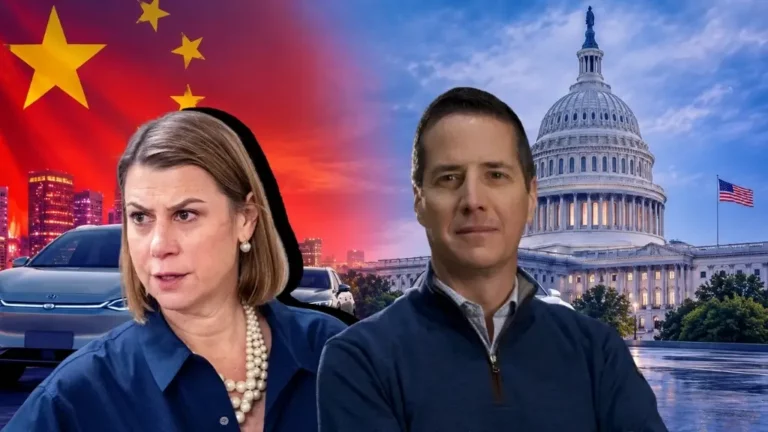
Haiken also said he hopes lawmakers, like Ohio Senator Bernie Moreno (R-Ohio), who authored legislation to ban Chinese-made cars in the U.S., would be open to dialogue.
At the recent CBT News Auto Leadership Summit, Sen. Moreno made it clear that he does not support seeing Chinese-made vehicles on American roads. His opposition stems from what he calls an unfair market, pointing to support the companies get from the Chinese government, and the potential for Chinese espionage.
In the meantime, Haiken said his team will lean on fixed operations, used cars, and F&I while the new-car business winds down.
Haiken called the Polestar location a strong one and said he would welcome another brand in the showroom. He is also holding out hope that the decision could be revisited, given the U.S. factory in South Carolina and the cars already on the road.