On the Dash:
- California’s retail share of U.S. light-vehicle sales has fallen to 11.4% in 2026, while Texas has climbed to 10.8%, narrowing the gap to just 0.6 percentage points.
- Texas has already surpassed California in total consumer spending on new vehicles and has led the nation in that category since 2024.
- The shift could influence where automakers focus product planning, marketing, dealer investment, and future inventory strategies.
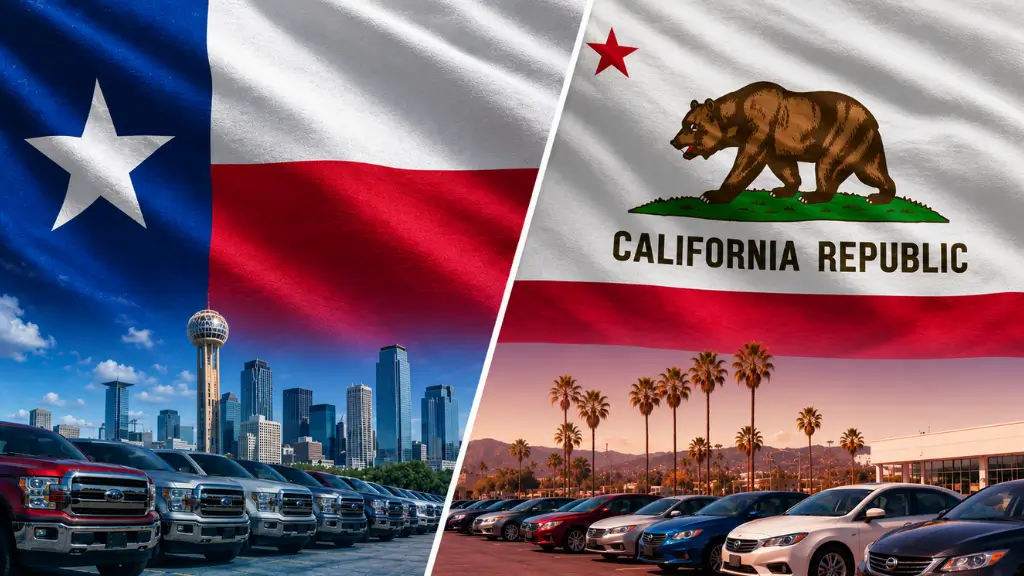
Texas is rapidly closing in on California as the nation’s largest retail automotive market, marking a potential turning point in where vehicles are bought, sold and prioritized across the U.S. According to JD Power’s Automotive OEM Intelligence Report. California still leads the country in new-vehicle sales, but its margin over Texas has narrowed sharply.
California’s retail share of new-vehicle sales has declined from 12.5% in 2019 to 11.4% in 2026, while Texas has grown from 9.3% to 10.8% over the same period. The gap between the two states has narrowed from about 3 percentage points to just 0.6 points.
Based on JD Power’s forecast of 16.3 million retail vehicle sales nationally this year, California is projected to sell about 158,000 fewer vehicles than it did in 2019, while Texas is expected to add nearly 197,000 sales during the same period.
Consumer spending tells an even sharper story
Even before overtaking California in total sales volume, Texas has already moved ahead in one important category: consumer spending. JD Power data shows Texas now leads California in total consumer expenditure share on new vehicles, holding 10.7% compared with California’s 9.9%.
That shift reflects more than population growth. Texas buyers tend to favor trucks, SUVs and larger vehicles, which typically carry higher transaction prices. Pickup trucks account for roughly 27% of Texas sales, compared with about 17% in California. Across other segments, Texas buyers tend to skew more toward mainstream brands, while California buyers show higher lease penetration and stronger luxury-brand preference.
What’s driving the shift
JD Power points to population growth as a fundamental factor. Texas continues to attract residents and businesses relocating from across the country, meaning more drivers, more families, and ultimately more vehicle sales.
The difference in financing behavior further separates the two markets. JD Power notes that Texas tax policy makes leasing less attractive, helping explain why leasing remains far less common in Texas than in California, where leases account for 30% of new-vehicle transactions. JD Power found that 69% of Texas new-vehicle buyers either pay cash or arrange outside financing, 23 percentage points higher than in California.
What this means for the industry
For automakers and dealers, the implication is straightforward: manufacturers’ marketing budgets, product planning and dealer investments are increasingly likely to follow the Texas consumer.
California is not disappearing from the automotive map. It remains the nation’s leader in electric vehicle adoption and continues to drive emissions and regulatory policy. As the U.S. auto market’s center of gravity shifts, automakers may need to pay closer attention to the preferences of Texas buyers. If current trends continue, Texas could soon move from challenger to leader in the nation’s retail automotive market.