On the Dash:
- Automakers are turning excess battery capacity into a new revenue opportunity as demand for EVs falls short of earlier expectations.
- Growing opposition to data centers could create reputational and political risks for automakers that supply their energy storage systems.
- Stationary storage could still benefit utilities and automakers by supporting grid reliability and creating a potential outlet for EV battery capacity.
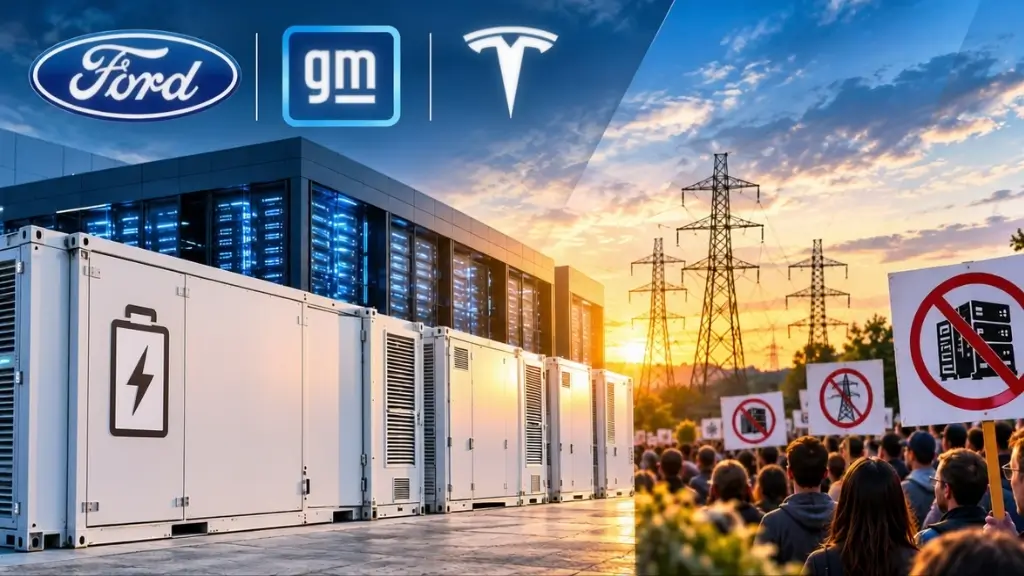
Ford, GM and Tesla are turning surplus battery capacity into a new revenue stream by supplying stationary storage systems for data centers and the power grid. But as community opposition to data center construction hits record levels nationwide, that business could eventually pull automakers into a fight most have so far avoided.
Rising electricity costs, heavy water use and land-use disputes have fueled a wave of local resistance to data center projects across the country. Automakers have largely stayed on the sidelines of that fight. That could change as energy storage accounts for a larger share of their business.
Softer-than-expected EV demand has left automakers with battery manufacturing capacity they no longer need for vehicles. Stationary energy storage gives them another use for that capacity and a new potential revenue source as EV sales fall short of earlier projections.
Tesla’s Megapack business remains the most established example, as the company’s energy storage division supplies systems to data centers and other large customers. Notably, SpaceX alone purchased $295 million worth of Megapacks in the second quarter.
Ford bets on Kentucky storage plant
Ford Energy will begin producing stationary battery storage systems at its Kentucky plant next year. The company plans to reach 20 gigawatt-hours of annual capacity in 2027 and continues signing customer contracts with utilities, industrial manufacturers and data centers. The business gives Ford another outlet for battery manufacturing capacity after it scaled back several EV plans.
GM pursues several storage paths at once
GM is spreading its bets further with its Ultium Cells joint venture with LG Energy Solution, which has started producing lithium iron phosphate battery cells for stationary storage at a Spring Hill, Tennessee, plant that received a $70 million investment. GM also plans to produce sodium-ion battery cells for storage starting in 2028 through a partnership with Peak Energy. The company is separately exploring second-life uses for EV batteries through a partnership with Redwood Materials.
Data Center Watch reported that opposition disrupted at least 75 projects worth roughly $130 billion in the first quarter alone. Residents have raised concerns over electricity bills, water shortages, noise and changing land use, and some of the pushback reflects broader anxiety about AI, automation and job loss. Michigan has become a particular battleground, with proposed projects facing rezoning defeats, withdrawals, pauses and local moratoriums, and data center development became a live issue in the state’s 2026 primary elections.
Building or operating a data center is a different kind of exposure than supplying the batteries that power or stabilize one. Still, automakers could face growing questions if consumers start linking their energy products to controversial data center projects, particularly as the backlash spreads to new states. Tesla arguably already carries more of that risk, given how closely Musk and the company are tied to both AI and data centers in the public eye.
The case for storage
Battery storage can also ease strain on data centers and the grid. Storage systems help manage peak electricity demand and support renewable energy by storing power when generation runs high and releasing it when supply drops.
For dealers, the takeaway extends beyond the factory floor. Automakers’ battery businesses are expanding well past vehicles, opening new revenue streams but also exposing manufacturers to industries and controversies outside traditional automotive turf.