On the Dash:
- Mercedes-Benz is lobbying to raise the bill’s Chinese ownership cap from 15% to 25%.
- The bipartisan bill from Sen. Moreno and Sen. Slotkin targets automakers over Chinese ownership stakes.
- The Senate Commerce Committee is set to consider the bill this week after a delayed hearing.
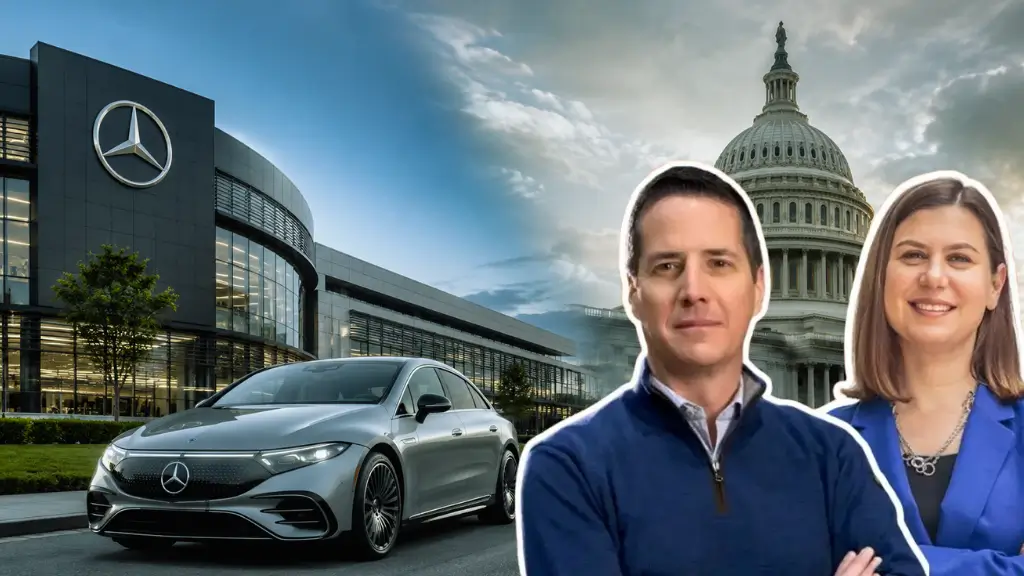
Mercedes-Benz Group AG is lobbying to soften a proposed law that could ban the automaker from the U.S. market over its partial Chinese ownership, according to people familiar with the matter cited by Bloomberg.
The bipartisan bill, introduced in April by Sen. Bernie Moreno (R-Ohio) and Sen. Elissa Slotkin (D-Mich.), would bar the sale of connected vehicles by automakers more than 15% owned by Chinese entities. Mercedes is nearly 20% owned by Chinese entities, putting it over that line.
Mercedes wants lawmakers to raise the ownership cap to 25%, the same threshold the bill would apply to suppliers of connected parts and software, Bloomberg reported. Some lawmakers are also discussing replacing the flat ownership number with a broader national security review, an approach that would likely favor the German automaker over the current draft.
No shareholder controls the company
Although the company declined to address the legislation directly, it said no single shareholder holds more than 10% of its stock and that no stockholder has board representation or authority over operational decisions.
Notably, nearly 10% of Mercedes is owned by BAIC Motor Corp., a Chinese state-owned automaker. Geely chairman Li Shu Fu holds another roughly 10% stake.
Bill faces Senate committee vote
The Senate Commerce, Science, and Transportation Committee is set to take up the bill this week after delaying a hearing originally planned for last week, according to Bloomberg. The House Select Committee on China criticized Mercedes in a July 16 social media post, saying the automaker is “actively lobbying the Senate in opposition” to the bill.
Volvo Car would also fall under the ownership threshold, but a grandfathering provision in the bill would preserve its existing agreement with the U.S. government.
The automaker has invested heavily in its U.S. operations, including another $4 billion announced this year for its Alabama plant through 2030. The company has assembled vehicles in Alabama since the 1990s and also operates a plant in South Carolina.