While most Americans see scrapyard fires as local news, the real story may be unfolding in repair shops, insurance offices, and family budgets across the country.
Americans don’t need another reason for vehicle ownership to become more expensive.
New vehicle prices remain painfully high. Used vehicle prices are still well above historical norms. Insurance premiums continue climbing. Repair bills have reached levels that would have seemed absurd just a decade ago. For many families, keeping an older vehicle on the road isn’t a preference anymore. It’s a necessity.
That’s why a trend developing across the country deserves far more attention than it’s getting.
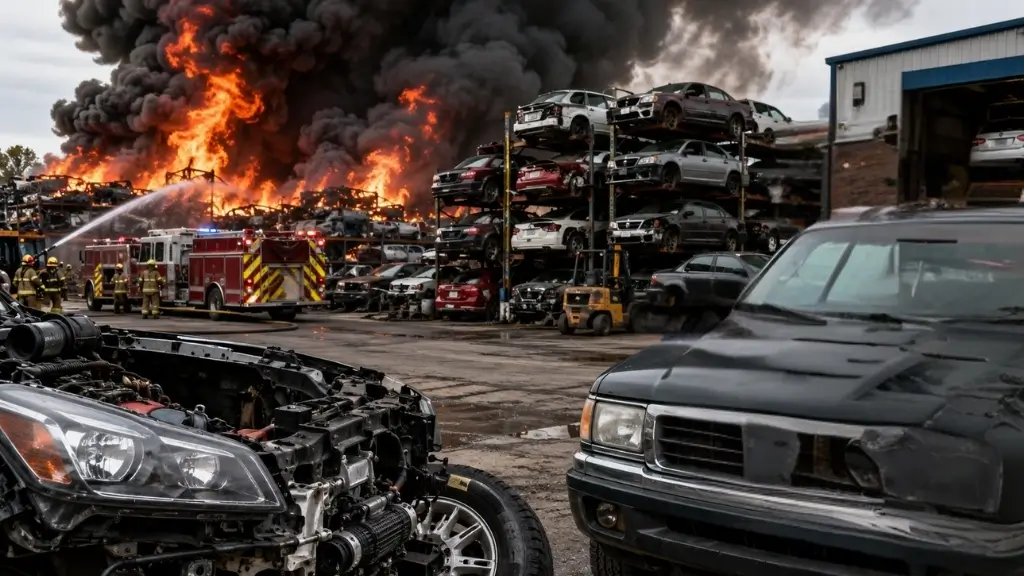
America’s salvage yards are burning.
Most people see footage of a scrapyard fire and assume it’s a local story. Firefighters respond, smoke fills the sky, investigators arrive, and eventually the headlines move on. But treating these fires as isolated incidents misses a much larger issue. Every major salvage-yard fire destroys inventory that helps keep repair costs under control for millions of Americans.
The average driver may never visit a salvage yard, but there’s a good chance they’ve benefited from one. Whether it’s a replacement transmission, a body panel after a collision, a wheel, a mirror, a seat assembly, or an electronic module, recycled parts help reduce repair costs every day. They provide alternatives to expensive new components and help keep older vehicles economically viable.
That matters because the economics of vehicle ownership have changed dramatically.
A generation ago, a damaged headlight was a relatively inexpensive repair. Today, many headlights contain advanced LED technology, sensors, cameras, and electronics that can push replacement costs into the thousands of dollars. Bumpers contain radar systems. Side mirrors contain cameras and blind-spot monitoring equipment. Modern vehicles are safer and more capable than ever before, but they’re also significantly more expensive to repair.
The salvage industry has quietly helped offset those costs for decades.
Most Americans think of a salvage yard as a graveyard for wrecked vehicles. In reality, it’s more accurate to think of these facilities as warehouses filled with reusable automotive inventory. Every totaled vehicle that arrives at a salvage yard contains components that may help repair another vehicle. Engines, transmissions, suspension components, body panels, wheels, electronics, wiring harnesses, airbags, sensors, and countless other parts are inspected, cataloged, and sold back into the marketplace.
That inventory is one of the reasons many repairs remain affordable.
When a salvage yard loses thousands of vehicles and parts to a fire, the impact doesn’t stop at the property line. Repair shops lose access to inventory. Collision centers have fewer options when sourcing components. Insurance companies lose salvage value. Consumers lose access to affordable alternatives.
Eventually, those costs find their way through the system.
The automotive industry has become remarkably effective at spreading costs around until nobody notices where they originated. Higher repair costs become higher insurance claims. Higher insurance claims contribute to higher premiums. Parts shortages lead to longer repair times. Longer repair times increase rental-car expenses. Consumers don’t always see the connection, but they almost always end up paying for it.
That is why these fires deserve more scrutiny than they typically receive.
Industry groups have reported record numbers of fires at recycling facilities in recent years. The explanation most frequently offered is lithium-ion batteries. On the surface, that explanation makes sense. Batteries are now embedded in nearly every aspect of modern life. Phones, laptops, power tools, e-bikes, scooters, hybrid vehicles, and electric vehicles all contain lithium-ion batteries. When damaged, crushed, punctured, or improperly handled, they can ignite and create fires that are difficult to extinguish.
There is no question that batteries present real challenges for recyclers.
But there is another question that deserves attention.
How many of these fires have been conclusively linked to batteries?
How many remain under investigation?
How many are still classified as undetermined?
Consumers deserve answers because the consequences extend far beyond the recycling industry.
In recent years, “battery fire” has become the explanation attached to an increasing number of incidents. Sometimes that explanation is supported by evidence. Sometimes investigations remain ongoing long after public assumptions have already solidified. That doesn’t mean batteries aren’t responsible. It means facts matter, particularly when billions of dollars in inventory and critical supply-chain assets are involved.
The bigger concern is that America may be paying too little attention to the role automotive recyclers play in maintaining affordable transportation.
The average age of vehicles on American roads continues to rise. More consumers are choosing to repair older vehicles rather than replace them. That decision isn’t difficult to understand. With new vehicle prices approaching levels many households simply cannot justify, keeping an existing vehicle running often makes the most financial sense.
The problem is that repair affordability depends on access to parts.
For decades, independent repair shops have relied on recycled components to provide consumers with options. A customer driving a twelve-year-old SUV doesn’t necessarily need or want a brand-new factory component if a quality recycled part is available. A family trying to avoid another car payment may decide to repair an aging vehicle because the cost remains manageable. An insurance company may choose to repair rather than total a vehicle because recycled parts help control expenses.
Remove enough inventory from the marketplace and those calculations start changing.
This is where the conversation intersects with the broader right-to-repair debate.
Much of the public discussion surrounding right-to-repair focuses on access to diagnostic information, software, and service procedures. Those issues matter. Consumers should have the ability to repair products they own. But access to information is only one piece of the equation. A repair manual doesn’t repair a vehicle. Diagnostic access doesn’t replace a damaged transmission.
The ability to repair something ultimately depends on obtaining the necessary parts at a reasonable cost.
Salvage yards have long played an important role in preserving that choice. They provide competition in the parts market and help prevent consumers from being locked into a single source for replacement components. As inventory becomes scarcer, that competitive pressure weakens. The result is fewer options and higher costs.
Independent repair facilities understand this reality better than most. These businesses compete every day against dealership service departments and large repair chains. Their ability to source quality recycled parts often helps them provide solutions that fit within a customer’s budget. Without that flexibility, many repairs simply stop making financial sense.
Consumers are left with two unpleasant choices: pay significantly more for repairs or replace the vehicle entirely.
Neither option is particularly attractive in today’s economy.
Insurance companies have their own reasons to pay attention.
Every totaled vehicle contains value that can be recovered through salvage and recycling. That recovered value helps offset losses throughout the insurance system. When inventory is destroyed before it can be recovered and resold, those economic benefits disappear.
No single scrapyard fire is going to transform the automotive industry.
But that’s not the point.
The concern isn’t one fire.
The concern is a pattern.
It’s a pattern of increasing fires, increasing vehicle complexity, increasing repair costs, increasing insurance premiums, and increasing pressure on the systems that help keep transportation affordable.
Viewed individually, each challenge appears manageable.
Viewed together, they tell a different story.
The automotive industry is undergoing one of the most significant transformations in its history. Vehicles are becoming more technologically advanced, more software-dependent, and more expensive to repair. At the same time, consumers are keeping vehicles longer because replacement costs continue rising.
That makes the automotive recycling industry more important than ever.
Yet it remains largely invisible to the public until something catches fire.
The next time headlines report another major scrapyard blaze, it may be worth looking beyond the smoke. The real story isn’t necessarily what caused the fire. The real story is what was lost, who depended on it, and whether Americans can afford to lose another source of affordable repairs at a time when vehicle ownership is already becoming more expensive by the year.
Because the cost of these fires doesn’t disappear when the flames are extinguished.
Like most costs in the automotive industry, it eventually finds its way back to the consumer.
Americans are already struggling to afford transportation.
The country can debate EV mandates, emissions rules, tariffs, fuel prices, and insurance regulation all day long.
But if affordable repairs disappear, none of those debates matter to the family staring at a $6,000 repair bill.
Check out my full commentary on this story: https://youtu.be/ycI5x8xcH8M
Looking for more automotive news? https://www.CarCoachReports.