
On the Dash:
- Canada will allow up to 49,000 Chinese EVs annually at a reduced 6.1% tariff.
- Federal leaders say the deal could support affordability and future domestic production.
- Automakers, labor groups, and provincial leaders warn that the agreement risks jobs and trade ties.
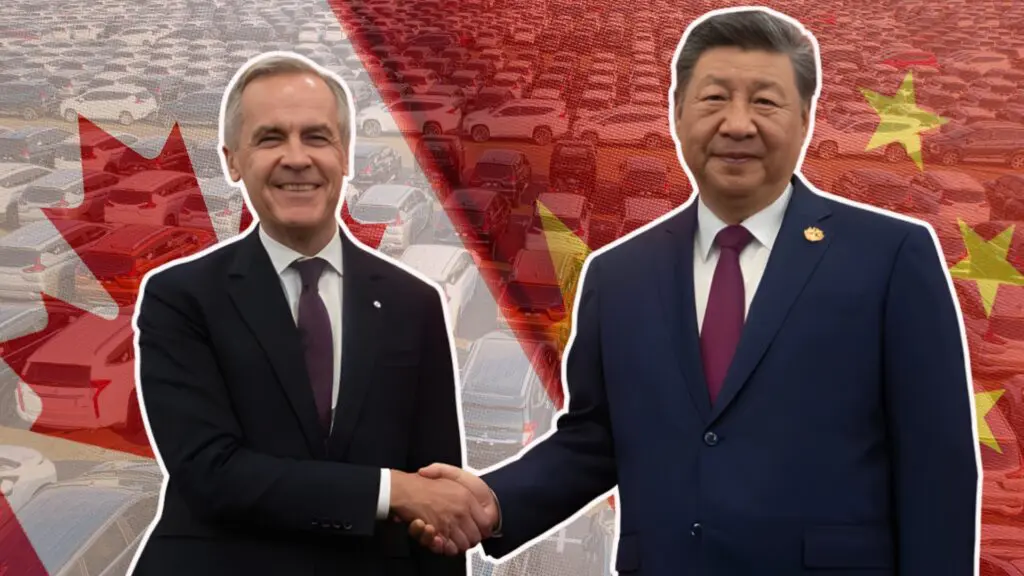
Canada is moving forward with a limited electric vehicle trade agreement with China that Prime Minister Mark Carney says could create future manufacturing opportunities for Ontario and the broader auto sector, even as provincial leaders, labor unions, and industry groups warn of long-term risks.
Under the agreement signed Jan. 16, Canada will allow up to 49,000 Chinese electric vehicles to enter the country annually at a 6.1% tariff rate. By 2030, half of those vehicles must be priced under $35,000. The move represents a sharp departure from Canada’s 2024 decision to impose a 100% tariff on Chinese EVs, citing unfair subsidies and market dumping.
Carney described the policy as a controlled, trial-stage approach intended to improve EV affordability while opening the door to future domestic production partnerships. Federal officials say Chinese automakers have expressed interest in working with Canadian companies, though no specific firms have been identified publicly.
The Canadian government argues the quota is modest relative to overall vehicle sales and does not pose an immediate threat to domestic manufacturers. Officials say any future production would be required to meet Canadian labor standards and would be phased in gradually.
Opposition has been strong within Canada. Ontario Premier Doug Ford warned the agreement could flood the market with low-cost vehicles without guaranteed domestic investment and could disrupt Canada’s access to the U.S. market, its largest auto export destination. Unifor, which represents Canadian autoworkers, said the deal risks accelerating job losses and weakening North American manufacturing competitiveness.
From a U.S. perspective, trade officials have taken a measured stance. U.S. Trade Representative Jamieson Greer said the agreement is unlikely to significantly affect American automakers, noting that U.S. brands continue to hold a dominant share of the Canadian market. He emphasized that the United States maintains its own tariffs on Chinese vehicles and that Canada’s quota system still places limits on market access.
However, U.S. industry groups have expressed concern that the deal could create a backdoor foothold for Chinese automakers in North America. Organizations representing Ford, General Motors, and Stellantis warned the agreement could undermine the integrated U.S.-Canada-Mexico auto supply chain and complicate long-term investment decisions.
The agreement arrives ahead of the mandatory 2026 review of the USMCA trade pact. U.S. officials have signaled that protecting American manufacturing jobs and preventing Chinese market penetration remain top priorities as those talks approach.