

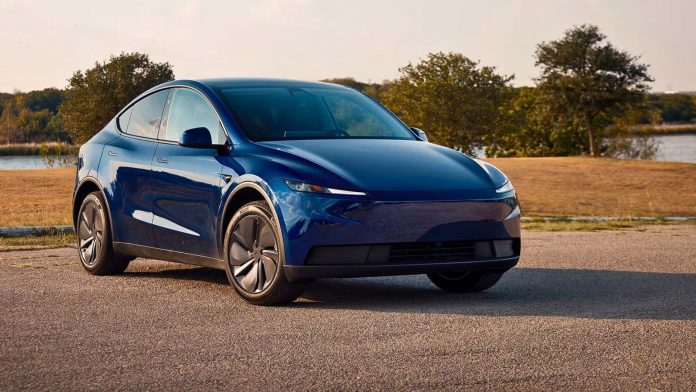
On the Dash:
- Tesla’s U.S. November sales dropped 23% to 39,8000 vehicles, the lowest since January 2022.
- Lower-cost Standard Model 3 and Model Y variants failed to drive robust demand.
- Analysts say Tesla needs entirely new models to maintain sales amid rising competition and weak consumer interest.
Tesla’s U.S. sales fell to their lowest level since January 2022, dropping nearly 23% in November to 39,800 vehicles from 51,513 a year prior, according to exclusive Cox Automotive data shared with Reuters. This slump occurred despite the EV manufacturer introducing lower-cost “Standard” versions of the Model 3 and Model Y.
The Standard models, priced nearly $5,000 below the previous base models, were expected to support sales following the end of the federal tax credit in September. However, the figures suggest the lower-cost versions were not enough to drive demand.
To counter what analysts say signals weak consumer interest, the EV maker is offering 0% financing on the Standard Model Y. Both Standard Models were also listed in inventory on Tesla’s website at reduced prices, which may indicate early signs of slow adoption despite the holiday-season push.
Despite Tesla’s market share rising to 43.1% from 56.7%, its U.S. sales fell more than 41% in November, reflecting its relative strength as competitors faced even steeper declines. High borrowing costs, intensifying global competition, and a lack of entirely new vehicles have contributed to the slowdown. Notably, Tesla has not launched a fully new model since the Cybertruck, which has struggled to find buyers, and its other models primarily feature minor updates.
On the other hand, Tesla’s brand image has been pressured by CEO Elon Musk’s political involvement and associations with far-right rhetoric, which some analysts say has influenced consumer perception. As the company transitions toward robotaxis and humanoid robots, which are key components of its $1.4 trillion market valuation, how effectively Tesla can maintain EV sales will be critical in the near term.
Ultimately, analysts stress that new product innovation is essential to reversing the recent slowdown.