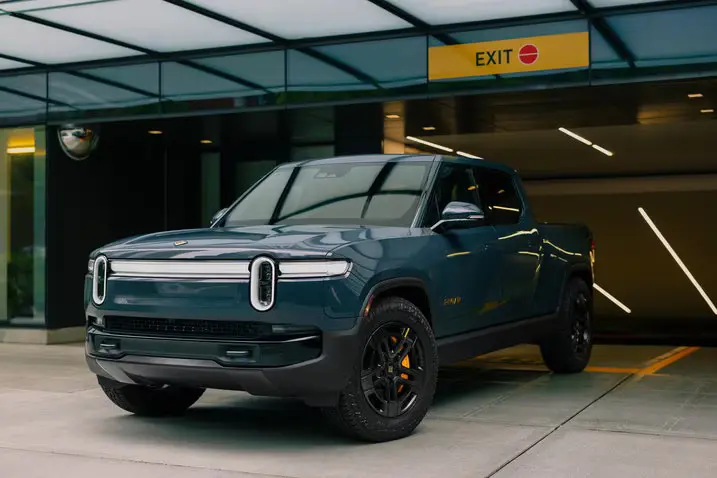
Rivian has unveiled redesigned versions of its all-electric R1 pickup and SUV models, the R1T and R1S, featuring improved range, performance, and computing power with the integration of Nvidia chips.
The 2025 model-year vehicles, while outwardly similar to their predecessors, incorporate over 50% new hardware components. Significant changes have been made to the batteries and electrical architectures, which Rivian describes as the “brains” of the vehicles. These enhancements aim to offer better quality and performance without compromise, according to Rivian CEO and founder RJ Scaringe.
Among the most notable upgrades is the new computing power, which Rivian claims is ten times greater than the previous system. This advancement is powered by dual Nvidia DRIVE Orin processors, forming the core of the “Autonomy Compute Module.” This system supports advanced driver-assistance features and offers a premium version with additional capabilities, including hands-free driving for limited periods, though drivers must remain attentive at all times.
These updates come as Rivian seeks to boost sales of its flagship models ahead of the anticipated launch of its more affordable “R2” models, set to begin shipping in the first half of 2026 with a starting price of about $45,000. The introduction of these lower-priced vehicles is crucial for Rivian’s expansion, especially as sales of its current models have slowed amid a generally sluggish market for electric vehicles.
In response to financial pressures, Rivian has implemented several cost-cutting measures. These include reducing headcount, cutting operational costs, and retooling its Illinois plant for greater efficiency. The company also paused the construction of a new plant in Georgia, resulting in a $2.25 billion saving. Despite these efforts, Rivian continues to burn through cash and report significant losses, with a reported loss of $1.45 billion in the first quarter of this year. Consequently, its stock has dropped approximately 50% year to date.
Deliveries for the 2025 R1S and R1T will start immediately. The new models will continue to offer three motor configurations—dual, tri, and quad—as well as Standard, Large, and Max battery packs, providing ranges of 270 miles, 330 miles, and 420 miles, respectively.
Pricing for the second-generation R1S SUV will start at $75,900, a $1,000 increase from current models, with top-end tri-motor models priced around $106,000. The starting price for the R1T remains unchanged at $69,900, but top-end tri-motor models will exceed $100,000. Pricing for the quad-motor vehicles has not been specified.
The updated battery packs will continue to use a “2170 cylindrical cell,” with the pack enclosure now incorporating large high-pressure die castings to simplify manufacturing and reduce weight. The tri- and quad-motor vehicles feature new Rivian-made drive units, with the top-end quad-motor delivering up to 1,025 horsepower and 1,198 pound-foot of torque in Launch Mode, achieving 0 to 60 mph acceleration in 2.5 seconds.
Additionally, the vehicles boast more luxurious interiors and a fully redesigned software interface. Charging times have also improved, with all vehicles capable of adding up to 140 miles of range in about 20 minutes.