On the Dash:
- New-vehicle sales are on pace to rise 1.2% in November on a selling-day-adjusted basis.
- Average transaction prices hit a November record of $47,154, with monthly payments reaching $840.
- Incentives, hybrid share and dealer inventory are rising as loan rates average 6.71%.
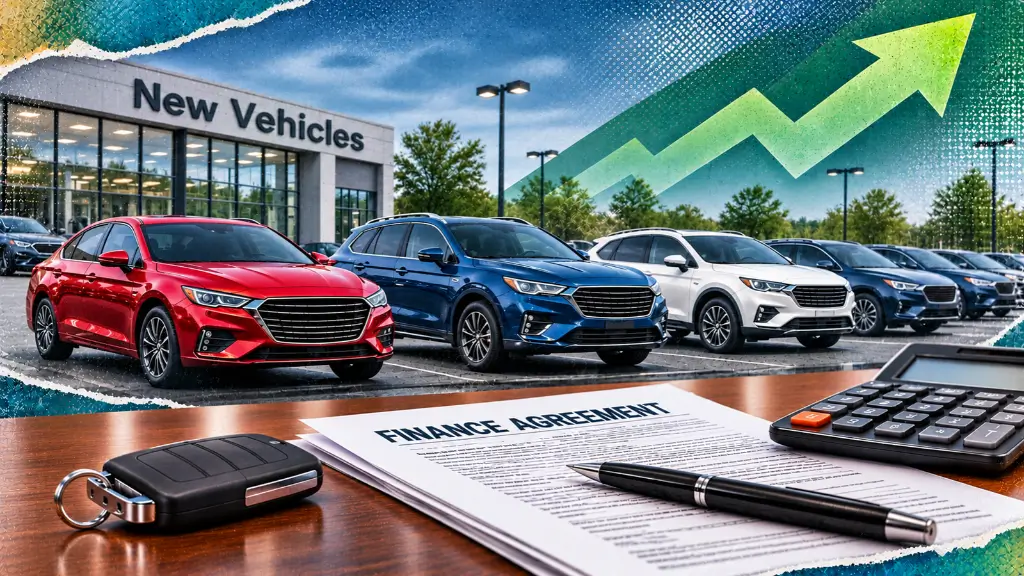
U.S. new-vehicle sales are on pace to rise in November on a selling-day-adjusted basis, according to a forecast from JD Power and GlobalData. The expected increase in sales comes even as average transaction prices and monthly loan payments are tracking toward November records.
According to JD Power, higher interest rates and fuel prices are also pressuring affordability, which has led many manufacturers to increase incentives. At the same time, dealer inventory is growing, and hybrids are taking more share of retail sales.
Sales edge higher as prices and payments set records
November 2026 has 23 selling days, two fewer than last year, so the numbers look different with and without the adjustment. The seasonally adjusted annual rate (SAAR) for both total and retail sales is expected to land below last year’s level.
- Total sales are projected at 1,200,100 units, up 1.2% adjusted and down 6.9% unadjusted.
- Retail sales are projected at 996,200 units, up 1.6% adjusted and down 6.6% unadjusted.
- Total SAAR is forecast at 15.7 million units, down 0.2 million, and retail SAAR at 12.5 million, down 0.1 million.
The average transaction price is expected to rise 2.2% to a record $47,154 for the month, while monthly payments are forecast to climb 4.2% to a record $840, up 0.6% from October. Thomas King, President of OEM Solutions at JD Power, said the month reflects the strain between affordability and sales volumes as interest rates and fuel prices stay elevated.
The average loan rate is 6.71%, the highest November level since 2023, and 30.3% of trade-ins carry negative equity. Buyers are stretching terms to manage payments, with 12.8% of new-vehicle loans running 84 months or longer.
Incentives & hybrids rise as inventory builds
Average incentive spending is trending toward $3,589 per vehicle, up 5.6% from a year ago, as manufacturers try to keep buyers in the market. Spending on gas-powered and hybrid models is rising 8.7% to $3,472, while EV incentives are forecast to fall 42.8% to $7,055 from an elevated base.
Hybrid share of retail sales is expected to reach 18.3%, up 3.0 percentage points, which King attributed to elevated fuel prices and greater hybrid availability. EV share is up 1.6 percentage points to 6.7% as the comparison laps the lower base that followed the expiration of the federal EV tax credit.
Retailer inventory has increased 6.8% to 2.4 million units. GlobalData expects global sales to fall 8.4% in November to 7.5 million units, with China again the main drag, and its full-year 2026 forecast stands at 87.8 million units, down 4.8%.
For dealers, the forecast points to higher prices and payments, growing lot inventory, and larger incentives on gas-powered and hybrid models heading into the final weeks of the year. Retail demand is holding up on an adjusted basis, even as financing costs and negative equity add pressure to how deals get structured.