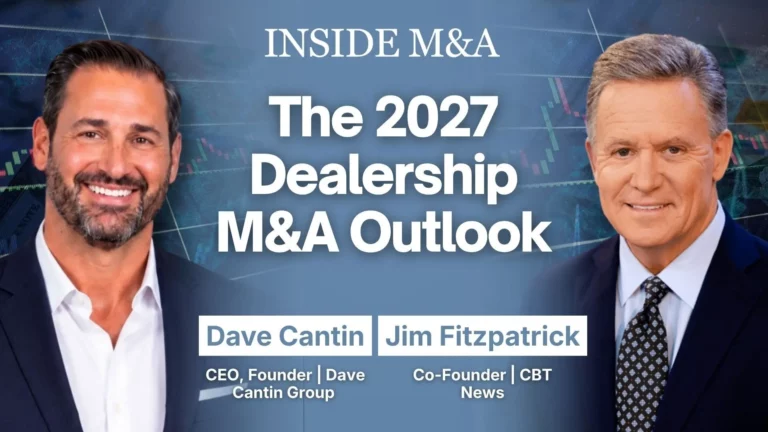
Dealers considering buying or selling a store want to know whether the market will hold up. While strong demand is helping, owners who prepare early are in the best position to benefit. On today’s episode of Inside M&A, Dave Cantin, Founder, CEO & Chairman of Dave Cantin Group (DCG), explains what is driving dealership valuations and deal activity in the final quarter of 2026 and heading into 2027.
According to Cantin, deal activity shows no signs of slowing. Buyers who were sidelined for years have built up capital and are now looking for strong businesses, while sellers have spent the time since the COVID-19 pandemic weighing whether to exit or grow. Most are focused on running their stores rather than planning for succession and more dealers are now approaching the market with a strategy, which is leading to some strong acquisitions.
"Even with interest rates where they are today, we are still seeing a robust 2026. Quarter after quarter, it's not slowing down."
Cantin doesn’t expect the upcoming midterm elections to have much effect on fourth-quarter deals. If buyers or sellers were concerned about the elections, they would already be asking to wait until after the vote, he said. But confirmed that his firm hasn’t seen that.
Buyers want growth while sellers see a window to exit
Cantin said strategic growth is the main reason buyers are active right now, since they want to grow alongside OEMs they view as true partners. While many aim to acquire several stores in one area and build platforms in the markets they choose, buyers now seek out deals after first selecting their markets and OEM partners. Meanwhile, many sellers have no next generation to take over and no employees who could afford to buy them out.
Cantin says current valuations are at an all-time high and many dealers see this as possibly the best time to sell.
Selling takes preparation, and neighbor deals can cost money
A decision to sell doesn’t mean a dealer is ready to do so, Cantin said. Before taking a dealership to market, his firm prepares the dealer, the platform and the people. The goals are to ensure a smooth handoff for the team and secure the highest possible price for the seller. Partners such as Goldman Sachs help with tax preparation, estate planning and asset management. Cantin said the process takes time.
"We jump to set them up for success. We don't jump to bring them to market."
Many dealers with one store or a few stores are contacting other dealers in their markets about acquisitions. Selling to a neighbor can feel safest, but it can leave significant money on the table.
A true advisory firm handles the valuation, appraisal, environmental review and due diligence. Dealers already carry homeowners, garagekeepers, life and health insurance. Cantin said an advisory team offers similar protection when an owner exits a business built over a lifetime.
Why dealers should treat their stores as a platform
Dealers are building clusters of stores in a single market to create synergies, Cantin said. Public dealer groups led the way, and privately held groups are now following suit, since few buyers want to own a single store in a market without other people there to support it. DCG encourages dealers to see their stores as assets in a larger portfolio. A wealth management advisor will suggest selling the 10% of a portfolio that is not performing. The money then goes into assets that do perform, he said.
Meanwhile, an asset that distracts an owner from performing in the store becomes the best move once it is sold. Owners then say they should have acted 10 years earlier.
Brand outlooks heading into 2027
According to Cantin, Nissan works for engaged operators who are in the store every day, and Audi needs a stronger product to win back dealers and then consumers. He also notes that Volkswagen dealers are disappointed that the manufacturer is not acting as a true partner.
Meanwhile, Porsche remains a blue-chip asset with a limited number of stores. Buyers who can afford one still want one, Cantin said. Mercedes-Benz is well led by Adam Chamberlain, President and CEO of Mercedes-Benz USA, and Cantin has no dissatisfied Mercedes-Benz dealer clients. He says buyers are actively pursuing strategic growth in partnership with OEMs, focusing on acquiring multiple stores in targeted markets. At the same time, many sellers lack a next generation or capable employees to take over. With valuations at an all-time high, many dealers see this as an ideal time to sell.