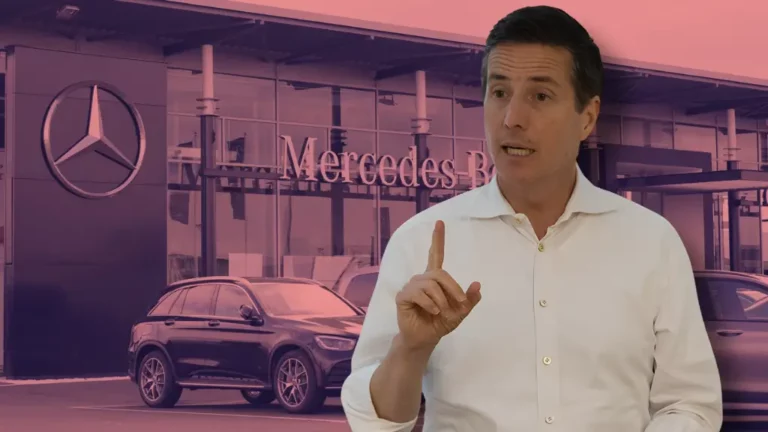
With dealership profits tightening and competitive pressures mounting, many retailers are looking for new ways to improve their bottom line. During today’s Inside Automotive episode, Dave Mondragon, Founder and CEO of AutoTrust Dealer Alliance, explains why he believes dealers don’t have a profit problem as much as a leverage problem, and how collective scale can help close the gap.
Mondragon states that dealer group consolidation has historically focused on achieving economies of scale. Larger groups can reduce costs, increase profit margins, and recover acquisitions more quickly than smaller operators. For instance, he highlights Carvana’s swift expansion of a Stellantis store. After Carvana acquired it, the store, which used to sell 30 to 50 units monthly, became one of the highest-volume Stellantis stores in the country.
“They didn’t do it because their dealers and their management team is better or stronger or smarter than the average dealer in the marketplace…They did it because of their scale.” He added that competing dealers face a difficult challenge without access to similar scale, unless they find a cooperative model that can match that leverage.
Dealers need leverage, not operational advice
First and foremost, Mondragon says most dealers already know how to run profitable operations and don’t need another consulting company telling them how to sell cars. “What they need,” he says, “is a better way to scale what they already have.” Therefore, he asserts that AutoTrust’s role is to create efficiencies and profit opportunities on the back end of dealership operations, including parts and service, without changing how dealers run their day-to-day business.
AutoTrust is structured as a 100% dealer-owned cooperative. Rather than acquiring dealerships, the organization aggregates member volume to negotiate better terms with vendors and partners. Profits generated through that leverage are distributed back to dealer members. The goal, Mondragon said, is to give a 5-,10-, or 20-store dealer group the same negotiating power as a 300-store public retailer.
“Today, we have more than 350 committed rooftops.”
Mondragon attributes AutoTrust’s growth largely to momentum following the NADA Show. Additionally, he expects the cooperative to surpass 500 dealers within the next 12 to 18 months and reach 1,000 dealers within three years, a scale he said would exceed that of the largest public dealer groups. “By this time next year, we’ll have well over 500 dealers on our platform,” Mondragon confirms.
Targeting non-OEM opportunities
Mondragon said AutoTrust is designed to complement, not compete with, OEM finance and incentive programs. Dealers continue working with captive finance companies on subvented deals, lease rates and floor plans. He says AutoTrust instead focuses on contracts and financing opportunities that typically fall outside OEM programs, including used vehicle and subprime financing.
Additionally, he notes that members benefit from improved lender terms, spreads and advance policies on that business. Mondragon confirms, “We give [dealers] access to all of these avenues and all these partnerships at greater discounts and greater incentives.”
“Our dealers are the pillars of their community…they’re also the backbone of the franchise system.”
Dealers no longer need to sell their stores to gain the advantages of scale, Mondragon said. Where public groups scale through acquisition, AutoTrust members scale through participation while retaining ownership. “We don’t want a dealer to have to sell out,” Mondragon said. “We want their business to be sustainable. We want them to pass it on to the next generation… our team works for the dealers.”
He pointed to industry-wide pressure as a reason for the model’s appeal, citing what he described as a drop in the industry’s seasonally adjusted annual sales rate and an estimated 12% decline in dealer profits this year. Mondragon said cooperative scale offers dealers a way to offset those losses without overhauling their operations.
Looking to the next five years, Mondragon said the auto retail industry’s future will favor dealers who find new ways to access scale while preserving their independence.