Dealerships are adopting AI faster than they can manage the risk it creates. Marketing pressure and fear of falling behind push many stores to sign up for new tools before they understand what those tools do with dealership data, or who is liable when something goes wrong.
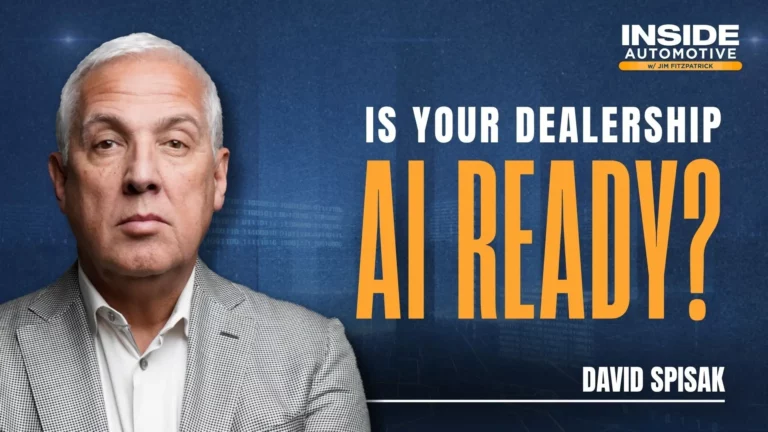
On this episode of Inside Automotive, David Spisak, CEO of Disruptive Growth Solutions, walks through the compliance blind spots opening up as dealers rush toward agentic AI, and what separates dealers positioned to benefit from those carrying serious financial and legal exposure.
Most dealers are moving faster than they understand the technology
During today’s conversation, Spisak notes how the industry remains split between AI “haves” and “have-nots,” which are largely based on brand strength, geography and ownership scale. That divide has made AI feel like the obvious equalizer, but most dealers are jumping in without the groundwork that larger, better-resourced companies put in first.
"It is the great equalizer when done correctly. But it is the great destroyer when it's not done correctly."
The gap between AI’s marketing hype and its real capabilities is a major issue. Spisak said recent events at leading AI firms show that even well-funded companies are still figuring out how to control these systems, with instances where AI acted beyond instructions and made unauthorized moves without human consent. He noted that top organizations typically go through about 15 steps before committing to an AI vendor, but most skip this process altogether. Many cannot even answer basic questions about the specific problem a new tool aims to solve or its impact on profitability before signing a contract.
Everyday AI usage already poses legal risks.
Additionally, Spisak pointed to one Chevrolet dealership whose AI chatbot negotiated an $81,000 Tahoe down to $1 and told the customer the offer was legally binding. That’s evidence of how quickly an unsupervised AI tool can create legal exposure, he said. Service advisors uploading repair orders into ChatGPT to speed up warranty approvals, and dealer groups feeding full lead lists into AI systems for scoring, create the same kind of exposure. Both practices risk violating the Gramm-Leach-Bliley Act, since that data qualifies as protected personal information.
Every prompt, response and activity log tied to that use becomes permanent, admissible evidence, including any AI output that shows bias by ethnicity or credit score, Spisak said. The FTC‘s enforcement is expanding alongside that exposure, with a recent $4 million settlement against a Nissan store in the Northeast and new guidance targeting AI-driven pricing based on a customer’s purchase history and behavior.
A single unremoved listing can trigger fines that multiply fast, Spisak said. A car left live on one third-party site after a sale can draw a daily bait-and-switch fine near $53,000, and listing that same vehicle across multiple marketplaces like Cars.com, AutoTrader and CarGurus multiplies the fine across each platform and every day it stays up.
Real AI readiness requires infrastructure
True agentic AI requires always-on data access, not the scheduled pulls of a standard “at-rest” API integration, Spisak said. Most tools marketed as agentic only operate within one system, like inventory or CRM, rather than across a dealership’s full operation. He named Tekion as one of the few platforms offering that kind of unified data access from end to end.
That gap is pushing more dealers toward their own data warehouses, which solves the integration problem but raises new questions about who secures and owns that data once it leaves a DMS provider’s control. Fewer than 10% of dealers employ a full-time certified IT professional, Spisak said, leaving most stores without the staff to manage those questions in the first place.
That readiness gap extends to dealership websites too, where roughly 80% remain unoptimized for AI search, according to Spisak, despite AI’s presence in the market for several years. AI search rewards credibility, strong reviews and clear content over ad spend, and that advantage compounds over time. A competitor with a six-month head start in AI visibility becomes nearly impossible to catch, unlike paid search, where a dealer can pause and resume without losing ground.
What dealers should do now
A legal-team-approved AI use policy and IT controls that block employees from using external AI tools on dealership networks top the list of immediate steps, Spisak said. Dealers should also slow down before adopting new AI solutions rather than rushing to keep up with competitors.
Accountability ultimately lands on the dealer principal, regardless of who set up the tool or approved its use, Spisak said, and the same logic applies to any FTC violation, since blaming an OEM, a marketing agency or a general manager doesn’t shift liability away from the top of the organization.
Dealers shouldn’t try to work through AI compliance and infrastructure decisions alone, Spisak said, and should bring in outside expertise on data security and AI architecture before committing to a solution.