On the Dash:
• Vision Pulse uses ultra-wide band signals to detect vehicles, pedestrians, and objects beyond a driver’s line of sight.
• The system delivers real-time accuracy while reducing dependence on expensive sensors like LiDAR and radar.
• Hyundai and Kia are testing the technology in industrial and transportation environments before considering mass production.
Hyundai and Kia on Monday unveiled Vision Pulse, a new driver safety technology designed to detect obstacles beyond a driver’s line of sight using ultra-wide band signals.
The technology uses UWB communication to identify the precise location of nearby vehicles, pedestrians, and objects in real time, even in visually obstructed environments. The system is intended to improve urban driving safety while reducing reliance on costly sensors such as LiDAR and radar.
Vision Pulse works by using UWB modules installed in vehicles to emit signals that interact with other UWB-enabled devices, including smartphones, wearables, and tracking devices. By measuring signal travel time, the system calculates object positions with up to 10-centimeter accuracy within a 100-meter radius. When a potential collision risk is identified, the system issues alerts to the driver.
Vehicles already equipped with Hyundai and Kia’s Digital Key 2 technology include the required UWB modules, allowing Vision Pulse to operate without additional hardware. The companies said the approach offers both cost efficiency and scalability as UWB adoption expands.
The automakers say Vision Pulse addresses the limitations of existing blind-spot detection systems, which often rely on fixed infrastructure or slower communication networks. UWB’s high-frequency bandwidth minimizes interference and enables rapid response times of 1 to 5 milliseconds. The system maintains more than 99 percent detection accuracy, including during nighttime or adverse weather conditions.
To improve real-world usability, the automakers developed predictive algorithms that can track multiple fast-moving objects simultaneously. This allows the system to anticipate movement patterns around a vehicle rather than react only after objects appear.
Beyond passenger vehicles, the automakers expect Vision Pulse to support broader safety applications. The technology is being tested in industrial environments to prevent collisions between workers and machinery and is also being evaluated for disaster response scenarios to help locate individuals trapped under debris.
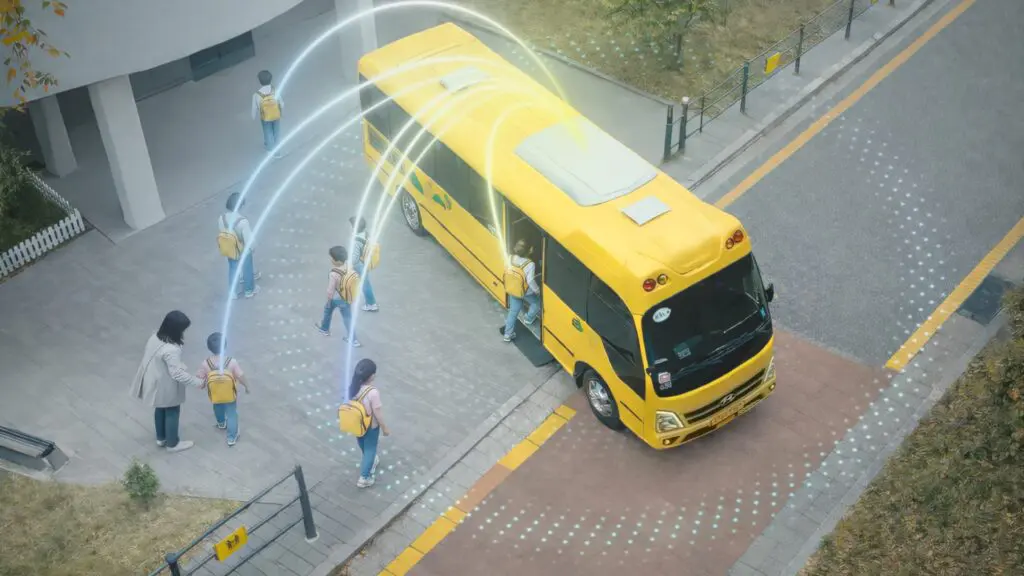
The companies recently showcased Vision Pulse in a campaign video demonstrating its use on school buses, paired with UWB-enabled keyrings designed for children.
The automakers are currently conducting pilot programs at Kia’s PBV Conversion Center in South Korea and at Busan Port Authority facilities. The companies emphasized that Vision Pulse remains a pre-development technology, with potential mass-production applications still under review.