Welcome back to the latest episode of The Future of Automotive on CBT News, where we put recent automotive and mobility news into the context of the broader themes impacting the industry.
I’m Steve Greenfield from Automotive Ventures, and I’m glad that you could join us this week.
This week, a major shift in the auto industry — one that could redefine how cars and trucks are built in America.
If the legacy automakers are going to compete with the onslaught of the Chinese automakers, they will need to rethink their entire business, focused on aggressively removing the cost of production, and dramatically reducing their innovation cycles.
So it’s exciting to see evidence that the legacy automakers are challenging their business models.
For more than a century, legacy automakers have relied on the same basic approach to manufacturing — perfected by Henry Ford himself — the moving assembly line. But now, facing unprecedented pressure from low-cost, fast-moving Chinese competitors, companies like Ford and Toyota are tearing up the old playbook.
This week, Ford unveiled plans for a $2 billion transformation of its Louisville Assembly Plant. The goal? Build a $30,000 midsize electric pickup by 2027, and do it up to 40 percent faster than today’s vehicles. The secret is a new “universal” EV platform and a radically different assembly process — not a single conveyor belt, but three separate lines, assembling the front, the rear, and the battery platform simultaneously before joining them together. Ford says it cuts parts by 20 percent, wiring by 22 pounds, and workstations by nearly half.
CEO Jim Farley admits it’s a gamble. “There are no guarantees,” he says. “This is a bet — and there’s risk.” But with Ford’s EV division losing more than a billion dollars last quarter, it’s a bet the company believes it has to make.
Just a month back, we heard that Toyota is making its own bold move.
In Georgetown, Kentucky, the company’s oldest U.S. plant is getting a sweeping overhaul. Known internally as “K-flex,” the new Line 1 can build almost any vehicle on Toyota’s TNGA-K platform — from Camrys to Highlanders to EVs — on the same line, with minimal downtime. It’s a highly automated, robot-driven operation designed for maximum flexibility, and Toyota believes it could become the global standard.
For both Ford and Toyota, the stakes couldn’t be higher. It’s exciting to see legacy automakers challenge 100 year old preconceived notions about how to design and build vehicles. Without such dramatic moves, the legacy automakers are going to continue to be on their back foot, inadequately prepared for the onslaught of dozens of Chinese automakers, who have figured out how to build high quality cars cheaper and faster than their legacy competition.
So, with that, let’s transition to Our Companies to Watch.
Every week we highlight an interesting company in the automotive technology space to keep an eye on. If you read my weekly Intel Report, we showcase a company to watch, and we then take the opportunity here on this segment each week to share that company with you.
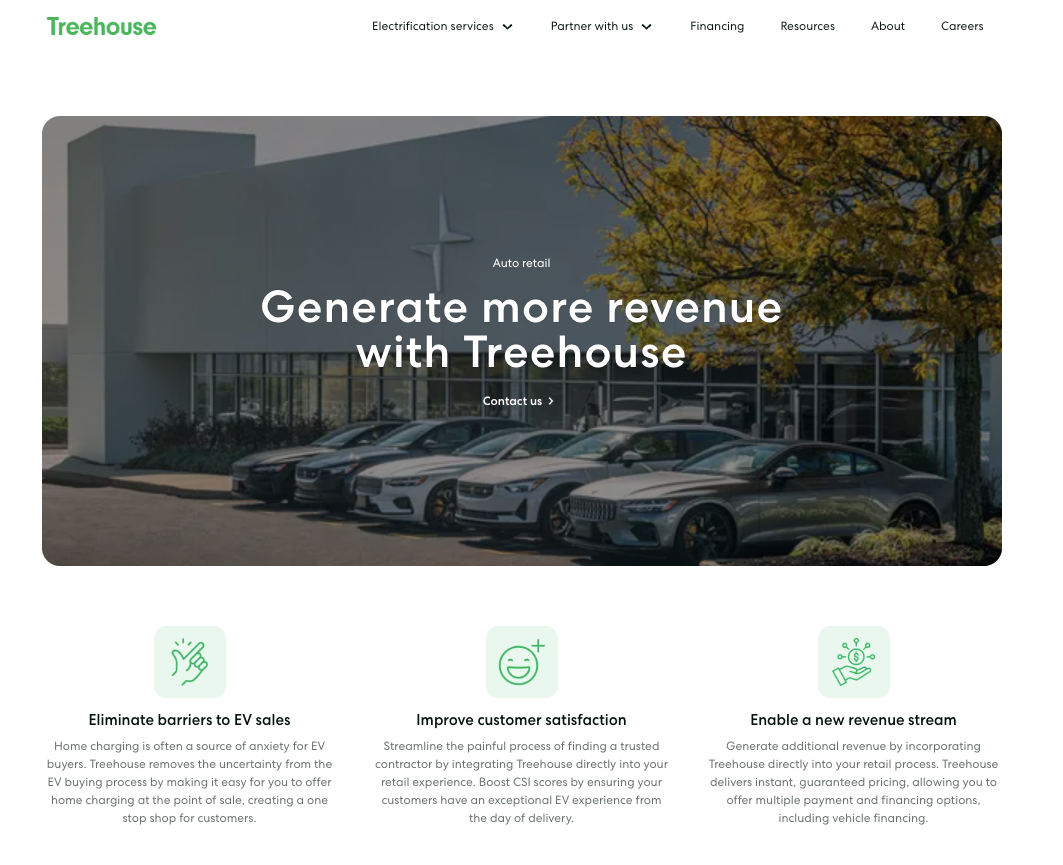
Today, our new company to watch is Treehouse.
Treehouse is an electrical contractor for the 21st century.
Treehouse can deliver electrification projects faster and with greater precision than other options.
Dealers generate more revenue from Treehouse.
You also eliminate barriers to EV sales, while improving customer satisfaction and enabling a new revenue stream.
How does Treehouse work?
Treehouse manages installation end-to-end in 4 easy steps.
Treehouse combines responses from a short customer survey with available property data to deliver an instant, guaranteed price.
Treehouse sends customers a link to upload photos of their electrical panel and where they’d like the charger installed.
All installations are done in compliance with the National Electrical Code and local regulations. Treehouse handles the permit process so customers don’t have to.
If you’d like to learn more about Treehouse, you can check them out at www.treehouse.pro
So that’s it for this week’s Future of Automotive segment.
If you’re an AutoTech entrepreneur working on a solution that helps car dealerships, we want to hear from you. We are actively investing out of our DealerFund.
Don’t forget to check out my first book, “The Future of Automotive Retail,” and my new book, “The Future of Mobility”, both of which are available on Amazon.
Thanks (as always) for your ongoing support and for tuning into CBT News for this week’s Future of Automotive segment. We’ll see you next week!