On the Dash:
- Ford Energy signed its first commercial customer: EDF Power Solutions North America.
- The Ford Motor Co. subsidiary is repurposing its Kentucky EV battery plant to produce grid-scale storage systems.
- The deal is a key part of the automaker’s plan to turn around Model e losses by 2029.
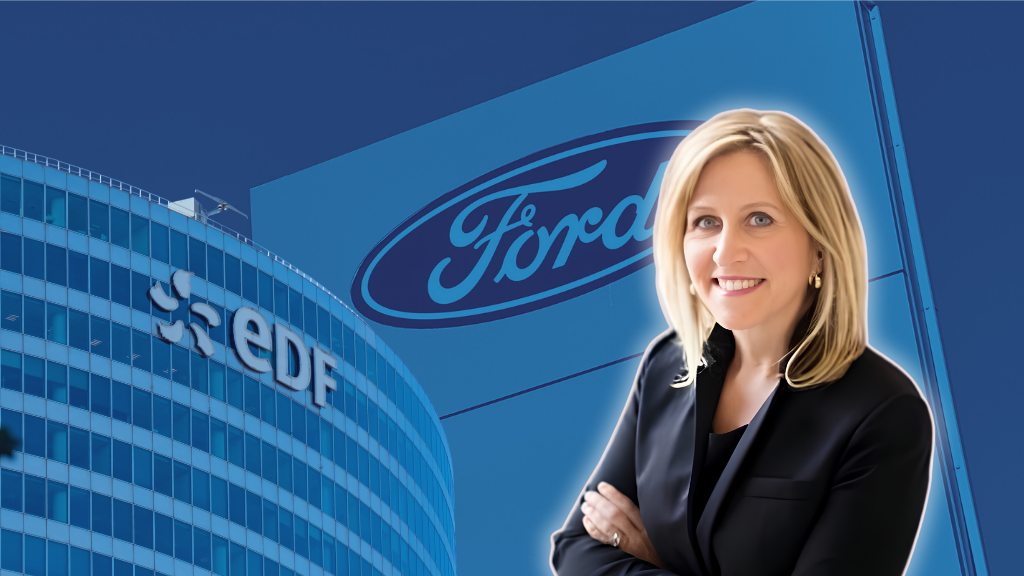
Ford Energy, a Ford Motor subsidiary, announced a five-year framework agreement with EDF Power Solutions North America. Under the deal, EDF can procure up to 4 gigawatt-hours of DC Block battery energy storage systems annually, for a total potential volume of 20 gigawatt-hours. Deliveries are expected in 2028.
EDF Power Solutions North America is a subsidiary of France’s EDF Group. It develops and operates low-carbon energy and grid infrastructure across the U.S., Canada, and Mexico.
The agreement is the first commercial contract for Ford Energy since Ford launched the subsidiary earlier this month. The business draws on repurposed plant capacity at BlueOval Battery Park in Glendale, Ky., which Ford originally built for EV battery production. Ford is targeting 20 GWh of annual deployment from the Kentucky facility by late 2027.
“This agreement with EDF Power Solutions validates the market’s need for a BESS supplier that combines industrial-scale manufacturing discipline with full lifecycle accountability,” Lisa Drake, president of Ford Energy, said in a company release.
The Ford Energy DC Block is a standardized, 20-foot containerized system rated at 5.45 megawatt hours per unit. It uses lithium iron phosphate cells and is available in two-hour and four-hour discharge configurations. Ford says the units can be used for frequency regulation, energy arbitrage, peak load shifting, backup power, and microgrid integration.
The deal comes as Ford works to turn around its money-losing Model e division. As CBT News reported, the division lost $777 million in the first quarter of 2026, with full-year losses projected at $4 billion to $4.5 billion. Morgan Stanley has called Ford Energy an underappreciated driver of that turnaround.
Ford Energy has no direct impact on vehicle production or dealer operations. It functions as a separate commercial business targeting utilities and industrial customers, not the retail channel.