Dealership families facing succession challenges or seeking access to capital often feel caught between keeping the business entirely in the family and selling it outright. Open Road Capital offers another option through equity partnerships that provide liquidity while letting dealership operators preserve their businesses and keep growing.
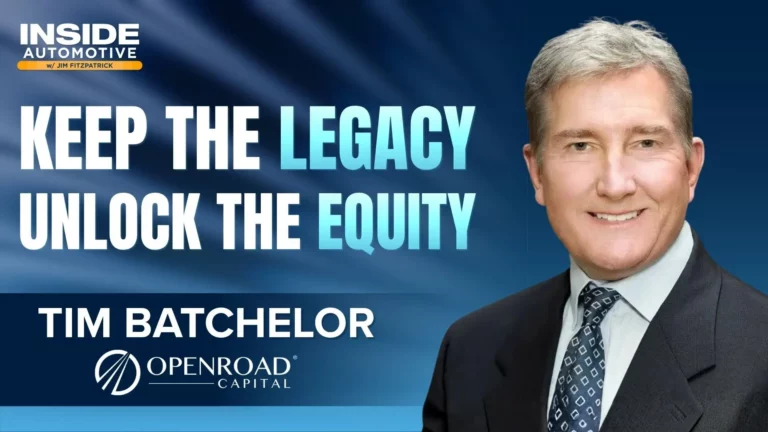
Tim Batchelor, Co-Founder and Managing Director of Open Road Capital, joins us on today’s Inside Automotive episode and elaborates that the idea grew out of a common challenge in family-owned dealerships. As founders age, some family members want to cash out while others want to keep running the business. When ownership interests are divided, those who want to continue the family legacy can find themselves outvoted, which can bring an end to a business that has operated for generations.
Solving succession friction
According to Batchelor, Open Road Capital can buy whatever percentage of the business family members want to sell, while providing support and capital for the family members that want to grow the business and continue the family legacy.
The company also partners with dealers who are not ready to exit but want to take some chips off the table, whether for diversification, to reduce risk, or for liquidity. Another segment of dealers is those who are looking to acquire more stores and expand beyond what their current capital allows. For those dealers, Open Road can come in as a partner, contribute as much as 100% of the capital for an acquisition, and adjust ownership to match.
“We don't run dealerships. We support the people that we invest with.”
Batchelor notes that the model addresses the growing challenge for dealership managers who want to become owners. As dealership valuations rise, those general managers may struggle to secure enough capital to buy the stores they operate. Open Road can back qualified operators and established dealers seeking to acquire additional locations, with ownership interests structured around each partner’s capital contribution.
OEM alignment
The company’s approach also depends on alignment with manufacturers and its operating partners. Batchelor said Open Road has developed solid relationships with most all major brands, including receiving rights of first refusal and access to open points.
Partnership Example
A partnership involving Herrin-Gear in Mississippi illustrates how the approach can support succession and liquidity at the same time. According to Batchelor, the dealership’s owner, Jack Herrin, wanted financial diversification and relief from working seven days a week without losing the family legacy. Open Road proposed elevating Reed Howell, who had worked for the group for 26 years and led its stores for 16 years, to president and selling him equity on a tax-advantaged basis. Batchelor said he pitched a structure in which the owner would sell 60% to 80% of the business to Open Road, retain 20% to 30%, and sell a minority stake to Reed, and the owner agreed to the plan. The result is it provided the owner with the liquidity and financial diversification he was seeking while allowing him to remain on the board. It also elevated his long-time protégé to an owner stake that changed his life, with no impact on the dealership’s employees. Batchelor said the owner has since passed away, and his family, which inherited his shares, has chosen to keep the shares rather than sell them back to the company.
Governance & exit terms
Open Road Capital is an operating company that happens to be funded by institutional capital. Its partnerships are structured to last in perpetuity, or as long as the dealer wants to continue the partnership. Open Road Capital and the Dealer Partner set governance and exit terms at the outset, with the goal of keeping partners aligned on major decisions and future growth. Batchelor said the company has about 53 dealerships and expects to reach roughly 60 as pending deals close. Batchelor said the company may approach 100 dealerships in the not-too-distant future, but it has set no specific target and does not pursue growth simply to increase its size.
Batchelor encourages dealers and their advisers to consider alternatives rather than treating a potential transaction as a binary yes-or-no decision about selling. He said a partial equity sale can give owners financial flexibility, preserve a role in the business, solve generational transfers, and create capital for future opportunities. At the very last, he said, dealers should understand their options.