On the Dash:
- Owner satisfaction hit 858 points, up 7, the biggest annual gain since 2018
- New models still lag carryover vehicles, with infotainment and setup issues persisting
- Premium brands lost ground, with mass market vehicles closing the satisfaction gap to 29 points
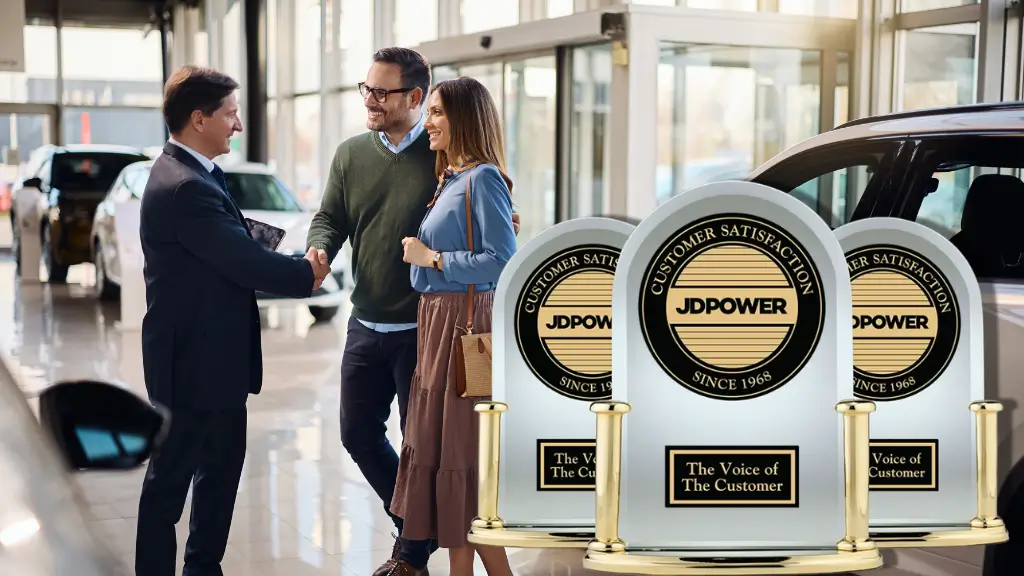
According to the JD Power 2026 U.S. Automotive Performance, Execution and Layout (APEAL) Study released Thursday, new-vehicle owners are more satisfied with their vehicles than they’ve been in years.
Overall satisfaction reached 858 points on a 1,000-point scale, up 7 points year over year. It’s the third straight annual increase and the largest single-year gain since 2018. Last year’s study showed a 4-point increase to 851, so this year’s jump nearly doubles the pace of improvement.
The gains track closely with this year’s JD Power U.S. Initial Quality Study, as owners report fewer problems with their vehicles. They’re also reporting more enthusiasm for how those vehicles look, feel and perform. JD Power’s Frank Hanley, Senior Director of Auto Benchmarking, said the data shows quality alone isn’t enough to drive owner enthusiasm. Brands that also deliver thoughtful design, comfortable interiors and easy-to-use technology are the ones seeing the strongest advocacy from customers.
Notably, interior design drove the biggest gains, up 11 points. The study found that owners responded well to better cupholders, phone placement and center console layouts. Exterior styling and ease of entry both rose 10 points, pointing to everyday usability as a growing factor in owner satisfaction.
New models aren’t moving the needle
New models still aren’t delivering the excitement dealers might expect, the study found. For a fifth consecutive year, newly launched vehicles scored only marginally higher than their carryover counterparts, up just 2 points overall. New premium models actually scored 3 points below carryover premium models, while new mass market models fared better, outperforming carryover models by 12 points. JD Power pointed to infotainment systems and vehicle setup as the main issues on new-model scores, a problem the study also flagged last year.
The gap between premium and mass market brands keeps narrowing. Excluding Tesla, the emotional satisfaction gap between premium and mass market brands has shrunk to 29 points, down from 66 points in 2008. Premium brands no longer hold a clear edge in infotainment, exterior styling, driver-assistance systems, headlight performance or even door-closing sound. For dealers, that means a premium badge alone carries less weight than it used to. Execution is doing more of the work.
Battery electric vehicles posted the sharpest gains of any powertrain type, up 22 points year over year. BEVs outperformed internal combustion vehicles in nearly every category, with the widest gap in powertrain satisfaction at 109 points. That’s a notable reversal from last year, when BEV satisfaction excluding Tesla had dropped 17 points.
Brand rankings
- Porsche ranked highest among premium brands for a third straight year, scoring 896, the only brand to top its segment average
- MINI led mass market brands for a third consecutive year at 875
- Hyundai ranked second among mass market brands at 858
- Kia ranked third among mass market brands at 857
Model-level awards
BMW AG collected the most model-level awards with six, followed by Hyundai Motor Group with five and General Motors with three:
- BMW AG: BMW X2, BMW X6, BMW 2 Series, BMW 5 Series, BMW 7 Series and MINI Countryman
- Hyundai Motor Group: Hyundai Palisade, Hyundai Santa Cruz, Kia Carnival, Kia K4 and Kia K5
- General Motors: Chevrolet Blazer, GMC Yukon and Cadillac Escalade
- Ford Motor Company: Ford Super Duty and Ford Mustang
- JLR: Jaguar F-Pace and Land Rover Defender
- Nissan Motor Co.: Nissan Murano and Nissan Armada
- Toyota Motor Corporation: Toyota RAV4 and Toyota Crown Signia
- Mercedes-Benz Group: Mercedes-Benz C-Class
- Stellantis: Ram 1500
- Volkswagen AG: Porsche 911
The BMW X6 and BMW 7 Series tied as the highest-ranking individual models. The Kia K5 has now won a segment award for six consecutive years, and the MINI Countryman for four.
The 2026 study is based on responses from 78,514 owners of new 2026 model-year vehicles surveyed after 90 days of ownership. It was fielded from June 2025 through May 2026, covering vehicles registered between March 2025 and February 2026.