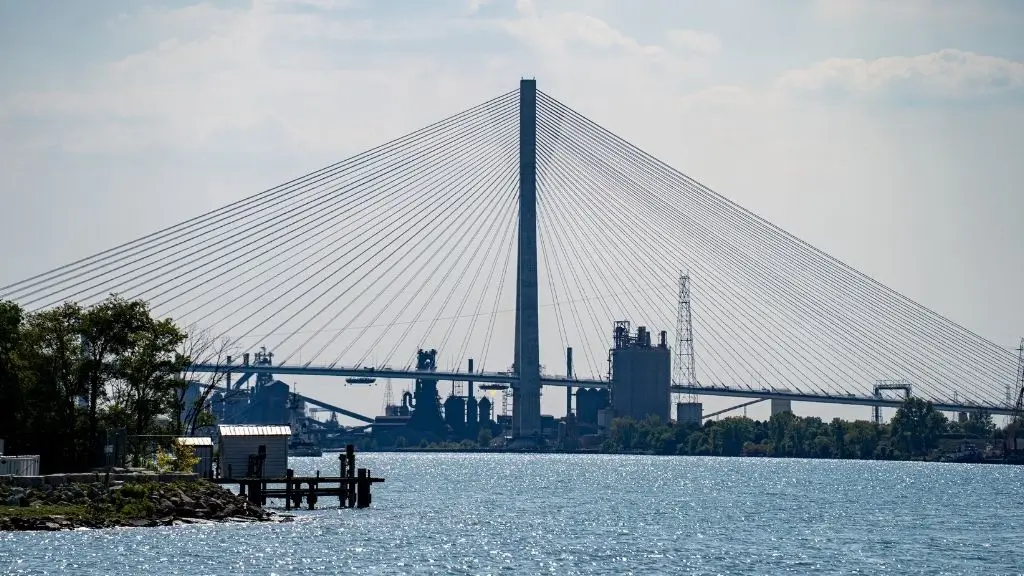
On the Dash:
- The Gordie Howe International Bridge is expected to improve freight flow between Detroit and Windsor, reducing delays for automotive supply chains.
- A new U.S.-Canada toll agreement clears a key hurdle ahead of the bridge’s opening and supports long-term cross-border operations.
- The second Detroit-Windsor crossing will add capacity and redundancy, helping protect dealers and manufacturers from future supply chain disruptions.
The U.S. and Canada announced an opening date in a joint press release Friday for the Gordie Howe International Bridge, following weeks of negotiations over toll governance and a 15-year economic development plan funded by a share of the bridge’s operating revenue.
U.S. officials had pushed back on an earlier plan that would have delayed any American share of toll revenue until Canada recouped its investment in the 1.5-mile bridge, a process that could have taken decades. The two sides ultimately agreed to a set of cooperative measures on toll governance and transparency, directing bridge revenues toward regional investment instead. The Windsor Bridge Authority will also work with U.S. officials on toll-rate adjustments and will seek agreement on certain non-market-related toll charges.
Michigan Gov. Gretchen Whitmer said the bridge will give people on both sides of the border better-paying jobs and brighter futures, and will speed up auto production, lower costs, ease traffic, and strengthen agriculture.
Why it matters
The Gordie Howe Bridge adds a second span between Detroit and Windsor and is projected to handle 400 commercial crossings per hour once it opens. A 2021 report from the Cross-Border Institute projected that the bridge would reduce truck border-crossing times enough to save about 850,000 hours a year, translating into billions of dollars in economic savings over the bridge’s service life.
The institute noted that cross-border automotive supply chains depend on fast, reliable crossing times, since a single vehicle assembly plant can rely on 1,000 trucks a day, all synchronized to deliver parts within tight windows.
The current bottleneck
Commercial traffic between Detroit and Windsor has relied for decades on the nearby Ambassador Bridge, which handles about 40,000 crossings and roughly $323 million worth of goods a day. The Moroun family owns the privately held bridge and also owns Warren, Michigan-based less-than-truckload carrier Central Transport, along with board seats at Universal Logistics Holdings and PAMT.
The Cross-Border Institute said the new bridge won’t replace the Ambassador Bridge but will instead give the corridor much-needed redundancy. Operating two bridges at the crossing essentially rules out a complete shutdown of the Detroit River crossing, the institute said in its report.
The Canadian Trucking Alliance said the new bridge adds capacity, modern border infrastructure and long-term resilience to the busiest commercial trade corridor between the two countries. The alliance said that modern customs facilities, expanded inspection capacity and direct freeway-to-freeway connections will ease congestion, strengthen supply chain security and divert heavy truck traffic away from Windsor’s residential neighborhoods.
Currently, officials expect the Gordie Howe Bridge to relieve pressure on the Ambassador Bridge and give automakers and suppliers a faster, more reliable route for parts and finished vehicles moving between the two countries. The agreement over toll governance and revenue sharing marks the last major hurdle before the bridge opens later this month.