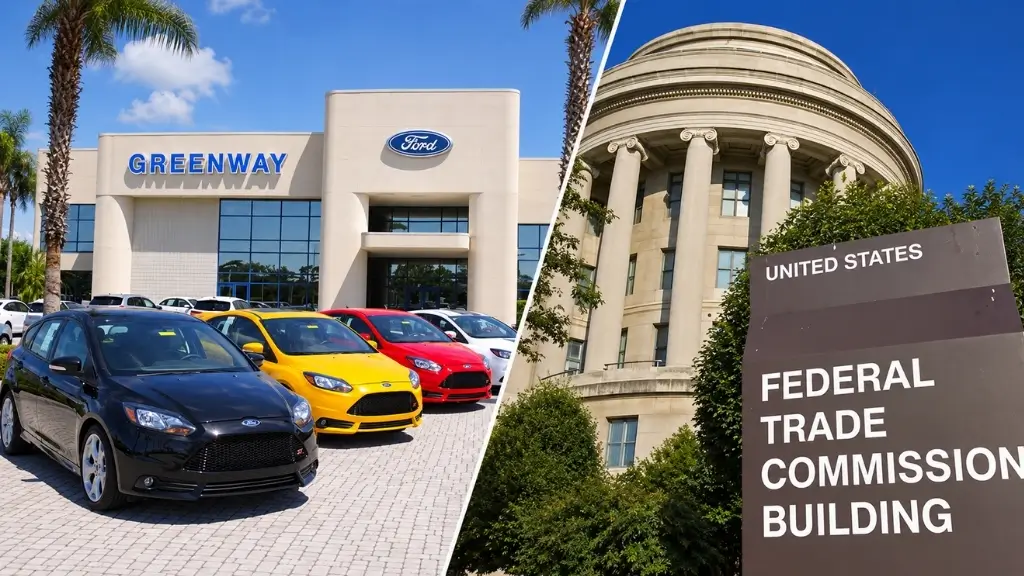
The Federal Trade Commission‘s (FTC) new advertising compliance rules are forcing dealers to monitor at least 16 violation categories across every department and every channel. Social posts, emails, and third-party listings left up hours after a car sells all count as advertising under the FTC’s framework.
Joining us on today’s episode of Inside Automotive is David Spisak, CEO of Disruptive Growth Solutions, who believes the rules are well-intentioned but unworkable. Spiak says the industry needs to clean up its own practices while pushing the FTC toward a more reasonable framework.
FTC policy
The FTC’s rules cover at least 16 compliance categories. For a dealership with multiple departments and more than one rooftop, that number multiplies quickly.
"We can't talk about it enough until we can get to a resolution. Either we put dealers in a position to firmly understand what needs to be done, or we get the FTC to come to their senses."
While the definition of advertising is broad, a salesperson sharing a new product on social media counts. Similarly, mentioning a rebate in an email or a third-party listing that remains online after a car has been sold can be considered a bait-and-switch advertising violation.
“There’s no way somebody can easily, effectively and accurately audit every source, every person, every day,” Spisak said.
The financial exposure is significant, as violations do not stay contained to a single category. For instance, one listing issue can generate infractions across several, with fines accruing by the day.
The industry carries the responsibility
Spisak says the FTC had legitimate reasons to act and that the industry itself is partly to blame. “Have we brought this on? Yeah. Do we have some culpability? No, we have a lot of culpability,” he says.
Additionally, he points to the COVID-era chip shortage as a clear example. When inventory dried up, many dealers charged well above MSRP. Research at the time showed that about 30% of buyers who paid that premium said they would never return to that store. That produced record-low brand and dealer loyalty, he says, while handing automakers a reason to push the direct-to-consumer sales model.
Notably, Spisak mentions doc fees as another area that creates customer confusion and price disparities. Fees range from $85 in California to $1,500 or more in some Florida markets. The years of inconsistency across the country made the industry an easy target, he says.
However, Spisak notes that not every dealer can absorb a major fine. He says newer operators and first-time store owners face the greatest risk, as many are running lean, working deal to deal, focused on making payroll.
“One big million-dollar fine, $500,000 fine. You’re done,” Spisak says. “The financial side would be catastrophic. The reputational damage would be the nail in the coffin.”
He says there is no good outcome once a store is publicly named. A dealer with 30 years in the business looks like they finally got caught. A dealer six months in looks like they never should have been approved. Either way, customers take notice and walk away.
Moreover, a pricing violation may be the result of a vendor. But the FTC fines dealerships, not vendors. A vendor that makes a mistake and lands the dealership in trouble with the FTC is likely to lose that dealer as a client. Spisak says dealers are paying attention and will remember who protected them.
Anyone touching marketing, advertising, social, search, or digital needs to actively and continuously audit their dealer clients.
Impact on advertising and sales
The FTC rules are changing how dealers advertise. Faced with the risk of costly violations, many dealers have considerably pulled back on advertising.
"Wait till the next wave of fines comes out across the country. And then every dealer in the country is going to go, okay, halt all sales until we can figure this thing out."
But as advertising goes down, so do sales. Notably, he contends that these fees are beginning to show up in the May numbers. “I’ve got dealers around the country and it’s very, very few that are saying that they’re having a good month versus even a great month. Most of them, it’s been anywhere from abysmal to underwhelming,” Spisak says.
Automakers have reduced incentives, leading to fewer rebates and discounts for customers and lower bonus payments to dealers. Spisak states that manufacturer payments, which dealers rely on for profitability, have dropped by 30 to 40 percent or more. For many dealerships, this income has disappeared and has not been replaced.
The path forward
The FTC rules are not going away, and dealers need to take them seriously. But Spisak says some of the rules need to change.
“We’re not saying don’t take care of these unscrupulous dealers. Absolutely do. We’re saying take care of the customers. We believe in that. But come on, you’ve got to do it in a way that doesn’t harm great dealers in the process,” Spisak says.
He says the industry has weathered difficult moments before and will adapt again. But this one requires action, not just awareness. Dealers need to audit every channel, align with vendors that actively protect them, and push industry groups to engage the FTC on a more workable framework.
CBT News Auto Leadership Summit
To help dealers and vendors navigate this issue, CBT News is hosting the Auto Leadership Summit on Fair Pricing and Compliance in Washington, D.C., on June 16.
The summit will give dealers and industry stakeholders a direct line to the people shaping that shift. The one-day event, held at the Salamander Hotel, will bring together dealers, legal experts, and elected officials, including Ohio Sen. Bernie Moreno.
Session topics include an in-depth analysis of the FTC ruling, best practices for transparent pricing and consumer disclosure, compliance frameworks for advertising and dealership operations, and a legislative outlook from NADA policy advocates.
Registration ends soon, and seating is limited. Reserve your spot at cbtnews.com/auto-leadership-summit.