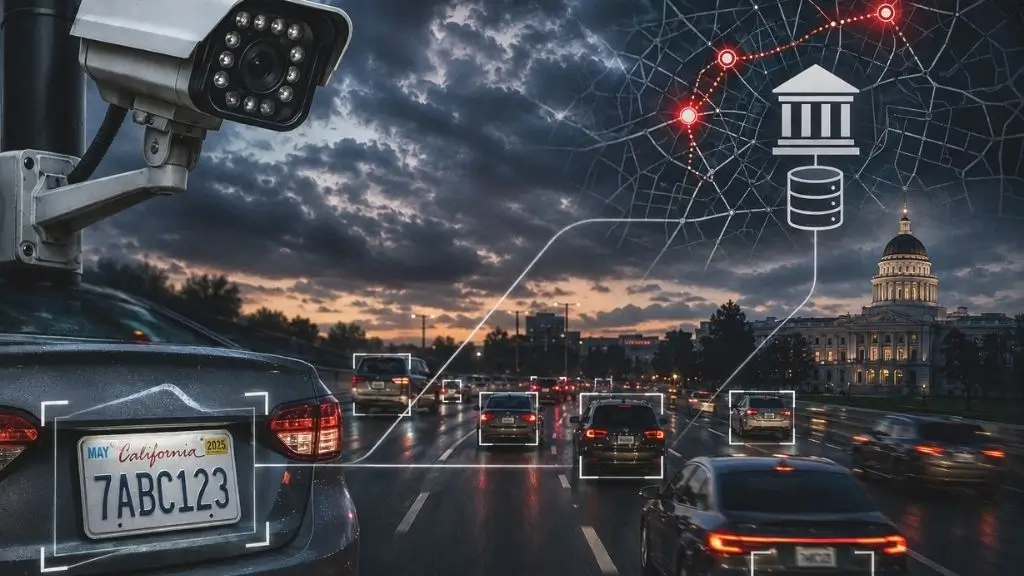
By now, most Americans assume they’re being watched online. What they don’t expect is just how aggressively they’re being tracked offline, every time they get behind the wheel.
A quiet but powerful fight is unfolding across the country over automated license plate reader systems, and it’s not just about traffic enforcement anymore. It’s about how much surveillance Americans are willing to tolerate before it crosses a constitutional line.
In San Jose, that line is now being tested in federal court. The city deployed nearly 500 automated license plate reader cameras, creating one of the largest vehicle tracking networks in the country. These systems don’t just capture license plates. They log where you drive, when you drive, what your vehicle looks like, and even unique identifiers like bumper stickers or roof racks. Over time, that data builds a detailed picture of your daily life.
That’s not speculation. That’s exactly what the lawsuit filed by residents and the Institute for Justice is arguing, that this kind of mass data collection amounts to a warrantless search, and therefore violates the Fourth Amendment.
And here’s where things get uncomfortable.
According to the complaint, thousands of government employees can access this data. Searches happen constantly, often with little oversight. That means your driving history isn’t just sitting in a local database. It can be shared, queried, and analyzed far beyond the original purpose of catching a stolen car or locating a suspect.
Supporters say these systems help solve crimes. Critics say they create a digital dragnet. Both can be true. But when the scale reaches hundreds of cameras and millions of data points, the conversation shifts from law enforcement tool to mass surveillance infrastructure. And Americans are starting to notice.
In Pine Plains, a small town in upstate New York, residents discovered that license plate reader cameras were about to be installed without public approval. What followed wasn’t a quiet concern. It was outrage. Town officials scrambled for answers. Conflicting explanations emerged. A recorded phone call suggested the rollout had been deliberately downplayed to avoid backlash. Residents packed meetings demanding transparency, and ultimately, the plan collapsed under public pressure.
This wasn’t a major city with a high crime rate. It was a town of about 2,200 people. That tells you something important.
The resistance isn’t just ideological. It’s instinctive. People understand when something doesn’t feel right. And this issue is spreading well beyond California and New York. In Washington state, multiple cities have already backed away from these systems after legal and public pressure.
In Canada, the government is going even further, eliminating automated speed cameras entirely. Officials there didn’t mince words, calling the systems a “cash grab” that failed to improve safety. That’s a remarkable reversal.
For years, automated enforcement was sold as a neutral, efficient solution. No bias. No discretion. Just data.
But that’s exactly the problem. Law enforcement requires judgment. Context matters. Algorithms don’t understand context, they enforce rules mechanically, often without regard for nuance or fairness. And when those systems are tied to fines or penalties, they create a powerful incentive to prioritize revenue over safety.
We’ve seen this before.
Red-light cameras exploded in popularity, then quietly disappeared in many areas after legal challenges and public backlash. The same pattern is now playing out with license plate readers and speed cameras. The difference is scale.
Modern ALPR systems don’t just catch a violation. They build a permanent record of movement. Over time, that data can reveal where you work, where you worship, who you associate with, and what routines define your life. That’s not traffic enforcement. That’s behavioral mapping. And once that data exists, it doesn’t just stay local. Agencies share it. Databases expand. Access grows.
The lawsuit in San Jose points out that this information can be searched across jurisdictions, sometimes even nationally. That means a single drive across town could become part of a much larger network of surveillance. Now consider the implications. Could this data be used to track political activity? Monitor protests? Assist federal enforcement actions unrelated to local policing? The answer isn’t theoretical. There have already been reports of misuse, including surveillance of individuals unrelated to criminal investigations.
That’s where the legal fight becomes critical. Courts are now being asked to decide whether this kind of tracking requires a warrant. The outcome could reshape how surveillance technology is used nationwide.
And make no mistake, the stakes are high.
If courts side with cities, expect rapid expansion. More cameras. More data. More integration between agencies.
If courts push back, it could force a fundamental rethink of how these systems operate, or whether they should exist at all in their current form.
This isn’t about being anti-police or pro-privacy. It’s about balance.
Most Americans support law enforcement. They want safer communities. But they also expect constitutional protections to mean something, especially when technology evolves faster than the law. Right now, that balance is out of sync.
Cities are deploying advanced surveillance systems first and asking legal questions later. Residents are finding out after the fact. Oversight is often minimal, and transparency is inconsistent at best. That’s not how this should work.
If a town is going to install a network capable of tracking every vehicle that passes through it, the public deserves a clear explanation, a vote, and strict safeguards. Anything less erodes trust. And once trust is gone, even useful tools become suspect.
There’s also a practical reality that often gets ignored.
Technology isn’t foolproof. Databases can be hacked. Systems can be misused. Errors can happen. And when they do, the consequences aren’t abstract. They affect real people, sometimes in serious ways.
False matches, incorrect data, or improper searches can lead to wrongful stops, investigations, or worse.
That risk grows as these systems scale. So where does this go next?
Expect more lawsuits. Expect more cities to quietly reconsider their programs. And expect lawmakers to start paying closer attention as public awareness grows.
Arizona is already considering putting a photo enforcement ban directly in the hands of voters. That’s a sign this issue is moving beyond courtrooms and into the political arena. And it should. Because at its core, this isn’t just about cameras.
It’s about whether Americans are comfortable living in a country where every movement on the road can be tracked, stored, and analyzed without a warrant.
For now, the answer seems to be increasingly clear. They’re not. And the backlash is just getting started. And if you want to see how bad it can get – just look to Europe where they are already installed and being used to ticket and track their citizens.
Check out my full commentary on this story: https://youtu.be/KAm_Ce4BDu0
Looking for more automotive news? https://www.CarCoachReports.