

On the Dash:
- The 2026 bZ starts at $36,350, offering dealers a lower-cost entry point, though the base trim sacrifices some range and power.
- While DC fast charging remains capped at 150 kW, AC charging has improved, and all models now come standard with a Tesla-style NACS port, giving buyers easier access to Tesla’s Supercharger network.
- Combined with longer ranges and higher output in upper trims, the 2026 bZ strengthens Toyota’s competitiveness in the U.S. EV market.
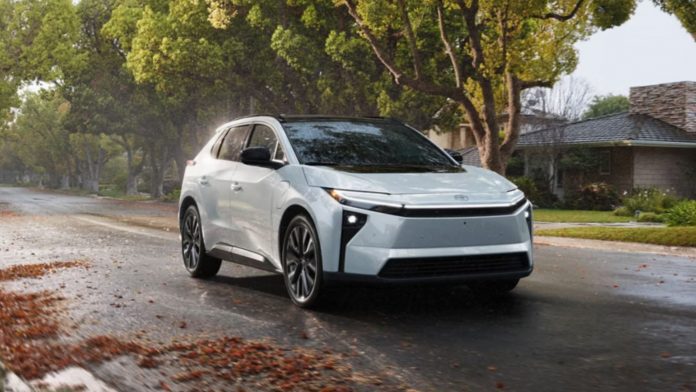
The 2026 Toyota bZ has officially launched in the United States, starting at $36,350. While this represents a more affordable entry point, it comes with reduced range and performance compared to the outgoing model.
The entry-level XLE FWD features a smaller 57.5-kilowatt-hour battery, providing an estimated range of 236 miles on a full charge, down from 252 miles in the 2025 version. The power output has also decreased to 168 horsepower, compared to 201 horsepower in the previous model. To compensate for these reduced specifications, Toyota has lowered the base price by $2,170.
On the other hand, higher trims offer larger batteries, longer ranges, and increased power. All versions beyond the base model are equipped with a 74.7-kWh battery, an increase from the 72.8 kWh in 2025. The XLE FWD Plus now offers a range of 314 miles for $39,350, representing a 62-mile increase, along with a power output of 221 horsepower. The XLE AWD model is priced at $41,350 and features dual motors that produce 338 horsepower, 124 more than the previous model, with a range of 288 miles, which is 60 miles more than before.
At the top of the lineup, the Limited FWD is priced at $44,750 and offers 299 miles of range, while the Limited AWD costs $46,750 and provides 278 miles, representing improvements of 63 and 56 miles, respectively, compared to the 2025 model.
Moreover, charging technology has seen modest upgrades. While the maximum DC fast-charging rate remains capped at 150 kilowatts, the AC charging speed has improved from 7.4 kW to 11 kW, enabling faster home charging. For the first time, Toyota has equipped the bZ with a Tesla-style NACS charging port, eliminating the need for an adapter at Supercharger stations. However, owners will still require an adapter to access CCS-only charging stations.
All trims come standard with LED lighting, dual-zone climate control, digital key compatibility, a 14-inch touchscreen with wireless Apple CarPlay and Android Auto, Toyota Safety Sense 3.0 driver assistance, eight airbags, and automatic emergency braking.
With improved range and horsepower in most trims, Toyota is positioning the 2026 bZ as a more capable electric crossover, despite its charging limitations compared to some competitors. This update highlights Toyota’s commitment to expanding its mass-market EV lineup while competing with faster-moving players like Tesla and BYD.