Americans were told Chinese cars were being kept out of the United States for security reasons. Washington has imposed massive tariffs, politicians promised tougher restrictions, and consumers were reassured that national security concerns surrounding connected vehicles were finally being taken seriously. China was tracking our every move through their software and their cars were collecting all the data from us – they said it was a security risk. We got that message!
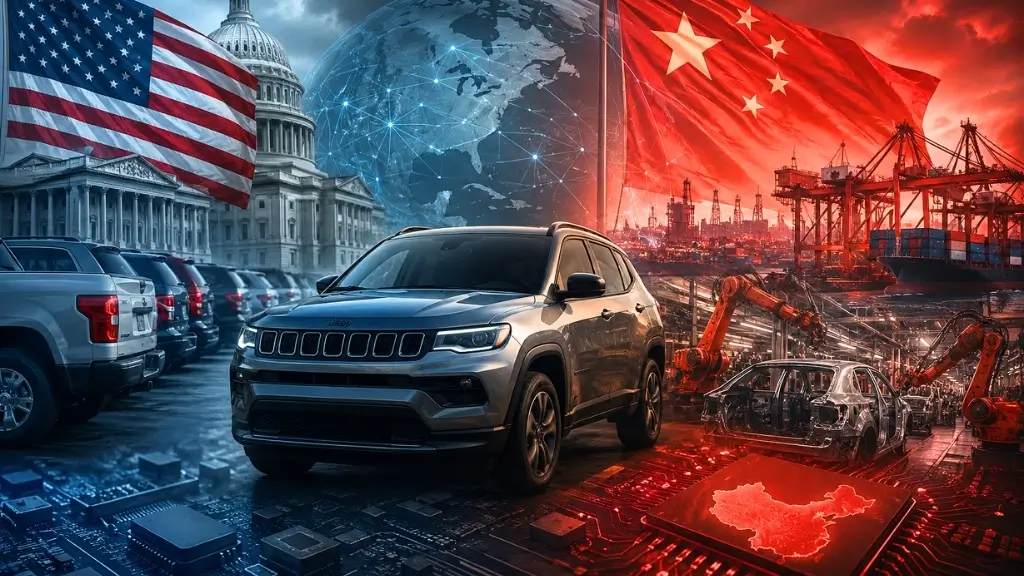
But while Americans were focused on keeping Chinese brands like BYD and NIO out of local dealerships, the global auto industry quietly found another way in. A back door way in.
And Stellantis just made that strategy official. They have opened the back door to China.
The parent company of Jeep, Ram, Dodge, Chrysler, and Fiat has now openly embraced deeper partnerships with Chinese automakers and suppliers, as part of its massive global restructuring effort. Stellantis’ new CEO Antonio Filosa is betting the company’s future on partnerships, software integration, shared manufacturing, AI systems, and Chinese EV technology to drive its long-term turnaround strategy.
This strategy should concern every American consumer, every UAW worker, every supplier, and every policymaker pretending this is only about cheap Chinese imports. This is a national security threat and we have just let in full access.
Because this is no longer simply about cars being built in China. Let’s be honest.
It is about China becoming embedded inside the future of the American auto industry itself. The impact could be devastating to the US economy and to everyone’s privacy. Even if you don’t own a Stellantis vehicle.
Stellantis recently announced a roughly $1.17 billion partnership with China’s Dongfeng Group to build new-energy vehicles (EVs) at a Wuhan manufacturing plant beginning in 2027. The deal includes future Peugeot and Jeep models for China and global markets. But that is only one piece of a much bigger shift happening inside the company.
At its recent Investor Day presentation, Stellantis unveiled its massive “FaSTLAne 2030” strategy, a 70 billion dollar global restructuring plan that includes 60 new models worldwide, major software partnerships, expanded AI integration, autonomous driving development, and new manufacturing alliances across China, Europe, India, and North America. And buried inside all the corporate buzzwords and investor talking points was the real story.
Stellantis is increasingly depending on foreign partnerships, including Chinese partnerships, to remain competitive in the EV and software-defined vehicle race. Even though EV sales are flat in the US.
CEO Antonio Filosa said it directly. Partnerships will now be “embedded” into Stellantis’ strategy going forward. That statement should have set off alarms in Washington immediately. Senator Bernie Moreno, from Ohio, has been the leader on fighting Chinese vehicles entering the US.
Instead, much of the political world barely noticed. It’s time to wake up the government.
For years, Americans were told tariffs would stop China from gaining influence over the U.S. auto market. But tariffs mainly target finished vehicles imported directly from China. They do not stop American or European automakers from embedding Chinese-developed batteries, software systems, electronics, supply chains, and EV platforms into vehicles sold under Western brand names.
That loophole is becoming the real battlefield.
Because consumers may soon be driving vehicles wearing Jeep, Dodge, Chrysler, or Ram badges while massive portions of the technology underneath come directly from Chinese partnerships.
And unlike traditional outsourcing, this goes far beyond cheap labor.
This is about batteries, semiconductors, AI systems, autonomous driving technology, connected-car software, and control of the modern automotive supply chain. This impacts jobs her in the US.
China already dominates huge portions of that ecosystem, they want to own it 100%.
Western automakers know it. Wall Street knows it. Dealers know it. The only people still being sold simplistic narratives are consumers.
The uncomfortable reality is that many legacy automakers no longer believe they can compete globally in EVs without Chinese involvement. EVs are dropping drastically here in the US and China continues to push it as they are not nearly as good at making gas or diesel engines. That’s why they continue to push EVs, because China owns most of the mines that produce the material for these EVs. That’ why the big push for electric cars and larger batteries.
That should terrify the UAW. It should terrify you. The auto industry is impacts half of the stock market. That is a huge piece of the economy. It’s not just words.
For decades, the union fought battles over outsourcing production to Mexico and lower-cost overseas manufacturing. But the push for EVs from governments has created an entirely different threat to American labor and to the businesses that support it. The Chinese goal is to get car companies to make more electric vehicles and fewer traditional drivetrain vehicles. The Chinese goal is to remove gas-powered vehicles and go all electric to their benefit. If China succeeds they claim to car brands that they will need fewer engine parts, fewer transmissions, fewer suppliers, and fewer workers.
Now combine that with Chinese dominance in batteries, electronics, and software. The long-term impact could devastate the industrial Midwest. Now the goal of China should be very clear.
America’s automotive economy is not just assembly plants. It is steel suppliers, logistics companies, plastics manufacturers, tool-and-die operations, electronics firms, engineering centers, repair facilities, rail systems, local dealerships, and thousands of small businesses tied to automotive manufacturing. When the supply chains leave, entire economic ecosystems collapse behind them. And Stellantis is already signaling where this is going.
Its new global strategy prioritizes shared platforms, shared technology, component reuse, software integration, and globalized manufacturing partnerships. By the end of the decade, Stellantis wants half its global volume running on just three platforms. One of those is its new STLA One architecture, which will support over 30 models globally while integrating advanced software systems, steer-by-wire technology, AI features, and connected cockpit systems. Much of it with Chinese parts and technology.
There are many companies developing these technologies, including Qualcomm, Wayve, NVIDIA, CATL and Mistral AI to name a few. Chinese and global tech partnerships are now deeply embedded inside the company’s future. Some are US businesses and others not.
Meanwhile, Stellantis plans to cut more than 800,000 units of manufacturing capacity in Europe while aggressively restructuring global production around efficiency and lower costs. That may make investors happy. But workers should be paying very close attention. Because you know this means less jobs too.
Even more revealing is Stellantis’ growing relationship with Leapmotor, the Chinese EV company in which Stellantis already owns a 51% stake. What started as a distribution agreement is now expanding into joint manufacturing operations in Europe. Stellantis and Leapmotor are also working together on sourcing and purchasing to improve “cost competitiveness,” corporate language for finding cheaper suppliers and production methods.
Again, that should concern American workers. Because once automakers become dependent on lower-cost overseas supply chains, they rarely reverse course voluntarily. The industry has seen this movie before. And it’s not a good movie.
Detroit once dominated global automotive manufacturing. Then came outsourcing. Then came offshoring. Then came global platform sharing. Now comes software-defined vehicles and Chinese battery dominance.
The difference this time is that modern vehicles are no longer just machines. They are rolling computers connected to cellular networks, cloud systems, cameras, microphones, GPS tracking, AI software, over-the-air update systems, and enormous data collection networks for those gigantic data centers popping up everywhere. That is why national security concerns are now colliding directly with automotive policy.
The Biden administration imposed 100% tariffs on Chinese EV imports and proposed restrictions on Chinese-connected vehicle technology over concerns involving data collection and infrastructure security. Those concerns are legitimate. Modern vehicles collect extraordinary amounts of consumer information including driving behavior, location data, communication records, biometric information, and behavioral patterns and your date is being sold – and you make zero dollars from that.
Now imagine foreign-controlled software systems integrated into millions of connected vehicles operating across the United States. That is no longer theoretical. That’s here – now.
And it explains why Senator Bernie Moreno’s proposal to block Chinese vehicles and components entirely represents a major escalation in the political fight over America’s automotive future. President Tru p has discussed many times and has warned us about not letting Chinese cars into the country.
Moreno’s message is blunt. Chinese automakers should not gain a foothold inside the United States, period.
This is no longer about incremental tariffs or symbolic political gestures. It is about whether America intends to maintain control over its own industrial base, transportation systems, and supply chains.
Frankly, many Americans are now asking another uncomfortable question. Why didn’t Washington stop this earlier?
President Trump spent years warning about unfair Chinese trade practices and the hollowing out of American manufacturing. His tariffs forced corporations to rethink supply chains and finally pushed China’s economic influence into mainstream political debate.
Yet despite all the rhetoric, automakers continued moving deeper into China’s EV ecosystem because executives saw lower costs, faster development cycles, and access to advanced battery technology. Those factors gave them raises and cheers from their investors. We all paid the price.
In many ways, Stellantis’ latest strategy shows exactly how far the industry moved while Washington focused primarily on direct imports instead of technology dependence.
And Stellantis is not alone. Ford partnered with CATL. Volkswagen expanded ties with Xpeng. General Motors continues relying heavily on Chinese-linked battery supply chains. Tesla’s manufacturing footprint inside China remains enormous.
The difference is that Stellantis is now openly telling investors that partnerships are central to its future survival strategy. That should be a flashing warning sign for policymakers. Especially because the economic risks extend beyond automakers themselves.
If America loses control of automotive batteries, semiconductors, software platforms, AI systems, and electronics manufacturing, the long-term consequences could ripple across the broader economy for decades. The auto industry remains one of America’s largest manufacturing sectors and one of the biggest drivers of middle-class industrial employment.
Once that infrastructure disappears, rebuilding it becomes incredibly difficult. Consumers were promised the EV transition would create a manufacturing renaissance. Instead, America increasingly risks becoming dependent on foreign-controlled supply chains for the most important technologies inside next-generation vehicles. And consumers may not even realize it is happening.
Because the next generation of vehicles may still wear familiar American badges while relying heavily on Chinese-developed technology underneath the sheet metal. That is the real issue Washington is finally beginning to confront.
The future automotive war is no longer about horsepower or styling. It is about who controls batteries, software, semiconductors, AI systems, connected infrastructure, and the data flowing through millions of vehicles every day. And China understands that perfectly.
The question is whether America waited too long to respond. Stellantis’ partnership strategy may ultimately become remembered as more than just another global business decision.
It may become the moment Washington finally realized the battle over America’s automotive future is no longer about where vehicles are assembled.
It is about who controls the technology inside them, who owns the supply chains behind them, and whether America still intends to build the next generation of vehicles itself.
And judging by the political backlash now building in Washington DC, Detroit, and the industrial Midwest, that fight is only beginning.
Check out my full commentary on this story: https://youtu.be/ieQbh796d_M
Looking for more automotive news? https://www.CarCoachReports.