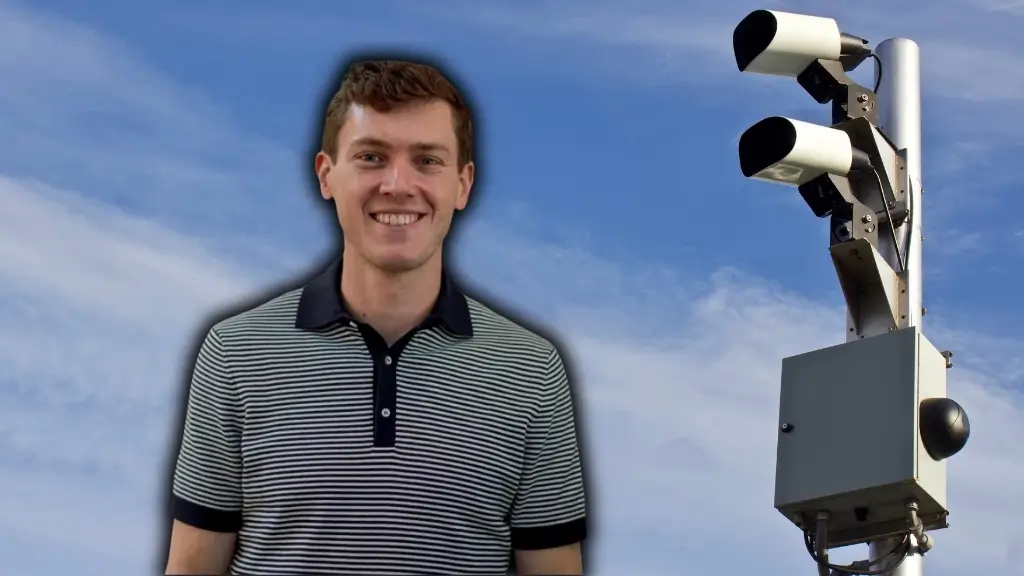
For years, Americans have been told not to worry about the explosion of AI surveillance cameras. They’re only looking for stolen cars. They’re only helping solve crimes. If you’re not doing anything wrong, you have nothing to fear.
Then the CEO of one of the country’s largest AI surveillance companies, Flock, said something that should make every American stop and think.
During a recent interview, Flock Safety CEO Garrett Langley referred to DeFlock, a volunteer group that maps the locations of Flock’s automated license plate reader cameras, as a “terroristic organization.” He contrasted the group with organizations like the ACLU and the Electronic Frontier Foundation, saying those groups use the courts while DeFlock’s “primary motivation is chaos.”
Think about that for a moment.
DeFlock’s primary activity is mapping the locations of publicly visible cameras installed throughout American communities. Flock argues that publishing those locations could help criminals avoid detection. DeFlock argues that citizens have a right to know where government-connected surveillance technology is being deployed.
Reasonable people can disagree over that debate. But calling transparency activists “terroristic” is something else entirely.
Words matter, especially when they come from the CEO of a company whose business depends on collecting, analyzing, and sharing vast amounts of location data. He didn’t call the group irresponsible. He didn’t call them reckless. He chose language normally associated with violent extremism. That choice of words tells us something about how criticism of surveillance is increasingly being viewed by the industry building it.
Then there was another statement that deserves just as much attention. Langley said, “We’re not forcing Flock on anyone.”
Really?
Americans never voted to install AI-powered camera networks throughout their communities. They didn’t vote for systems capable of tracking vehicle movements across cities. They didn’t vote for technology that has evolved far beyond simply reading license plates.
Today’s systems can identify vehicles by make, model, color, aftermarket wheels, roof racks, bumper stickers, damage, window tint, and countless other characteristics, even when a license plate isn’t visible. Every generation of this technology becomes more sophisticated than the last.
This isn’t simply about solving crime anymore. It’s about building an increasingly comprehensive picture of where vehicles travel, when they travel, and how artificial intelligence can connect those movements. That is why transparency matters.
If these cameras are installed in public places with taxpayer dollars, why shouldn’t the public know where they are? That’s the question DeFlock is asking. And asking makes them terrorists.
It’s also a question the surveillance industry appears increasingly uncomfortable answering. Perhaps the most revealing part of this controversy isn’t the quote itself. It’s what it says about the mindset behind the technology.
When someone maps surveillance cameras, the cameras aren’t questioned. The person documenting the cameras is, that’s an extraordinary shift. The debate moves away from whether expanding surveillance deserves public scrutiny and toward whether the people asking questions are somehow the threat. That inversion should concern anyone who values accountability.
It’s also worth noting that public frustration with surveillance technology isn’t limited to the United States.
Across Europe, including parts of England and France, there have been repeated incidents in which surveillance cameras have been vandalized or removed. Similar incidents have occurred in the United States. To be clear, destroying public or private property is illegal, and I don’t support it. But those incidents reflect something policymakers and technology companies shouldn’t ignore: a growing segment of the public feels these systems are being imposed without meaningful public debate or consent.
Ignoring that frustration won’t make it disappear.
Calling critics “terroristic” certainly won’t either.
The irony is hard to miss.
The surveillance industry frequently tells Americans these systems are about building trust and making communities safer. Trust, however, isn’t built by dismissing or demonizing people who ask legitimate questions about privacy, accountability, and the limits of government surveillance. Trust is earned through transparency. Taking a way that transparency is a huge issue that is growing quickly.
Americans can support law enforcement while also believing there must be limits on mass surveillance. They can believe violent criminals should be caught while also asking who owns the data, who can search it, how long it is retained, and whether artificial intelligence should be allowed to follow their daily movements without their knowledge.
Those aren’t extremist questions. They’re the kinds of questions citizens in a free society are supposed to ask.
Garrett Langley’s comments may have been intended to defend his company. Instead, they revealed something far more important. They exposed an attitude that many Americans have long suspected exists beneath the rapid expansion of AI surveillance: that questioning the system is becoming more objectionable than expanding it. He said the quiet part out loud.
That’s a conversation worth having, because once a society accepts ubiquitous surveillance as normal, history suggests it rarely moves in the opposite direction.
So let me get this straight, we did not vote to add these surveillance cameras, and letting people know where they are located makes us the bad guys. This is not a joke.
I guess I’m a terroristic for discussing and telling everyone about this
Check out my full commentary on this story: https://youtu.be/DAPXpfXRUPI
Looking for more automotive news? https://www.CarCoachReports.com
Listen to The Drive Car Show – https://www.youtube.com/@thedrivecarshow